

Written in 2015

By seeking a retail-sale revenue stream too quickly, McLaren brought its MP4/12C road car to market prematurely, a move in 2011 that nearly scuppered this nascent brand

A pack of ruthless English racers, the McLaren lads developed solutions to the range of engineering and calibration issues that pocked the MP4/12C, then gave it a minor face lift and a new name, 650S. To provide air cover and diversion, they also brought out the P1, a hybrid supercar that starred in multiple YouTube videos much beloved by fanboys.
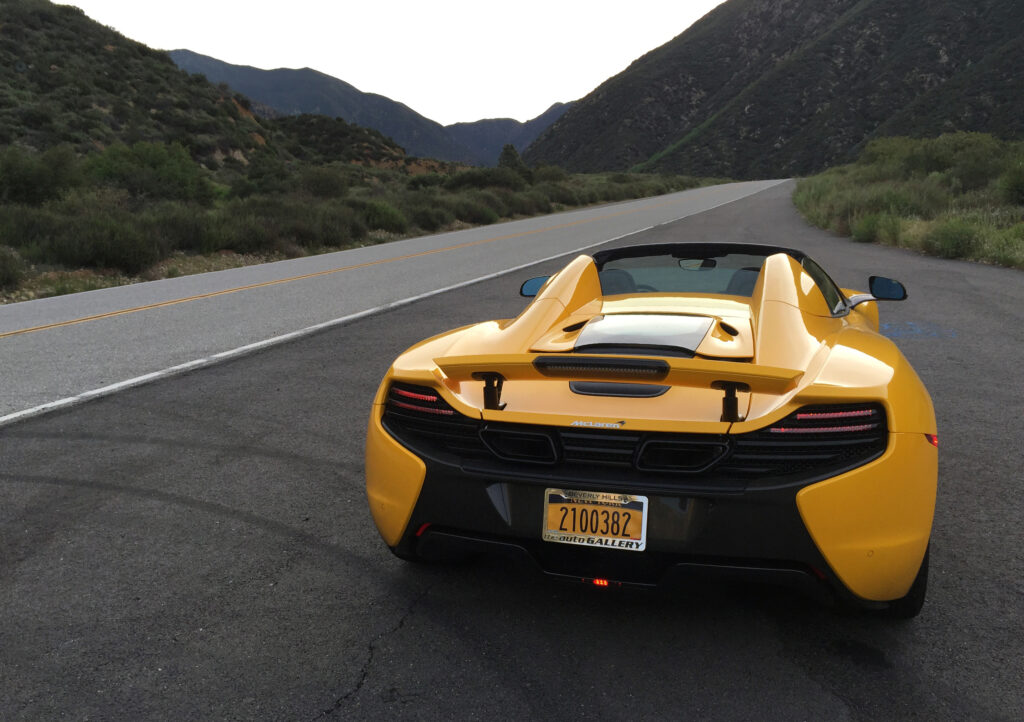
Based on our days with the 650S, working through a checklist collected from former MP4/12C owners, the 650S is now what the “12C” should have been. In spite of its status as the only open-top McLaren, we expect diminishing demand for 650S in the U.S. Sales attention will shift to the 675LT “Long Tail” track day car debuted in March at Geneva. More important to long-term success is the 570S that debuted a few days after our 650S test drive. As the most civilized and thoroughly sorted McLaren to date, the 570S can attract a new owner group, and as McLarens all have variations on the same powertrain, the 570S can be evolved with hotted-up special editions. To be plain, it’s the 570S we most want to sample, as it will put a solid foundation in place for sales growth.

McLaren’s four years of radical product evolution have depressed residual values, leaving early adopters unhappy, a customer care challenge McLaren must face head-on. No amount of jingo-istic reporting from English YouTube journalists will wash away this issue with current and former American owners. McLaren may need a financial program that buoys trade-in value if early adopters buy another McLaren.

Preamble done, it’s time for 650S pre-flight. Top up, entry requires moves reminiscent of an Olympic high jumper, thanks to the tall side sill. Thankfully, the 570S has lower side sills—proper ladies can wear a dress and drop into the 570S with dignity intact. But for the 650S, modest folks should wear pants.
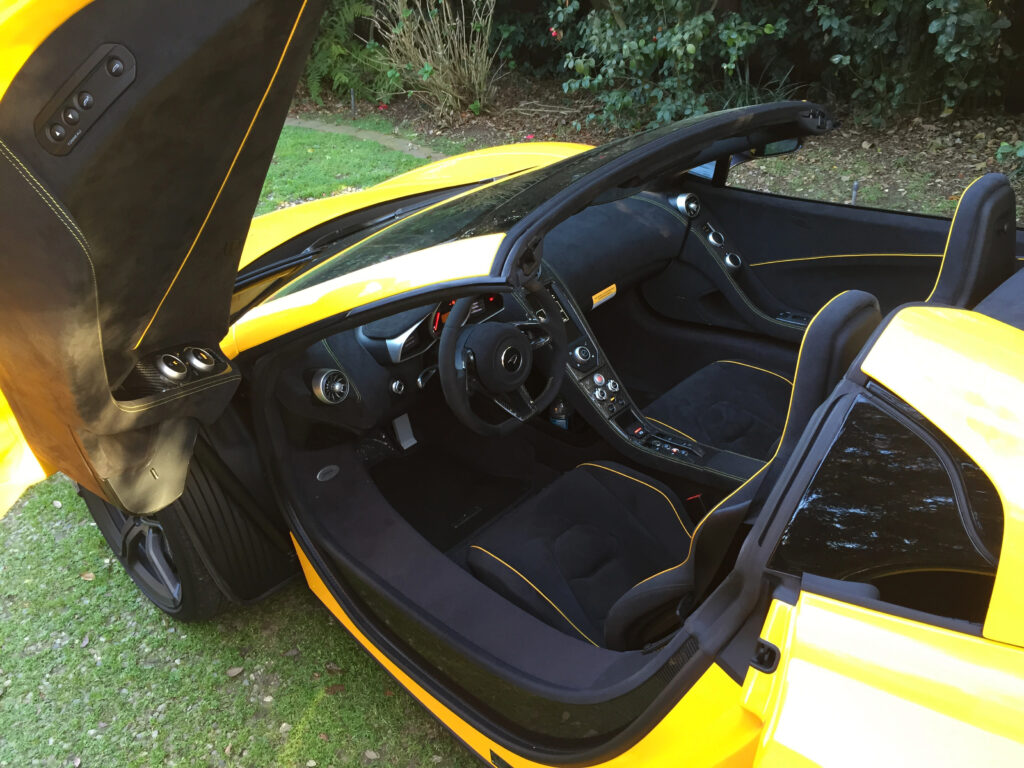
Moving the seat as far back as possible resulted in a bolt upright driving position that simply did not work. In spite of my height, I adopted a go-karter’s position, sitting relatively close to the dash, knees splayed like a yoga-meister, steering wheel adjusted to its shortest reach.
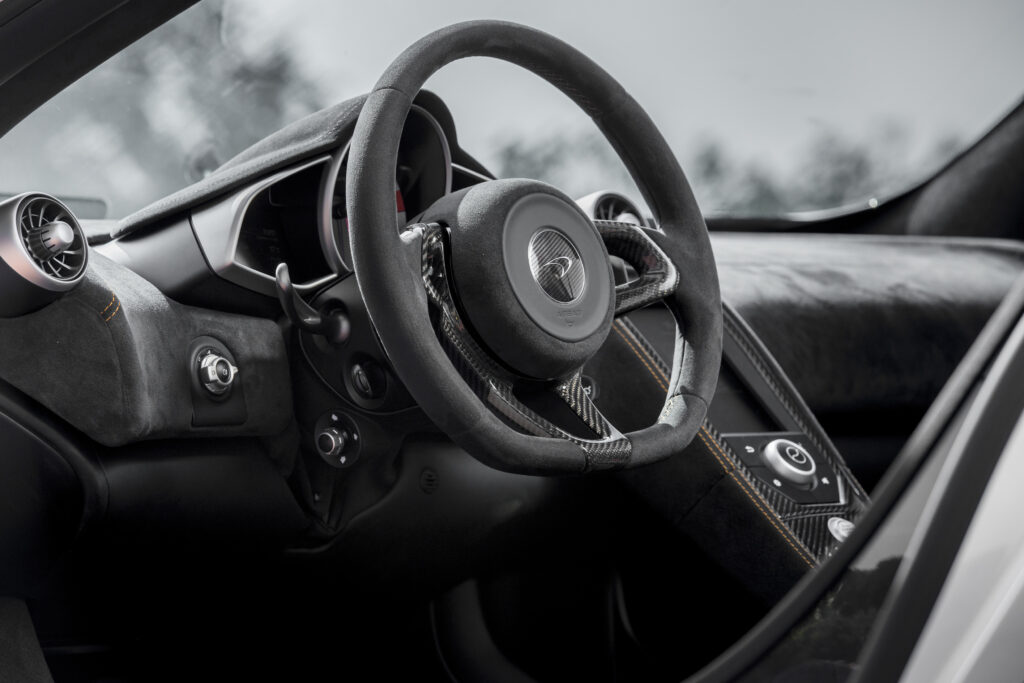
Due to the bubble-like windshield, low dash, and feet placed close to the front axle line, one has the sense of being thrust forward, riding between the broad front fendercrests. Optional Alcantara across the dashtop limits reflections on the broad windshield—except for the contrasting stitches and the optional carbon-fiber trim around the head unit. If one lives in a warm clime with lots of direct sunlight, order the Alcantara with dark gray stitching to limit reflections. You might request for dull soft-touch paint on the trim of the upper dash, too.
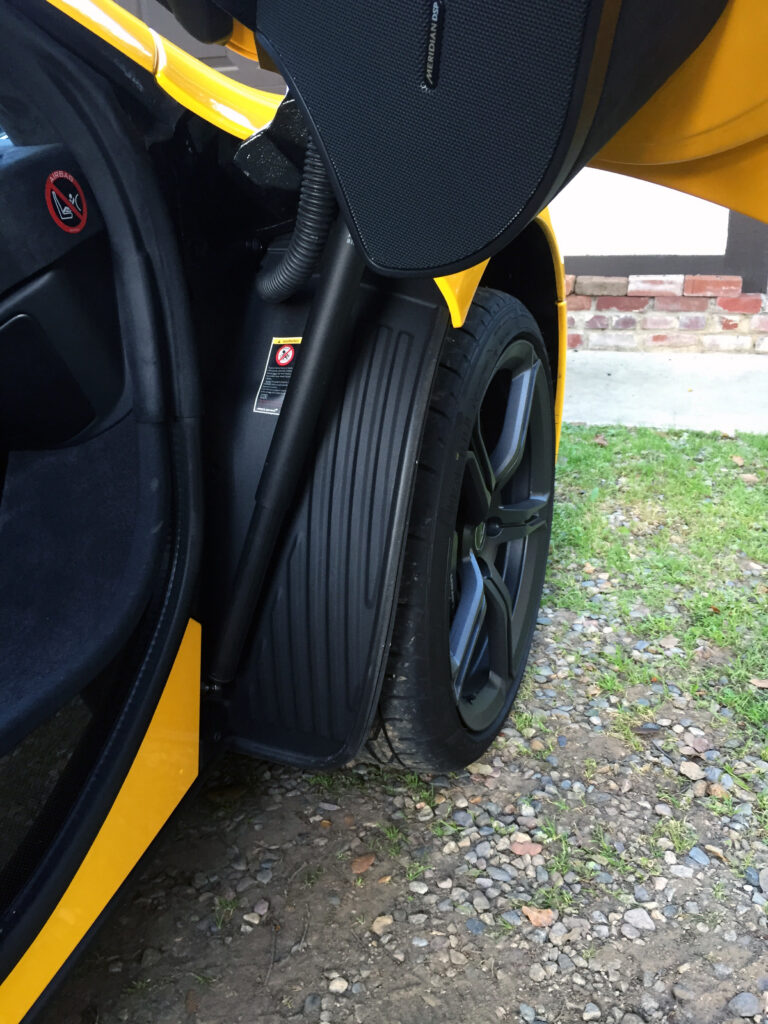
650S offers ample elbow and shoulder room, with no restrictions to upper body movement. A burly athlete will have room enough. Taller customers can buy a 650S with manual seats to gain an extra inch-plus of headroom. Or, order the power seats, then have McLaren custom-fit a thin shell. On drives that included 70 or 80 miles of mountain road, I was comfortable, with no residual spinal kinks or aching legs. For anyone under six feet tall, the cockpit is almost plush. If you’re tall, sample the car at a McLaren ride-and-drive marketing event, then follow up at a dealership to understand your seating strategy.

In keeping with the ruthless racer esthetic, bodywork is molded composite to shroud the chassis and manage aerodynamics—a logical choice for a track car like the new 675LT. But here the McLaren lads have learned a hard lesson: not all buyers want a $350,0000 Plastic Fantastic road car, even if the body and all the related detailing is stunning, the product of one of the best car designer’s currently working, Frank Stephenson. The upcoming 570S wears alloy bodywork produced with the aerospace Superforming process, yet another significant change that will impact valuations of older McLarens. Adopting alloy panels is a smart move, one I have suggested for the Corvette Stingray to elevate its perceived value and cachet..
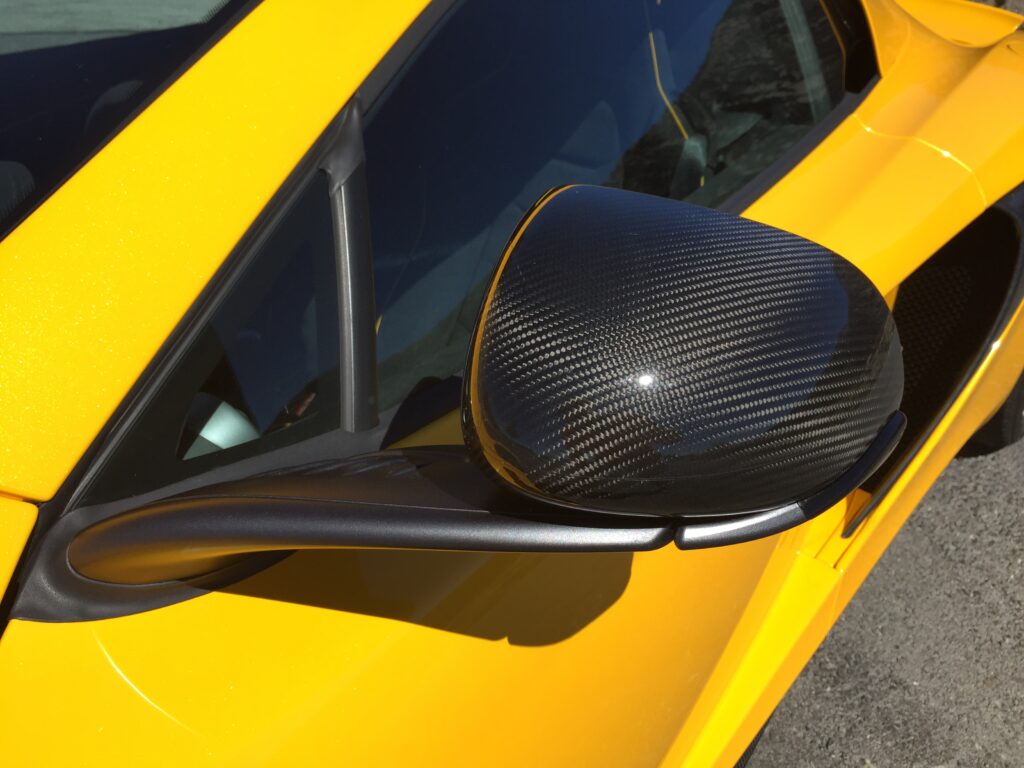
With a rearview camera, proximity sensors front, rear, and side, and light low-speed steering, 650S executed J-turns in our garden with ease. Gone are the days when driving a rear-mid-engine exotic car brought the potential for looking like a fool in a parking garage. This bodes well for the everyday usability of the 570S.
Pre-flight inspection over, we headed for the mountains. Our short toddle to a canyon road tested McLaren in another way: Los Angeles freeway gridlock on a scorching afternoon. Yet air conditioning remained chill, McLaren’s corporate 3.8-liter twin-turbo V8 purred silent and steady, and dual-clutch gearbox was unfazed, never temperamental. High marks to McLaren for its hot-weather development work.
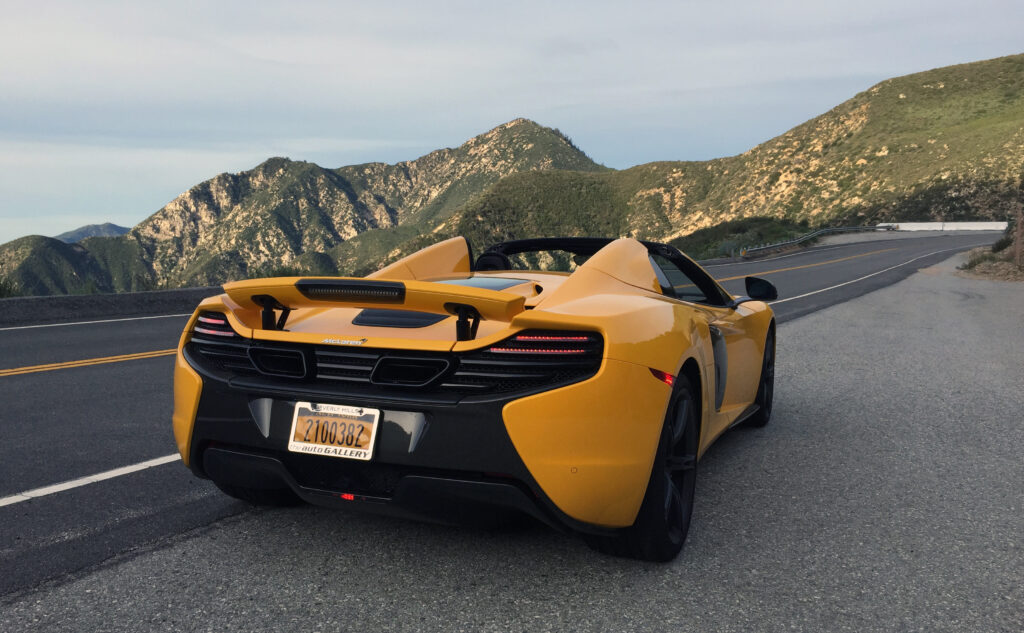
In traffic, leave suspension and powertrain settings in Automatic for a commuter car experience. For road use, we recommend the intermediate Sport settings, leaving the most aggressive setting for track day events, or familiar mountain roads.
Its software scripting now thoroughly sorted, the gearbox shifts smoothly, without miscues. I did everything possible to provoke issues noted by former owners, but all been resolved. To use a handgunner’s term, the “double-tap” downshift calibration that angered early owners has been amended. Because of a line of code meant to deliver super-fast downshifts under heavy braking, early cars could drop two gears rather than the single shift the driver more than likely expected. The double-tap was a racer’s trick requiring the dexterity under fire of a Formula One driver, and it did not translate well to a road car—the sort of product mistake made by a group that was learning the expectations of exotic car buyers.
The only open issue is the shape of the paddleshifters. For those who prefer a 10-and-2 position on the steering wheel, the shifters are small and too far away, forcing adoption of a 9-and-3 position, with thumbs hooked above the cross spars. McLaren might want to “clinic” optional taller paddles for those who prefer 10-and-2.
Around town, McLaren is low-key, a racer playing it cool. 650S blends in boulevard traffic, producing no wearisome turbo pops or histrionics like an Alfa Romeo 4C does. The ride is comfortable, almost serene, indication of good chassis work. Goose the throttle and the whooshing sound of compressed air fills the cabin at lower revs, but there’s none of the extrovert yowling of a Lamborghini traveling at any speed above 10 mph.
Airboxes pop open at about 4000 rpm, the engine sound changing from flatly muffled to mild roar. On the final rush to 8500 rpm…lift-off, the reason why you pay the money. Suddenly, immediately, you’re moving quickly, with deep bellowing accompaniment. It’s not a “ripping canvas” sound like a 458 Italia, but it’s a deliberate, purposeful song.
Set in Sport mode, traction control allows room to play. Coming out of tight low-speed corners onto short chutes with loads of throttle and high revs breaks the tires loose, the rear end slurring sideways till a momentary breather on the throttle brings it straight. It’s predictable and readily adjusted breakaway. With such carefully considered traction control, ample power, and impeccable steering, the 650S is entertaining at speeds under 40 mph, happy to play neighborhood hooligan.
Longer, more open corners are the McLaren’s native habitat—and thanks to turbocharging and a high rev range, this car needs a track for full extension of abilities. Turn it loose and in a matter of seconds you’ve burst past 130 mph and are on your way to jail and suspended license. Based on 650S performance, it’s safe to conclude the lighter, more powerful 675LT will exhilarate.
Under heavy braking, the airbrake pops up, shifting the center point of weight rearward, placing more downforce on the rear tires and thus increasing their braking potential. More than a surprising visual filling the rearview mirror, the airbrake’s effect is felt. Save breakfast till after a pre-dawn Sunday drive.
That airbrake speaks to McLaren’s engineering and esthetics, and dates to the 1995 McLaren F1, which remains the most remarkable of all supercars. These boys of Surrey are not building exotic cars for people who want to show off curbside. McLaren is much like Porsche: sober, deliberate, ruthless. McLaren is the second-most successful Formula One team in history, and before Michael Schumacher won five in a row for Scuderia Ferrari, McLaren was ranked number one.
When 570S arrives in America this fall, McLaren’s product plan will be where it should have been from the start: P1 hyper-exotic built in small numbers for the Yas Island brigade; 675LT as the lightweight track-focused car, the highest evolution of the 650S chassis; and the new alloy-bodied 570S as the everyday sports car for people like me who want a rare experience for dawn patrol mountain drives that also serves for weekend travel with a favorite companion.
McLaren should develop a trade-in regime that reaches out to 12C and 650S owners to cycle these early adopters into the 675LT and 570S, creating potential long-term customers. It’s a small population that can afford such cars. For the next couple of years, McLaren needs a healthy dose of Lexus-style customer care process.
McLaren must differentiate, too. From the P1 with its batteries and electric motors to the new 570S, all McLarens share fundamentals: 3.8-liter twin-turbo V8, and variations on the carbon-alloy chassis. If McLaren continues down this path, excepting the ultra-rare P1, every new McLaren will simply undercut the previous cars, and that causes potential buyers to hesitate. There’s a reason why Ferrari has a California T V8, a 488GTB V8, and various V12s in the stratosphere. Same applies with Porsche’s range of engines. McLaren will eventually be forced to follow suit.
More so than the 675LT track car, we’re eager to sample the 570S, a sporting car for open-road adventures. McLaren now has the products it needed in 2011 and 2012. Let’s see how they woo past and potential customers.