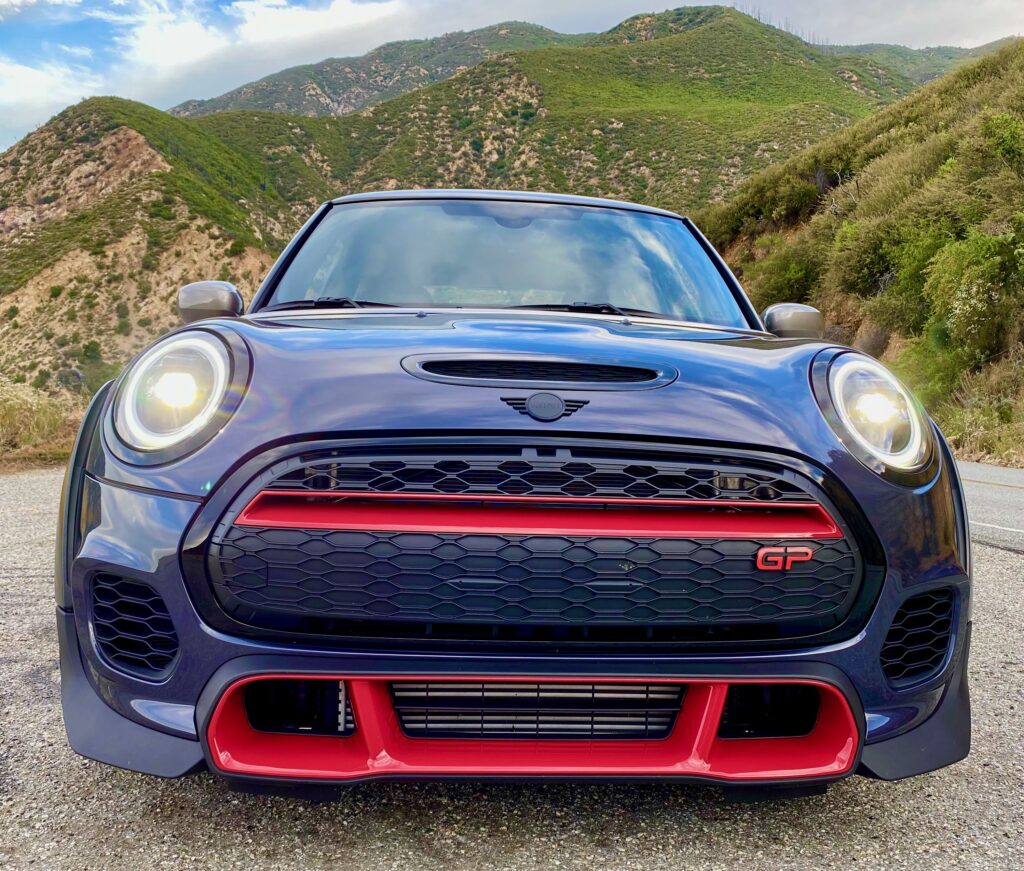
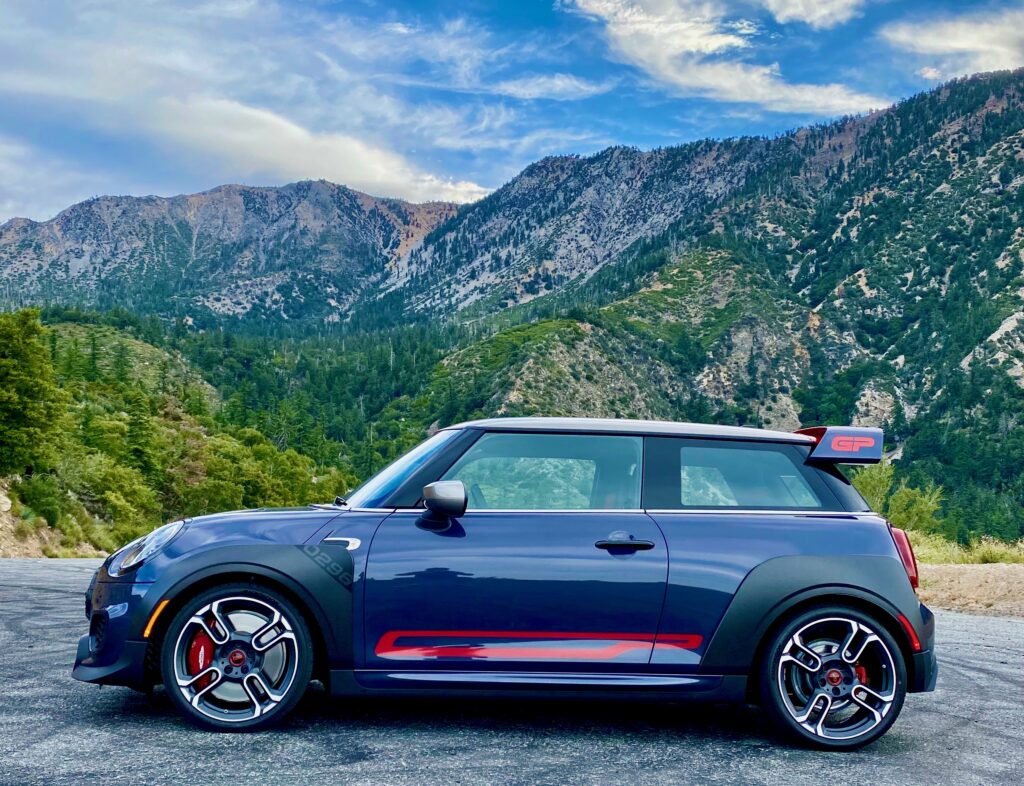
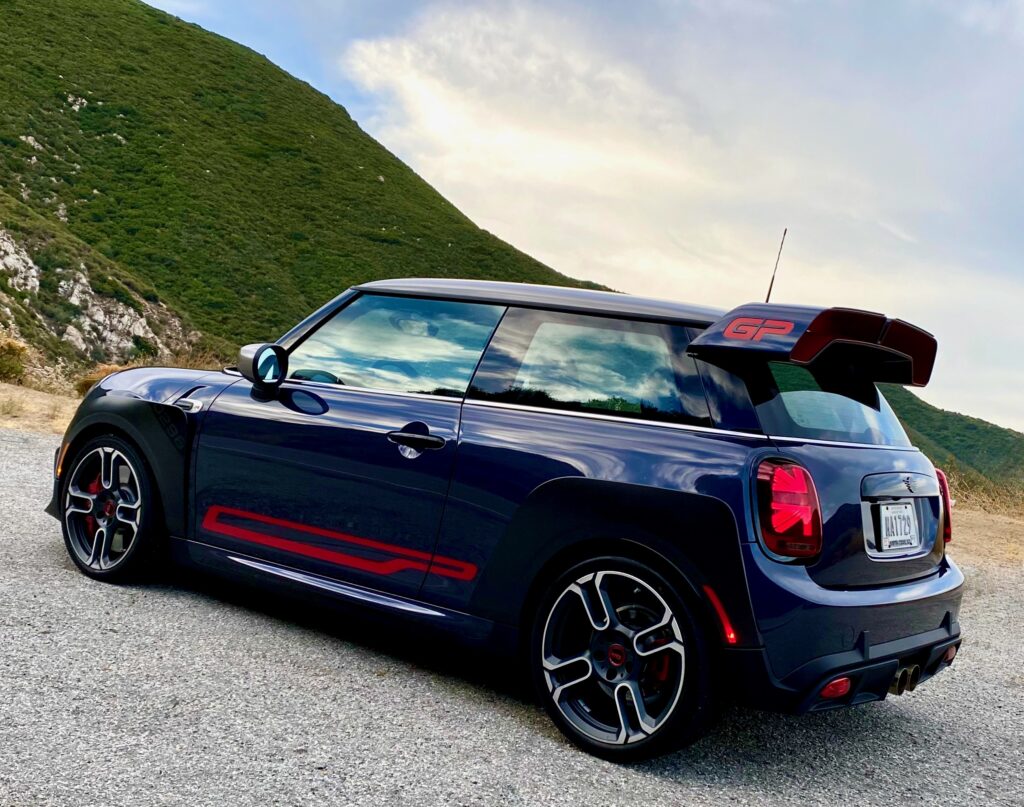
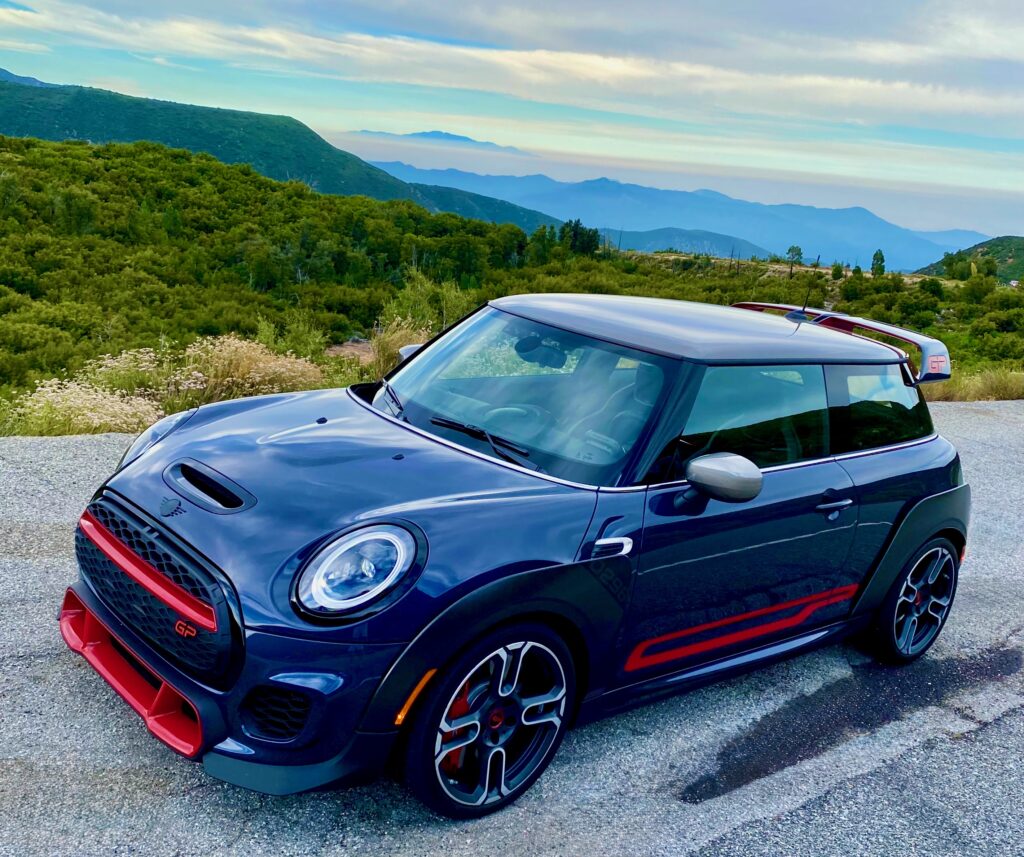
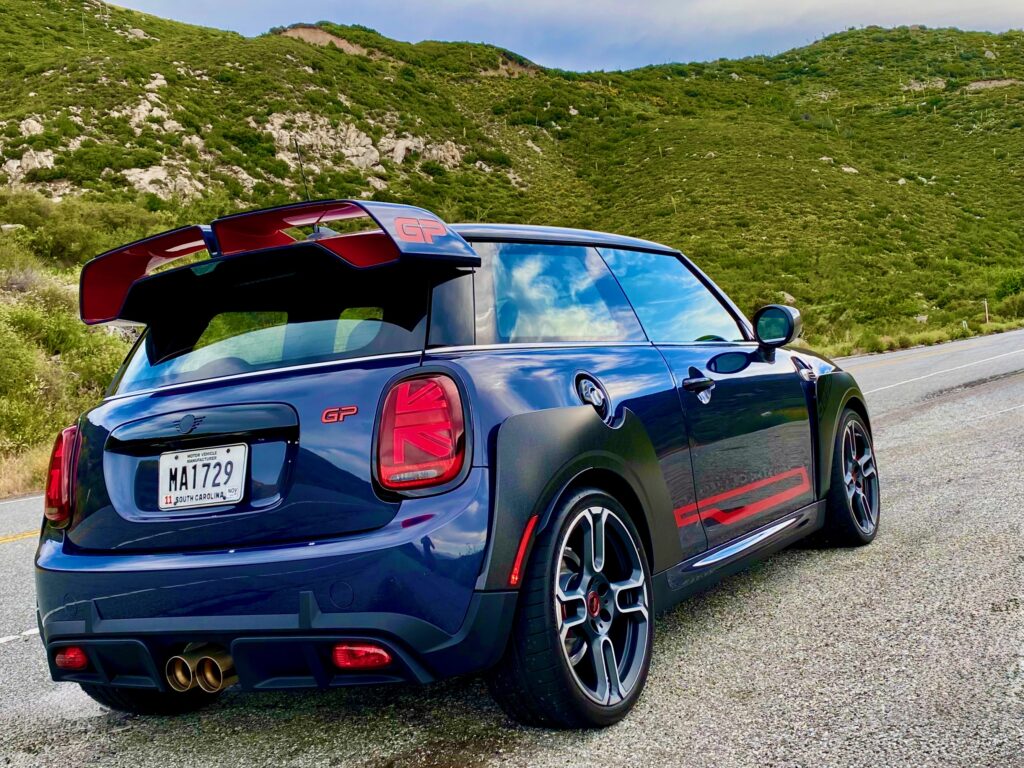
MINI generously offered this car to test drive during the very worst of the COVID period, summer of 2020. Southern California canyons were empty, allowing for enjoyable drives any time of day. I didn’t have to wake up well before dawn to reach empty canyon roads. Yes, a long time ago both on the calendar and in memory. But this car stands out as the best MINI since the original Frank Stephenson designed MINI Cooper S introduced as a 2002 model. This BMW-era car should find its way onto auction blocks at Monterey and Amelia Island in time. MINI JCW GP is a factory-built hot rod, a European tuner car. The 2020 story begins below.
MINI John Cooper Works GP is not the absolute fastest factory-built front-drive compact car in the world. But it’s the best looking, most distinctive, most enjoyable and most livable of the breed. I’d gladly take it over a crook-back Honda Civic Type R.
MINI is offering 3000 individually numbered John Cooper Works GP 2-seaters for 2020, rapid little cars that extend a tradition reaching to the John Cooper Austin Minis that won the Monte Carlo rally three times in the 1960s. For MINI GP, BMW wedged the most potent version of its corporate 2-liter turbo engine into its smallest architecture, then added cornering, braking and most obviously legit high-speed aerodynamics to deliver a tidy, balanced road car that’s competent on-track, too. GP is the MINI for the red-blooded fringe, validating the basic goodness of all MINIs. MINI GP is the Olympic athlete giving testimony to the robust DNA of a handsome family.
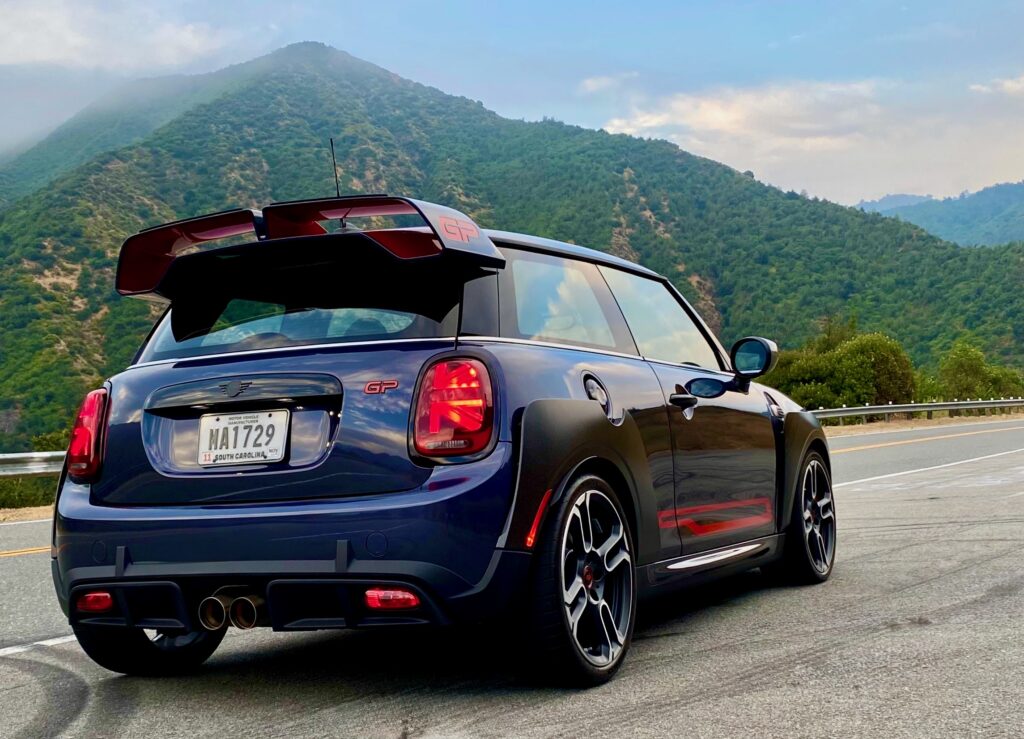
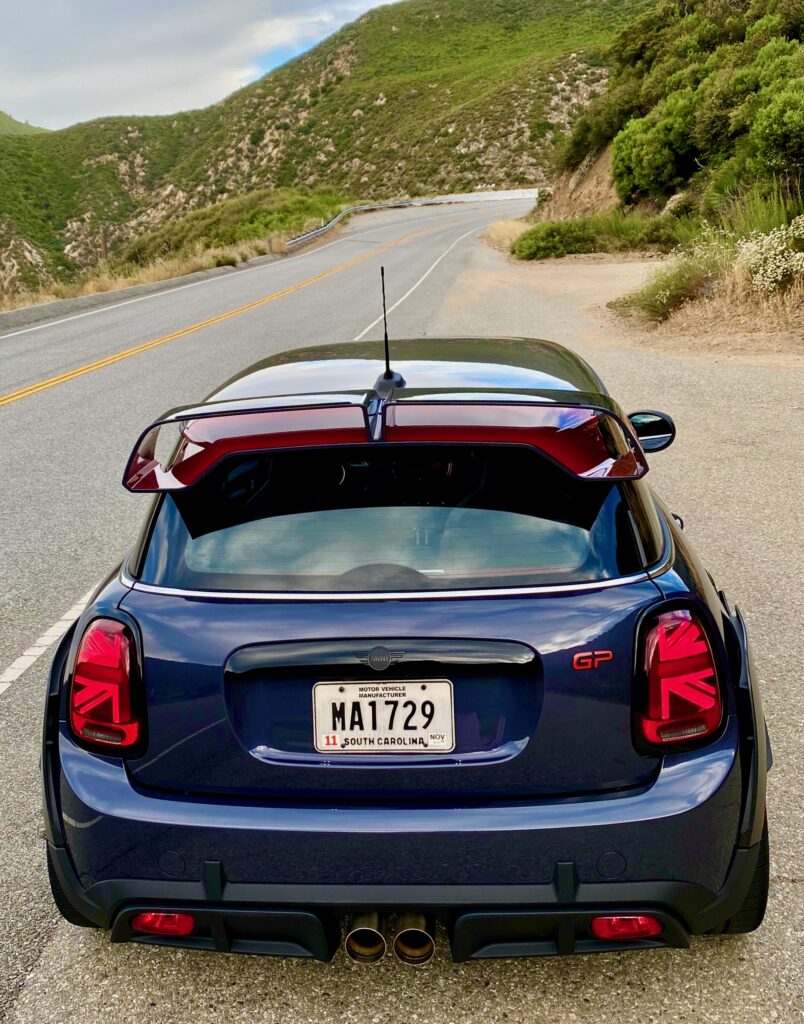
GP-specific exhaust brings a deep, sharp roar, reminiscent of 4-cylinder race cars. If a passenger doesn’t like the sound, buy him an Appletini and compliment his flowery silk shirt—he has no blood in his veins.
Built in a limited run of 3000, MINI JCW Grand Prix emphatically refutes the argument that we will soon reach “peak piston engine,” that western man has run out of ideas for the gasoline engine. Far from it.
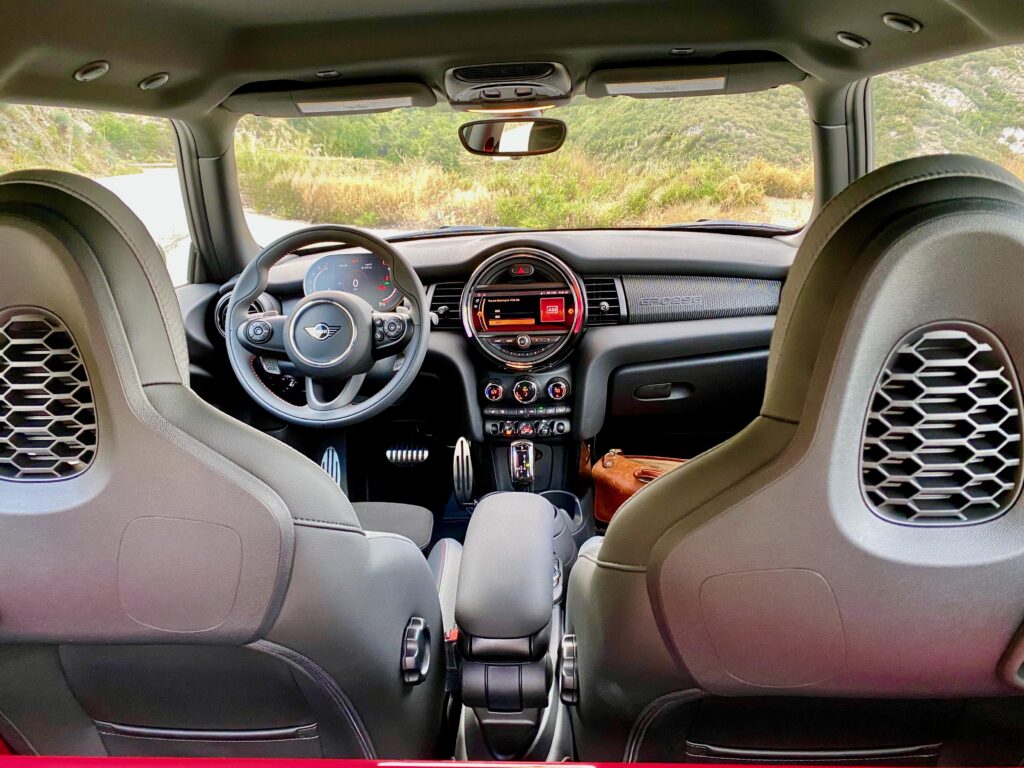
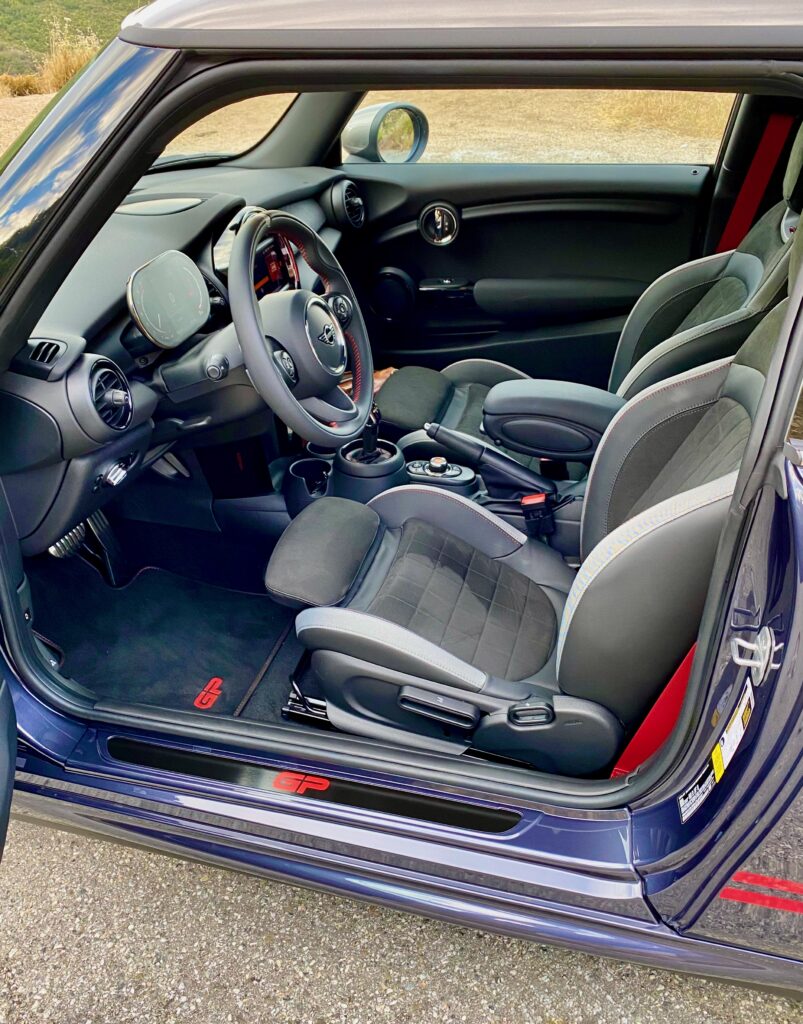
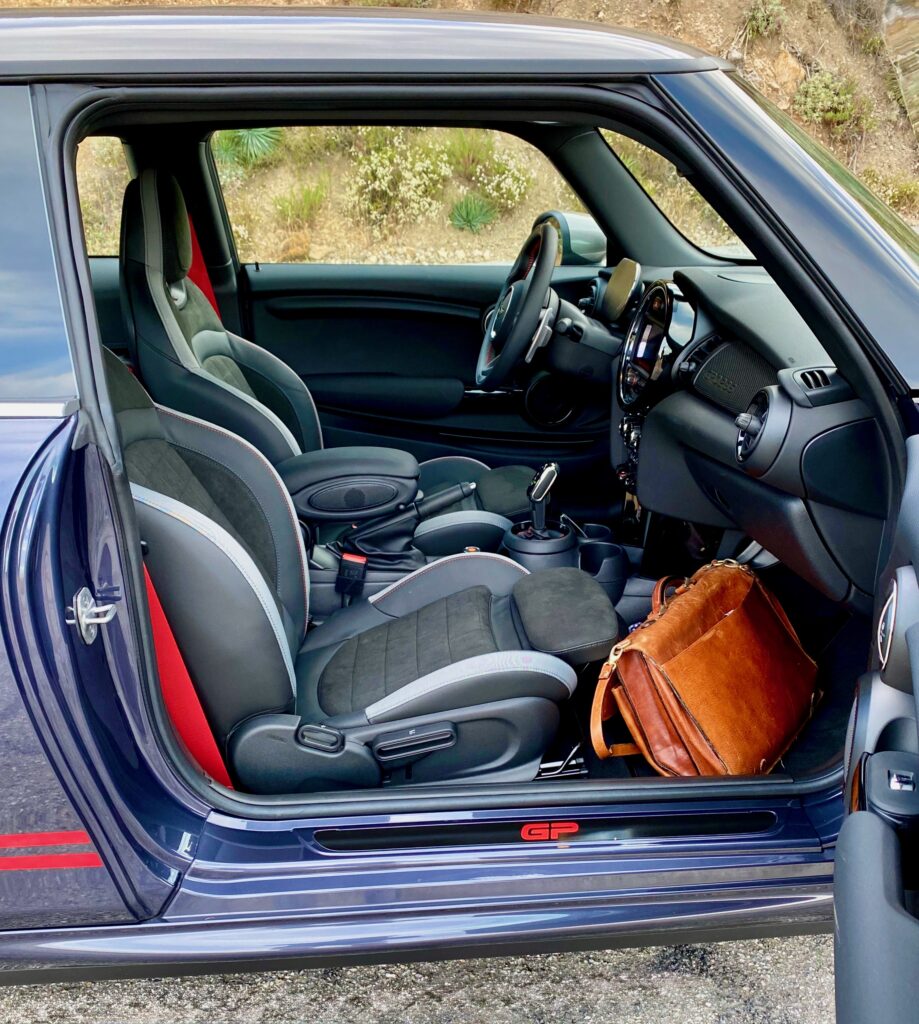
Side bolsters will dig into the ribs and hips in cornering, stabilizing the body. Wheel is a chunky delight to work. Flatscreen directly ahead has unique GP graphics. Tall people fit MINIs with no trouble. Tall roof, big doors. Paddleshifters are produced with 3D printing, a talking point.
On a mountain road in the right hands, this stubby front-drive 2-seater will leave behind supercars from the early 2000s, achieving speed with incredible ease. It’s not the fastest-ever street-legal front-drive car—front-drive lap honors at the Nürburgring belong to a one-dimensional track car at the time of writing—but MINI GP is rapid while retaining balanced on-road manners. Feel the car leap from 70 or 80 mph to far beyond 100 and you’ll snort, “Peak piston engine, indeed.
Into the smaller MINI architecture, BMW wedged the most potent version of its corporate 2-liter turbo engine, known for duty in the BMW M223i, X2 M35i, and in the larger JCW Countryman and Clubman.. It’s a textbook example of stuffing the bigger car’s engine into the smaller car where it becomes the little engine that could, can and will.
MINI JCW GP is a factory-engineered extension of a genre founded with entrepreneurial spirit in the late 1950s and early ‘60s with cars like John Cooper’s Austin Mini rally cars, the Simcas and Renaults of “le sorcier” Amédée Gordini, Carlo Abarth’s speedy Fiats, and Alpina BMWs. Notice that these hallowed names have been absorbed and “branded” by the tier-one carmakers most closely associated with these European tuners of the ancient past. But the spirit remains.
Compared to the JCW MINI hatchback, the GP has an additional 75 horsepower. Moving pieces are modified, and most importantly BMW’s signature twin-scroll high-pressure turbo is evolved along with powertrain scripting. If only a market existed in the U.S., this engine would find ideal application in an ultra-lightweight, diminutive mid-engine sports cars—think BMW or MINI interpreting a Lotus Elise. MINI GP’s engine is glassy smooth in its ferocity.
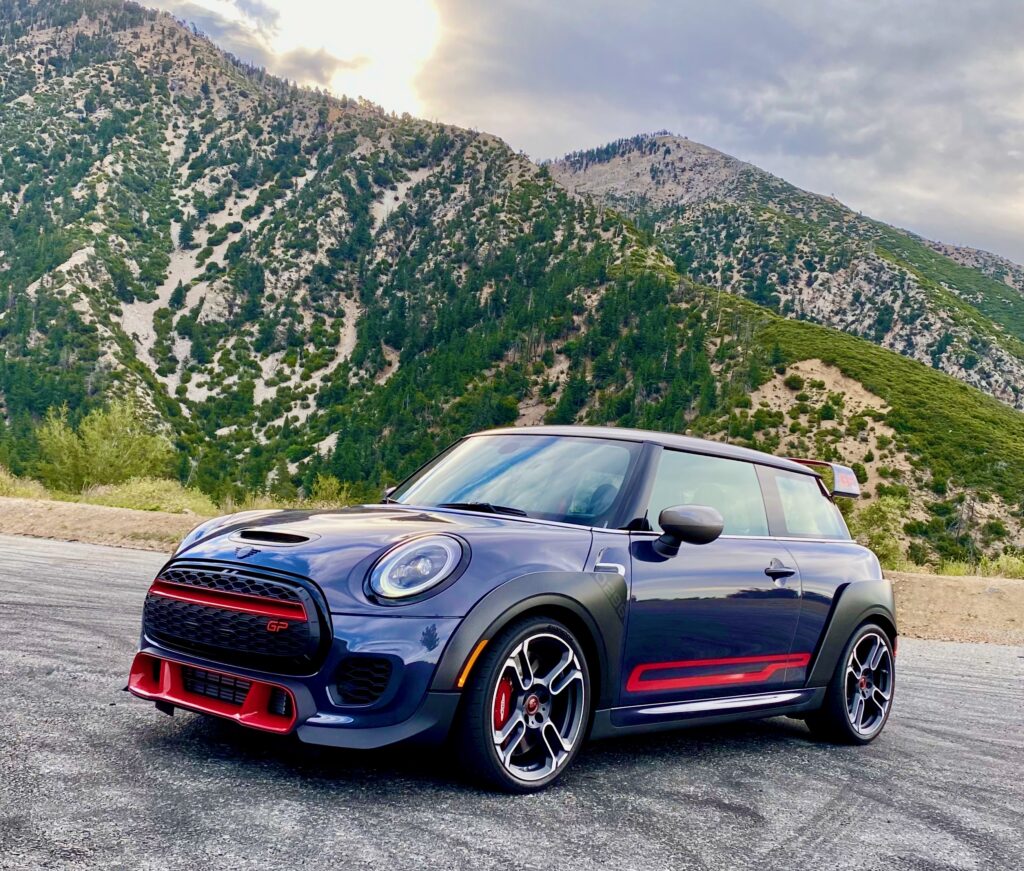
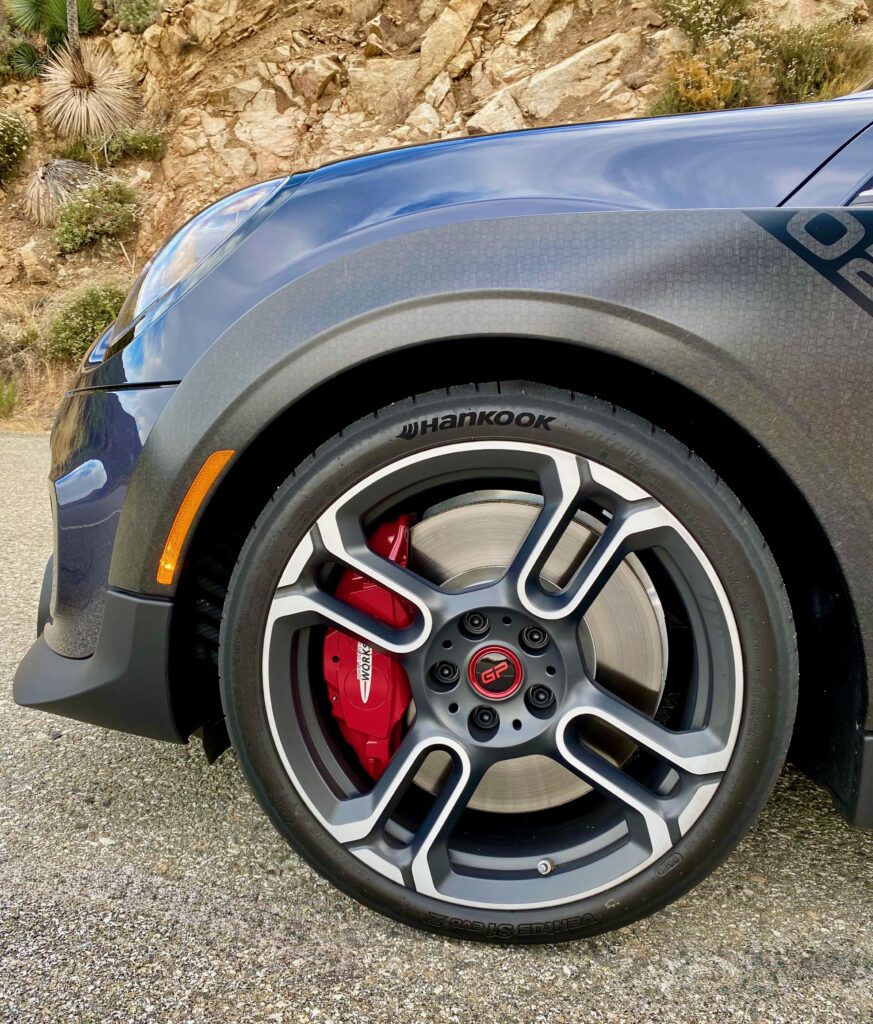
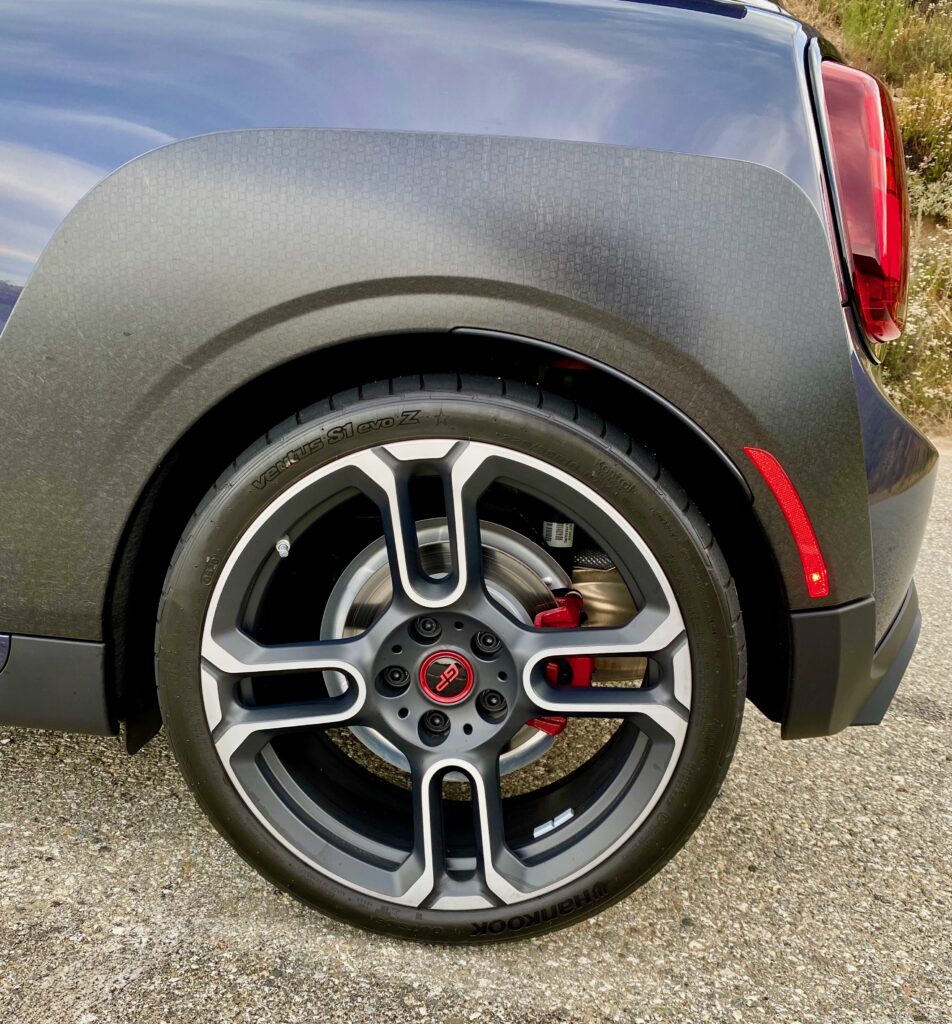
Wheels measure 18 by 8, shod with Hankooks. The outer circumference has no tread, just dimples and a thick band of gummy rubber to help bite asphalt. Discs are 14.17 inches with no shortage of bite.
Delivering maximum torque from 1750 rpm to 4500, this little tea pot is on the boil almost immediately. Pulling away from a stop, the engine turns from dull-witted to spectacular a mere blink after squashing the throttle. From 5 mph up, it’s spectacular. There’s no dead spot across a 4500-rpm range, just relentless urge. The engine doesn’t rev terribly high and doesn’t need to because…turbos.
8-speed Steptronic sports transmission with integrated mechanical differential lock for the front wheels. When the gearbox locks to deliver power without any sort of “buffering,” torque steer can occur, even at extra-highway speeds. Pay attention.
Like all the best current turbo engines—from the other Germans, from Ferrari—it is nothing like turbos of the late 1990s and early Noughties, with laggy dead space below 3500 rpm. For best effect around town, tramp the throttle then sidestep the brake.
Barge boards are carbon-fiber-reinforced plastic. Each car is individually numbered, designated on barge boards and passenger dash panel, a techie way to individualize.
Purist vehicles are coming back into fashion, and in MINI GP the gearing and performance of the 8-speed paddle-shifting gearbox is less about sprinting away from stoplights and more about performance between 30 mph and perhaps 120 mph, the range one normally enjoys on runs through California mountain canyons and hill country across the US. So rapid is GP on the hunt, it can catch you out and remind you to pay attention.
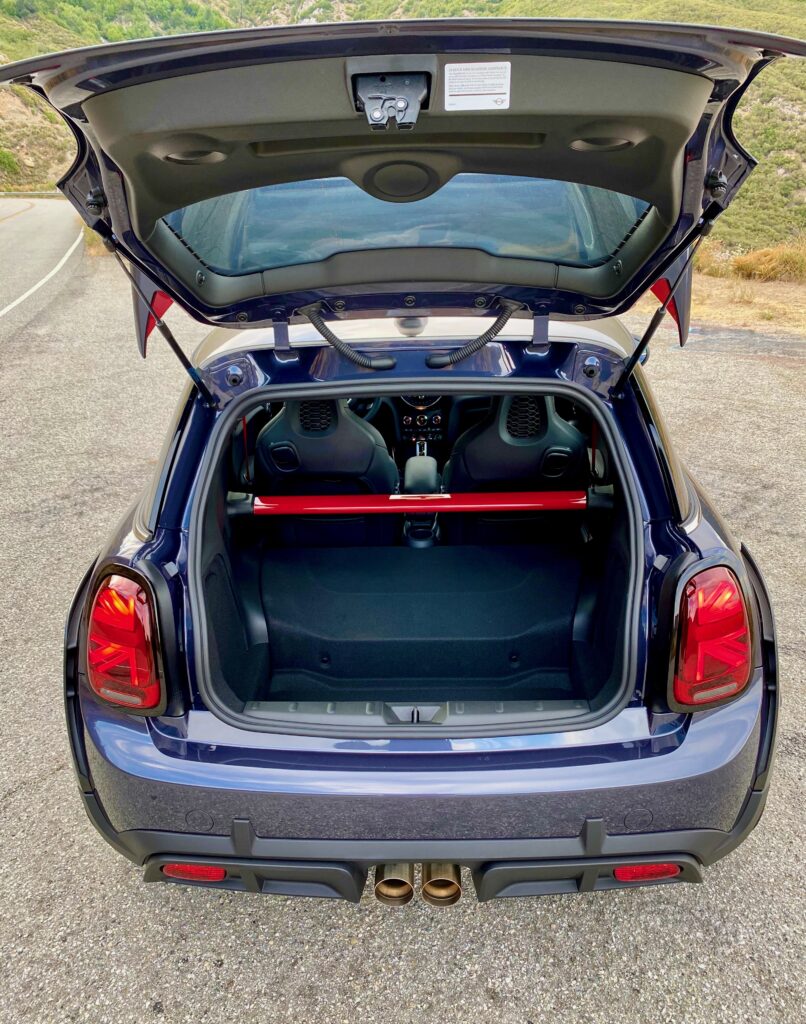
MINI GP can serve with style as a parts chaser for a high-end restoration shop—with no backseat, there’s plenty of cargo space. Ting-Ting. Crossbar is stout, tying together bulkheads near suspension mounts, needed in a hatchback with a big sunroof. Aids handling precision. Every man-jack in the shop will eagerly volunteer for the duty of fetching parts.
To put all that power on the ground, MINI adopted a locking differential. Mash the throttle at 70 and 80 mph and MINI GP will ever so slightly torque steer, meaning it will pull to one side, requiring steering correction to maintain the desired line of attack. Pay no attention or get in too deep, and you can find yourself changing lanes, such is the strong pull. Here again, that sage comment from German F1 and Le Mans racer Hans Stuck applies: “When you drive, DRIVE. Hang up the phone.”
This is a front-drive car. The all-wheel drive of the larger MINIs, based on shared architecture with BMW X2, will not package in this strictly ballroom micri-compact MINI. Hence, front-drive coupled to loads of power and the steering/chassis dynamics that brings.
Feedback to the steering wheel from the extra-gummy Hankook tires enlivens the experience but reminds that this is no place for fops or fools. Either drive with style or go sip an Appletini and leave this MINI to people with gristle in their wrists.
Wheels measure 18 by 8, shod with Hankooks. The outer circumference has no tread, just dimples and a thick band of gummy rubber to help bite asphalt. Discs are 14.17 inches with no shortage of bite.
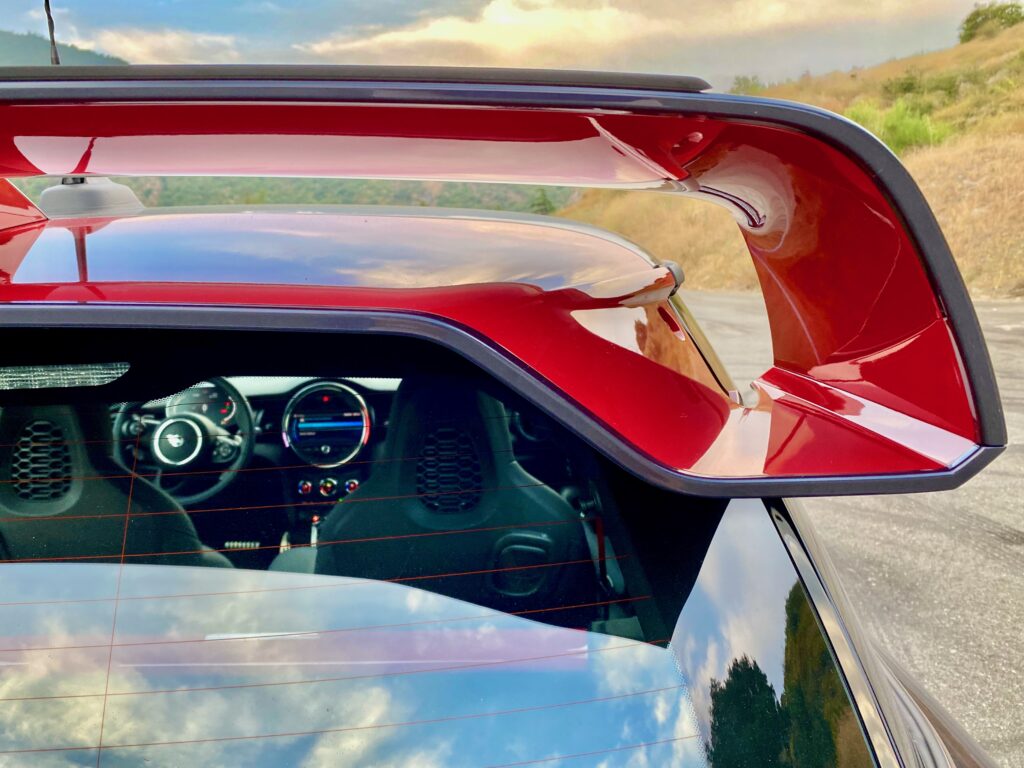
The aerodynamic addenda is real, not 1970s Disco accoutrement that does nothing beyond the parking lot. The barge boards around the fender wells guide airflow, cooling air to the brakes and the rest adhering to the slab sides to enhance stability at the extra-legal speeds. And that wild bowtie roof spoiler is a clean plug-and-play solution, bolting tidily at the rear roof cap. The aero is legit.
GP is the MINI for the red-blooded fringe of MINI ownership, validating the basic goodness of all MINIs. MINI GP is the Olympic athlete in a handsome family. Torque does not fall away one bit until 4500 rpm, providing a big, fat swath that is easy to exploit, easy to apply. Max horsepower picks up the gauntlet without the least hesitation.
MINI has two platforms, the larger vehicles like Countryman and Clubman built from the same “engineering toolkit” as the X2 and X3, big enough to package all-wheel drive. The dedicated small MINI platform is plumbed only for front-drive.
That it torque steers slightly at extra-legal highway speeds serves as reminder that it will also accelerate like a demon from 70 or 80 to much higher speeds. MINI is batch-building 3000 individually numbered John Cooper Works Grand Prix two-seaters, rapid little cars that extend a tradition reaching to the John Cooper Austin Minis that won the Monte Carlo rally three times in the 1960s. MINI GP has evolved fundamental engineering to deliver extraordinary power, cornering, braking and most obviously aerodynamics.
MINI has a short wheelbase, about 6-7 inches shorter than its main track toy rivals. In brevity we find both character and limitation. In cornering, MINI GP informs the driver it is working up on the balls of its thickly muscled but very short legs. The short wheelbase likely gives advantage to rivals in long, higher-speed corners. Honestly, I’ll take the visceral excitement of the MINI wanting to pivot.
Ride height is 10 millimeters lower than the already aggressive John Cooper Works donor car. In spite of multiple changes to bushings, struts, springing, and even the rear multi-link axle, the car has a supple ride on anything but the worst pavement. When you live and die on the streets of LA, expect an occasional tummy-thumping bunny hop over expansion joints.
To support that argument, look no farther than BMW’s M2 coupe, which has a longer wheelbase and thus superior high-speed handling compared with its precursor, the stumpy 1M Coupe. For most of us, it’s the sense of excitement and exhilaration that a car brings, not absolute speed.
MINI GP is a riotously entertaining little tea pot that will never fail to put a big grin on the driver’s face. It is another car of recent months I did not willingly relinquish at the end of a week-long stay. I wanted to put out bowls of food and water and let it stay in the garden for a long time.
That short wheelbase brings one other forced compensation: MINI GP bunny hops over highway expansion joints, where an overpass or curving onramp meet the main highway surface. In Full Attack mode—would you choose anything else?—the chassis will hop forcefully enough to wiggle the intestines. The answer is known to anyone who races, to anyone who has driven vintage tuner and sports cars: brace the knees for those moments, perhaps even lift the hips ever so slightly out of the saddle. It’s a wonderfully vintage echo of original European tuner cars, tiny 1960s sedans and coupes. The bunny hop is amusing, so removed from the robotic supercars that go so fast but do not always provide a sense of fun and games. If you want to go fast, perhaps you should work for it, just a little.
MINI GP is blisteringly quick, a hoot on a mountain drive, and should do well on tracks like Concours Club or Thermal, but it is entirely livable as an everyday or frequent scooter.
MINI GP is marketed as a track car, yet it’s on a mountain road where it shows it’s not one-dimensional, but instead a balanced, poised, and thoroughly entertaining road car.
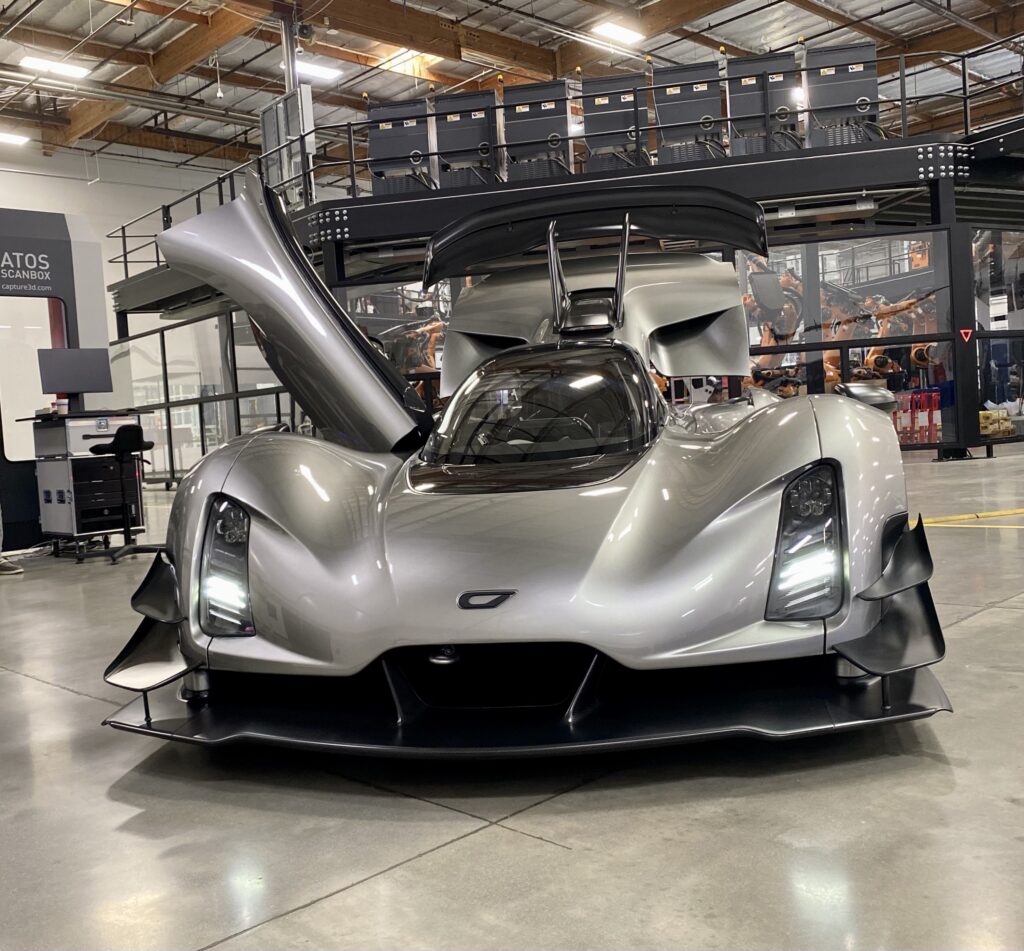
Note the diffuser. The entire rear of the Czinger vehicle is defined by aerodynamics, airflow, downforce. Wing is simply massive with mounts directly above the rear axle line, planting the rear suspension and tires in corners.
Interviews for the original story took place on November 16, 2021. This is my archive site. Other automotive writers eventually figured out that Divergent/Czinger is a highly advanced engineering and scientific enterprise. Where car companies feared to tread–the auto industry is at best a gathering of fast followers–now the defense industry is partnering. Divergent has the ability to transform the production systems of the U.S. defense industry. We need companies that can deliver the goods quickly and efficiently.
“I founded Divergent about seven years ago as a technology development company for digital manufacturing. We were a Google Moonshot company. Divergent is the 70 percent owner of Czinger Vehicles, which is the product company, and the Czinger 21C demonstrates what our digital architecture can do,” says Kevin Czinger, Founder and CEO of Divergent 3D and Czinger Vehicles.
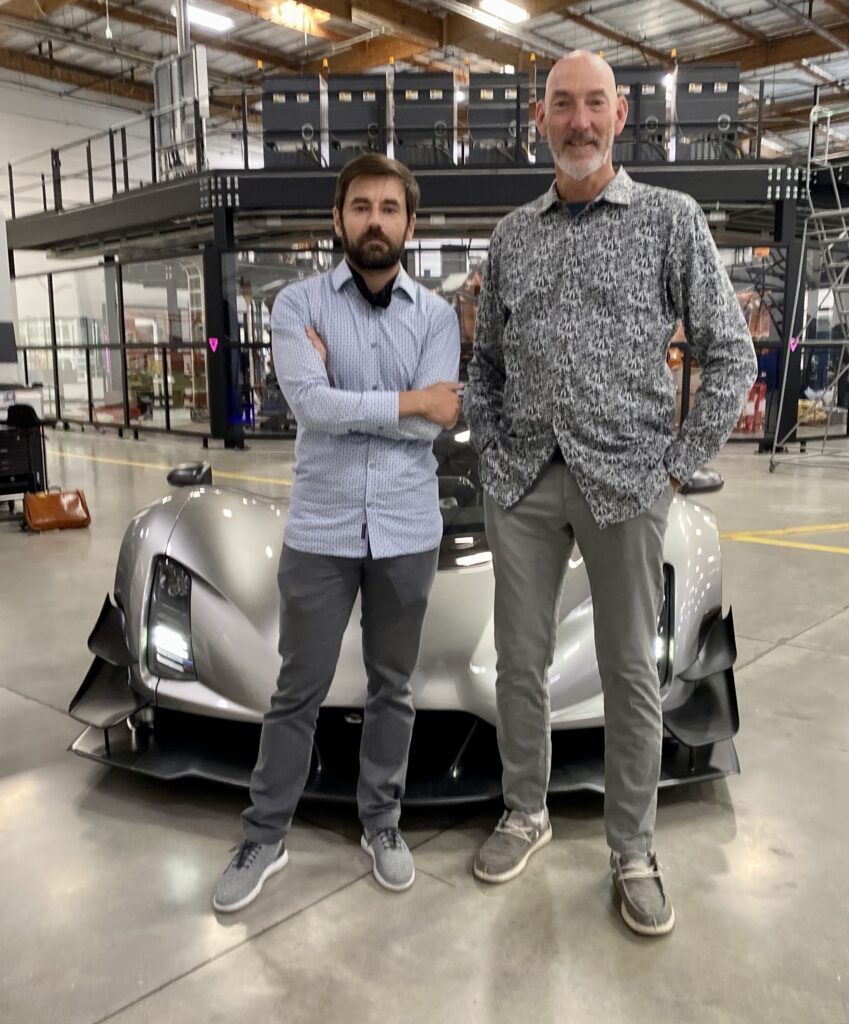
November 2021 at conclusion of our meeting. Kevin and Lukas Czinger with the 21C. They are a father-son duo that works. Kevin is intense, dominating conversations. Lukas is equally brilliant, but quietly deferential to his father. For any CEO or chief engineer visiting, I recommend a secondary quiet tour of the manufacturing process with Lukas, who is author of much of the Divergent process. The Czingers are the real-life Howard and Tony Stark of Iron Man.
Kevin Czinger and his son Lukas assembled a team of former Formula One and Le Mans race car engineers to work with his Divergent scientists and programmers. Czinger Vehicles’ 21C is the first-ever 3D-printed “digital” car, a proof of theory of Divergent’s architecture, a brilliant calling card for OEM contracts as a Tier 1 supplier. The 21C could just as easily be branded “QED,” quod erat demonstrandum.
Approaching Divergent’s headquarters in the nondescript industrial district of Torrance, California, in the shadow of the 110 freeway leading to the Port of Long Beach, you’d never expect to find an enterprise ready to redefine performance and luxury vehicles. Then again, Old World charm aside, Maranello and Gmünd were insignificant towns when Ferrari and Porsche were founded.
“A program like this is much more akin to a motorsports program,” says Ewan Baldry, Czinger’s Chief Engineer. “We built a team that is predominantly motorsports with a sprinkling of OEM on top so we don’t just build a race car. The Divergent structure crew are a blend of scientists, technologists…aerospace. We have people involved who have not designed a car before, so they are not bridled by convention and that helps us explore the possibilities of this manufacturing process.”
Bodywork is simply an aerodynamic sheath constructed of SMC, like Corvettes, or the earlier McLarens. The McLaren folks will complain now that I criticized their SMC bodywork, but they wanted to compete with Ferrari and Porsche. Czinger is another sort of technological statement. Here, SMC makes sense. Not only in engineering and design, but in production methodology, this is arguably the most advanced 4-wheeled high-performance road vehicle on the planet. In some measures, it’s more advanced than Formula One and Le Mans cars, due to the science behind its creation.
When Baldry joined us in the presentation room and gave his CV, I understood how a start-up could create such a vehicle. Baldry spent the late 1990s with Williams Formula One as a design engineer. For many years he ran his own firm, Juno, producing the sort of tidy little sports-prototype race cars that the English love for track play days. He also had stints at English cottage industry sports car companies Ginetta and TVR.
Ewan Baldry is Chief Engineer at Czinger Vehicles. He started at Rolls-Royce in Crewe in the Vickers era. He spent the late 1990s as a design engineer at Williams Formula One. He ran his own sports car company, Juno. And had stints at TVR and Ginetta. He helped field the Ginetta Le Mans cars.
Czinger’s 21C is the most innovative supercar since Gordon Murray’s McLaren F1 of the mid-1990s, ensuring its immediate acceptance into the pantheon of hero sports cars. The prototype you see here, which is production-intent but not yet in its fully developed state, has shattered production car lap records at Laguna Seca on the Monterey Peninsula and Circuit of the Americas (COTA) outside Austin, Texas. Kevin Czinger and Baldry assume that in six to nine months they can revisit these tracks and shave many seconds off those records. Bear in mind the COTA record was previously held by the brutal McLaren P1, one of the first three cars to wear the moniker “hypercar.”
The satchel in the car. Yes, I was behind the security wall in the manufacturing and assembly area to see the first car.
The 21C is a 1+1 vehicle, passenger tucked directly behind the driver, both seated centrally along the keel of the 3D-printed chassis structure. The cabin draws on aviation architecture, from fighters and also obviously from gliders, with a glass canopy arching from the massive integral roll-hoop above the passenger to the extremely stout crash-worthy A-pillars and the leading edge of the dashtop. A second low-drag long-tail version will be available, tuned with less emphasis on abdomen-twisting high-downforce cornering capability and more on high-speed slipstreaming and continental touring.
Interior shot. Two pedals, stop and go. Note crossbrace running behind the gauge pack, with bare aluminum structure to carry the steering wheel—design meets engineering. This first car is the high-downforce road-level track day car. Hence the aggressive heavily bolstered seat. Also know the depth of the door sill, the door frame. Owners who are not accustomed to Le Mans prototypes should be taught the best method for climbing in. Owner’s manual should include videos demonstrating ergonomics of 1+1.
“We have several guys on our powertrain team who joined us from Mercedes-AMG’s Formula One engine program,” says Baldry. Those are Luiz Oliveira and Kevin Shelton.
Luiz Oliveira played a leading role in powertrain development. He spent many years with Mercedes-AMG Formula One.
“Chris Wright will be turning up in December from Honda Formula One with ten seasons to his credit, including Mercedes,” says Baldry. “And then Jim Maher, who has been at Bosch the last eight years working on similar hypercar programs like Mercedes-AMG Project One and Aston Valkyrie. He is head of powertrain.” If you want a team of speed assassins that bring the respect and provenance of a unique powertrain, this crew is a very fine start. After years of the Formula One circus—brutal travel regime, hours of labor in compressed timeframes, the inevitable divorces—settling in coastal Southern California with a Green card to create 3D-printed hypercars holds appeal. Czinger will have no trouble attracting the finest talent.
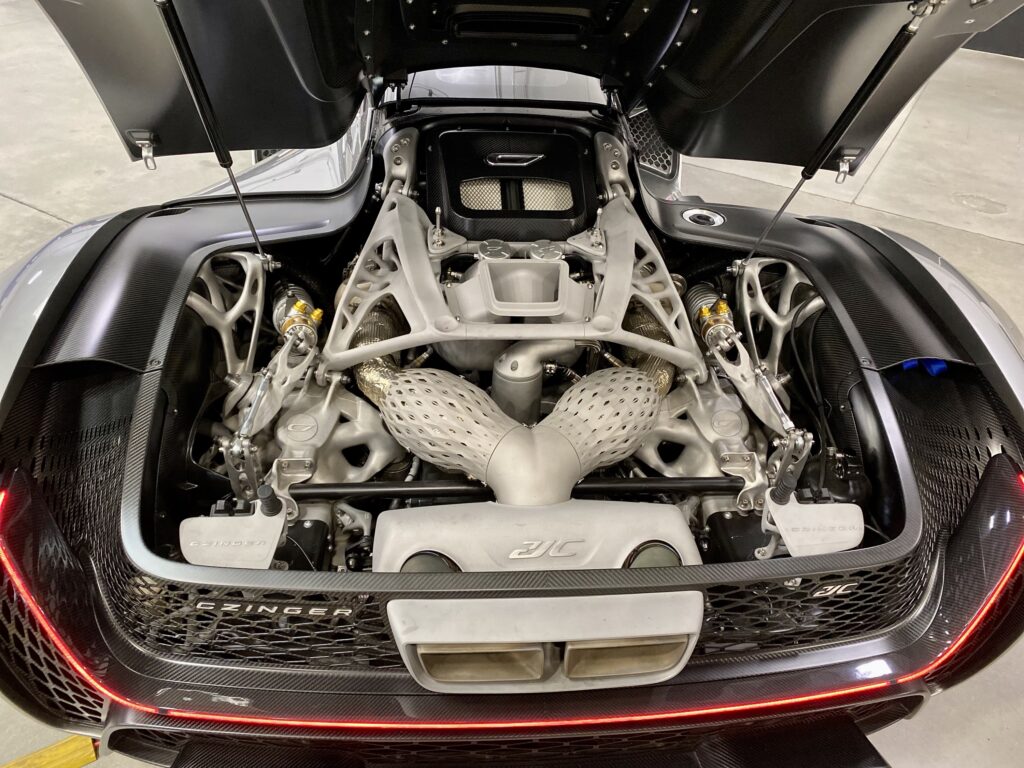
Star of the show is the engine bay presentation. If this does not sell a supercar collector on Czinger and Divergent, it’s time to buy a Corolla.
Czinger’s 2.88-liter 950 horsepower twin turbo V8 revs to 10,000 rpm. The engine runs on gasoline, though it can be set up to run on methane, too. The powertrain has two electric motors up front, mounted inboard, and one motor-generator out back. Drawing heavily on Formula One and Le Mans thinking of recent years, Czinger is creating a unique engine to rival any in the world. Czinger is not buying batches of engines from Mercedes-AMG, Audi or Detroit like so many short-lived makers of supercars, or even established greats like Pagani or Lotus. Czinger is the exact opposite of the sort of vaporware supercars and kinky vanity project exotics I’ve seen over the past 35 years. With its first offering, Czinger proves it’s as real as it gets.
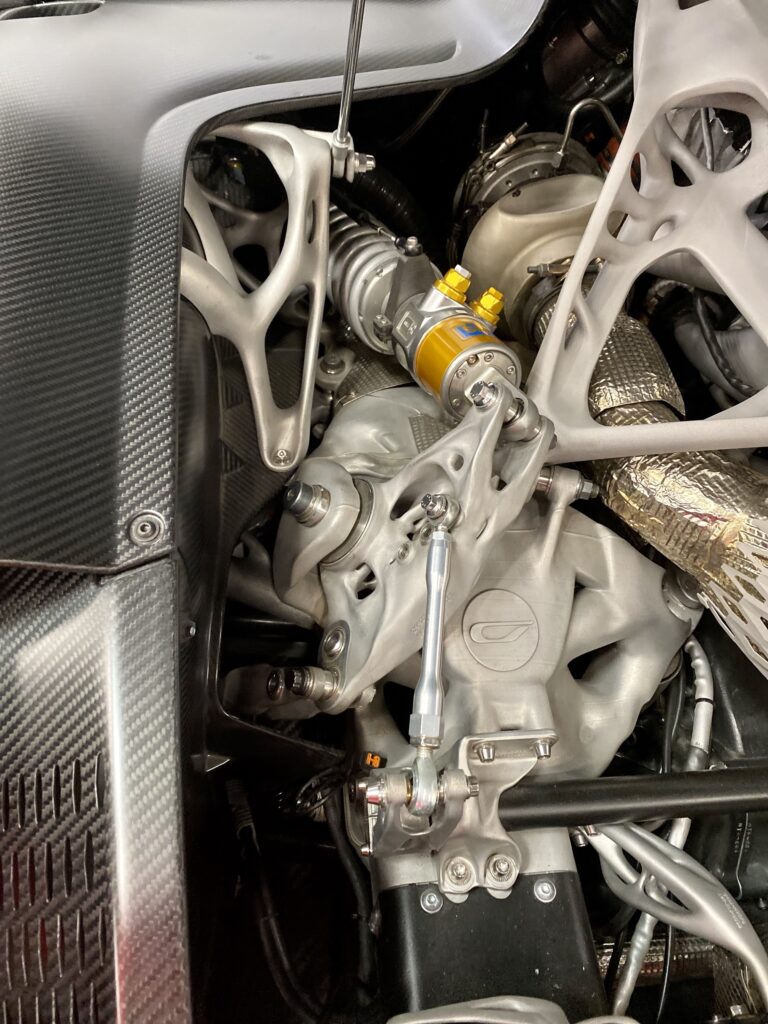
Rear suspension meets powertrain. Note position of damper, working on cranks.
“Powertrain is fairly akin to what you find in an LMP1 car [Le Mans prototype race car]. The EV side has only 2.8 kWh of storage. We use the latest A123 battery like Formula One. Incredibly expensive and very high-power lithium-ion,” says Baldry. “The actual cells themselves are capable of 1200 horsepower in terms of their rate of work, but in our system that is reduced to 420. That’s still huge for a pack of this type. We have 950 horsepower from the twin-turbo V8 combustion engine. And another 300 from the electric front axle,” says Baldry. It runs on an 800-volt architecture, which is the consensus German standard for production battery-electric cars.
The X-Trac gearbox is one of the few pieces that is not Czinger’s own creation, but even here Divergent and Czinger are reaching beyond just selecting ratios. If I had to gamble, I’d reckon that elements of the gearbox will be unique to Czinger by time of launch, or perhaps in a follow-up vehicle. Divergent’s 3D printing will eventually touch virtually every element of Czinger vehicles.
Dave O’Connell, Chief Designer, Czinger Vehicles and his primary collaborator, Nik Stefanov, Director, Digital Design. O’Connell has been a lead designer at Mitsubishi and is a professor in Art Center’s automotive design program.
“The high-downforce and low-drag versions of the car run the same gearset, but for the low-drag variant we may have an optional gearset for super V-Max performance with a longer ratio,” says Baldry. “In both forms, the 21C is a road-legal, full FMVSS, crash-tested, emissions-compliant vehicle.” The 21C will be homologated for sale in North America, the EU, and other major markets for specialty cars, with no need for low-volume waivers. The vehicle has crash structure to match any other supercar available.
Jon Gunner, Czinger’s CTO, states that “The 21C structure is engineered to withstand all worldwide safety requirements. These include roof strength testing. The federal roof test loads the top of the A-pillar with 3x the weight of the vehicle, that results in a local deflection of less than 4 inches. The occupants are also protected by frontal and side curtain airbags as well as pretensioning seatbelts. In addition to the regulatory requirements, Czinger has also engineered pyrotechnic bolts on the doors, so in an event the car is upside down, the occupants can still exit the vehicle safely.” To repeat, this is not a vaporware effort.
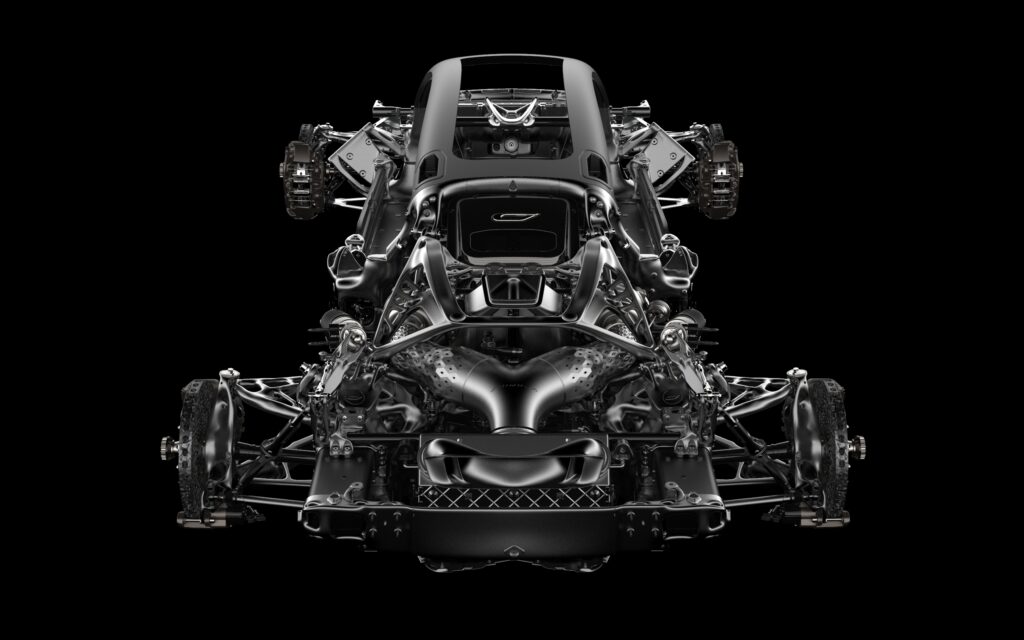
Interviews took place in Czinger’s meeting room before moving to the work space out back. Here, the rear subframe, which carries powertrain and suspension. Rear subframe, which is made with perhaps a dozen pieces all bonded together. No human could perform the calculations to create these shapes without Divergent’s powerful algorithms. If you buy a 21C, wouldn’t you want this made into a coffee table or perhaps a wall mount?
“Chassis-wise, very similar approach, recruiting from motorsports. We have Nick Alcock heading aerodynamics,” says Baldry. Alcock’s Formula One résumé includes Renault, Williams and Lotus. He also did a stint in the U.S. working for Don Panoz on the Panoz Indycar. Body panels are an unstressed carbon-fiber skin for aerodynamics, meaning the bodywork is not structural.
Suspension member. Again, note the almost biological shapes, like tendons, generated by Lukas Czinger’s mighty algorithm.
The car weighs 2910 curb weight with fluids, about what a McLaren 765 Longtail weighs. It is many hundreds of pounds lighter than other gas-electric hybrids, another measure of the weight-savings of the 3D printed pieces.
A glamorized view produced in “the tube.” A collector might order two, one with bodywork, another stripped bare for presentation.
Cooper Keller is Director of Testing and Quality and leads all material testing plans, customer testing for Divergent and vehicle testing development for Czinger as well as quality. Cooper ensures that Divergent and Czinger are ISO 14001, ISO 9001, IATF 16949, and AS 9100 certified. That’s Tier 1 supplier quality, not vaporware. include but is worth mentioning is Cooper Keller our Sr. Director of Testing.
Brake assembly. Note the complex shapes, which resemble tendons and muscles. The algorithms result in almost biological forms. The Divergent system can take upwards of 40 percent of the weight out of the component, dramatically lowering unsprung weight and opening the path to greater cornering capability.
As seen in the photos of the brake assembly and rear frame, the shapes are like human tendons and muscles, growing thicker and thinner, everything curved and turned with complex but elegant radii. The pieces appear to be from an alien spacecraft. These pieces are the best sales tool for both the car and for Divergent as a Tier 1 supplier. Czinger should offer clients the option of suspension pieces or the rear frame mounted for display.
Brake assembly. Note the complex shapes, which resemble tendons and muscles. The algorithms result in almost biological forms. The Divergent system can take upwards of 40 percent of the weight out of the component, dramatically lowering unsprung weight and opening the path to greater cornering capability.
Czinger will produce 80 copies of the 21C at $2 million, to be followed with more broadly capable, less extreme Czinger vehicles already under development, though clearly they intend to settle at the pinnacle of any given market segment. Don’t expect any Czinger vehicle to be produced in very low volumes. If Czinger does not have 70, 80 or 100 years of well-steeped provenance, well, Czinger has the aura of Iron Man, of California advanced technology, and that’s the future, that’s the best provenance any company can hope for.
Note aero addenda and pure aerodynamic forms, clearly a stylized version of the LMP1 and LMP2 cars that run at Le Mans. Iron Man is the best movie metaphor for the Czingers, father and son, but another movie scene comes to mind: Something wicked this way comes.
THE MACHINE BEHIND THE CAR, A MACHINE TO CHANGE THE WORLD It is impossible to understand Czinger Vehicles without first understanding Divergent 3D. Both enterprises are so technologically advanced that the father-and-son duo of Kevin and Lukas Czinger could be cast as the real-life Howard and Tony Stark, the Iron Men of the automotive world. To engineers and executives alike, the following may prove far more thought-provoking than the resulting hypercar. The following is the reason Czinger has immediate provenance, a place in the supercar firmament. The quotes that follow explain why serious collectors will want to own a 21C.
Viewed from the rear, note the massive cooling/aero outlet behind the front wheel arch. Also note the depth of the “sill,” a product of the 1+1 seating down the centerline of the vehicle, passenger directly behind the driver.
“When I first showed the spec and design of the machine,” says Kevin Czinger, “literally I had people saying ‘Are you trying to create the Jesus Machine? Is this a joke?’”
“This is our own software,” Czinger continues. “We call it bidirectional evolutionary structures. We invented, built and own all essential elements of the Divergent production system. Our hardware stack. We give the client a piece at this price with zero tooling, complete manufacturing value, flexibility. We bring down mass, increase performance. An agnostic production system.”
“We make the full range of purpose-built materials. And the circular sustainable economy system, dematerialization and closed looping. Mass production, stiffness, reduction in part count. Obviously, this manufacturing architecture collapses the supply chain and product development process as well.”
“This printer can do 12 lower control arms at 469 milliliters per hour. The fastest commercially available alternative today is probably doing 30 to 40 milliliters,” says Czinger.
After three hours in the facility, I drove to a lunch gathering with an automotive CEO and his top engineers. Within days they visited Divergent and within a week had a test project initiated. To any CEO or automotive engineer reading this, let me state that if you are not exploring application of this process to at the least your suspension components, you are derelict in your duties.
“This is completely fixtureless automated assembly,” says Czinger. “We developed a digital engineering platform. We have been working with several companies for four years now. We have been qualified by brands within three of the world’s top five OEMs. Our first OEM production programs have SOPs in the first half of 2022.”
“Here in all dimensions, you can optimize structure, then you can start to integrate all the functionality and make it much more efficient without tooling or fixturing. We fully qualify for safety structure, Tier 1. All quality management, all the ISOs, all the audits. We are fully audited, fully qualified. Both the structures and the production system.”
“You can design any piece with design complexity being equal in cost. All features for assembly are built in. So complexity is basically free,” says Czinger. Divergent and Czinger so tightly integrate and collapse the stages of concept, design, engineering and printing and assembly of performance and specialty car pieces that they eliminate multiple steps in the development process and integrate and simplify the components on an almost biological template.
“This is a clean-sheet architecture. I took a technology-agnostic approach,” says Czinger. “We need to massively reduce manufacturing impact on the environment by dematerializing. We are taking 20 to 70 percent of the mass and energy out of these structures. And then they are designed at the end of their lives to be re-atomized and turned back into a printable powder and reprinted. You trap all the materials, just like the can industry. Fifty years ago, a beer can required 83 grams of aluminum, almost all of it mined. Today that 83 grams has gone to less than 13 grams and 76 percent of that is recycled. We need to do that on larger structures and then cascade it down across our production infrastructure if we want a planet that survives.”
“We started doing programs producing a single suspension component. We would take the client’s hard points, their design, their load paths. Then generate that structure and test it against the existing structure. We were taking out 20 percent-plus of the mass from high-performance production vehicle components that were using the latest thin-wall aluminum casting technology. The OEMs were asking us to take out 5 percent, which would be a game changer. We were taking out over 20 percent.”
“I am trying to replace body-in-white tooling and stamping completely across all segments starting with a minimally viable version of this digital system,” Czinger continues. “We are looking for nearly 99 percent up time and zero waste.”
“If you look at the brake caliper and carrier here,” Czinger says, taking the brake assembly in his hands and then passing it over, “we are reducing mass by about 40 percent. Imagine the same thing with an EV motor. Take the rotor and stator, everything for hydraulics, all conduits for thermal management and electronics, and those disappear, and you are simply taking the rotor and stator into the crash area of the vehicle and generating structure around it that has all these features.”
“No human could design these pieces,” says Ewan Baldry. “It could not be realized without these powerful tools.” Lukas Czinger adds that “the software interprets the load path. It puts the material where it’s needed for that exact load path.”
If Divergent can reduce unsprung weight of the suspension and braking systems by 30 or 40 percent, it signifies a seismic shift in the design and the ultimate performance of sports cars. Divergent and Czinger are 3D printing all the major components of a hypercar chassis and producing a gas-electric hybrid hypercar that is hundreds of pounds lighter than equivalent cars from European car companies.
“If you cut a cross section of that frame, it would look like the inside of a human bone,” says Kevin Czinger. “Just like nature is competing for material and energy, and selecting material over eons, this is doing the same thing but in hours.”
“These are all invented materials,” he continues. “No such thing as a printable high elongation aluminum with enough ductility for crash other than the one you see here. There is no such material as a high-modulus aluminum with enough stiffness other than what you’re seeing here. These are all patent-pending materials.” Short-hand is to call it powder-bed laser sintering to create the part.
“In our R&D space, we are looking at renewable fibers for future body panels,” says Lukas Czinger, the VP of Operations and Manufacturing, and the developer of much of the Divergent 3D automated assembly and manufacturing system. “Thermo-plastics that with heat we can manipulate and reshape to have a more recyclable body system, more environmentally friendly body system. We have already taken a lot of the body engineering out by having the full 3D-printed chassis structure. The body is really about aero and styling more than it is part of the chassis.”
How is this all possible? “For Divergent we have wrapped three tech pillars into one fully integrated system,” says Lukas. “The first is generative design. We don’t have your typical CAD engineers doing surfacing and CAD design. We built a software team that created algorithms for designing those parts. Our design process for, say, an upper control arm is this: here are the attachment points, here’s the load cases it supports, here’s the volume that it can consume so it doesn’t collide with any other vehicle systems, essentially press play, run these design algorithms, and that component is produced as a 3D model.”
“This system is already about 3 to 5 times more attractive than body-in-white economics. We are assembling at about three parts per minute,” says Lukas. “If you were to build out a welding line, you would spend about 3X what we are spending today.”
“Our system is replacing all body-in-white welding with a cell-based assembly method, not line-based. It is completely automotive-grade capable, but this is assembling at near-aerospace accuracy. And all the tooling stays consistent between assemblies. We can shift from one assembly to another without changing the system,” says Lukas. Divergent has its own bonding agents and its own means of bringing together and joining complex and sometimes heavy pieces like rear frames with extraordinary accuracy.
“If this was an old school method,” says Lukas, “we wouldn’t have a system where you can just change the software with no hardware changes. There’s no hardware that changes when the design changes. It can produce a structure that’s end tolerance is about 2 times as accurate as your usual OEM. It is doing all of its software programming, so all the robot motion paths, all the IPC programs, is all done offline in automation software that we have written. We are doing full tool pathing, full motion paths, full signal for the IPC generation in our own software package offline. Then we are downloading onto the cell. When we download those programs over the air onto the cell, we already have virtual assembly with the full process, and we have qualified that the parts are designed perfectly for that assembly process.”
Divergent may not change the entire auto industry overnight, but any chief engineer or CEO whose company produces performance cars or high-end specialty luxury cars should make the pilgrimage to Torrance, California. With the ability to reduce component weight and mass by 20 to as much as 40, 50 or even 60 percent, and to integrate multiple functions into a single 3D-printed piece, Divergent will become a critical supplier to all sports car makers, and in time have significant impact on luxury vehicles of all varieties.
Reasons to include a Miata MX-5 Club in a well curated collection of performance cars are obvious to any knowledgeable enthusiast: light weight, virtually perfect balance, three pedals, a manual shift lever that works directly on the gearbox resting inches away from your shin and, most importantly, everyday access to the Dark Art of heel-and-toe braking even on a five-minute sunset drive to the local market to pick out a tidy bottle of Pinot Noir.
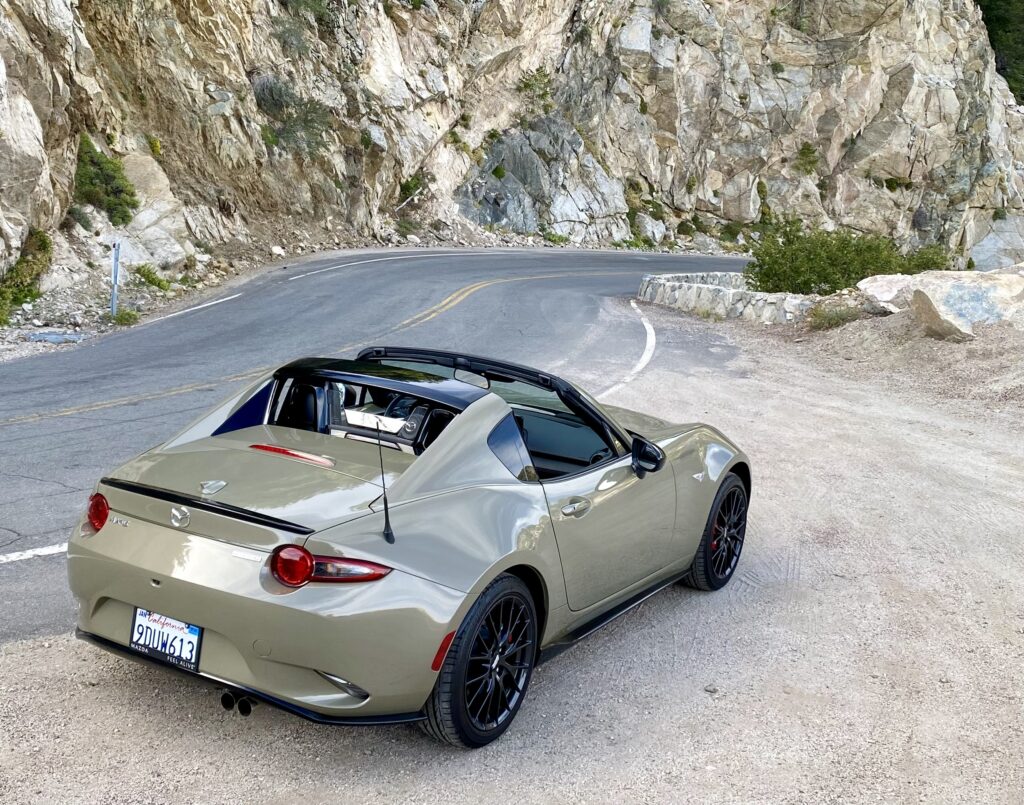
The test car, finished in Zircon Sand, a one-year special color that is somewhere between desert camo and muddy water.
For that well-curated collection, the only Miata model to buy is the Club with manual gearbox, equipped with the Brembo/BBS/Recaro option package. It’s an odd, awkward trim level designation—Club—probably implying amateur-level racing in a club. But tick the right option boxes and your Miata will not be like your grandmama’s Miata that reminds her of those carefree days in the ‘70s when she was a swingin’ babe.
On a winding road or a short sprint to school drop-off Miata can entertain. With the Brembo/BBS/Recaro option package, the Miata Club is a fine little sports cars, not a foolish car for West Hollywood hairdressers.
The Miata Club with Brembos et. al. is a purist small-displacement sports car that can keep its owner’s knowledge of the Dark Arts sharp. There’s a reason Miatas are often found in the outbuildings of guys who own vintage European sports cars: muscle memory related to working the clutch pedal and that snick-snick shift lever is toned and reinforced
Miata is a unicorn in the automotive world: front engine, rear drive, very light weight, and available with a proper manual gearbox operated through metal levers. There is an immediacy of sensation in shifting that can only be accomplished with a front-engine rear-drive car, the gearbox sitting alongside your shin and ankle. BMW M2, M3 and M4 offer similar designs, as does the Toyota GR86 (formerly the Scion FR-S). Last-gen front-engine Corvettes also had this wonderfully direct arrangement. If Detroit iron appeals, both Mustang and Camaro still offer this type of shift linkage. Otherwise, it’s all electronic controls, paddleshifters and computer scripting.
Miata Club can amuse and educate at relatively low speeds. Miata is a momentum car, with just barely enough power to bring the chassis to life. Its optimal operational window is 20 to perhaps 80 miles per hour. It’s slow off the line, and buzzy much above 80 or perhaps 90. The limited power forces the driver to be efficient and precise, to maintain momentum rather than bleeding it off through needless braking, with no room for the sloppy moves a supercar can cover up with massive amounts of power.
Miata cockpit is snug and cozy. At over six foot two, I found it comfortable. Ample room for my size 13s to work the pedals. Switches and dials are all simple and easy to locate without taking eyes off the road, desirable in a sports car. The touchscreen remains as odd as it was eight years ago, stuck on the dash, but there’s really no place else to fit it.
Boys weaned on motocross dirt bikes excepted, few people under the age of 30 or even 40 or 50 will understand the shifter and clutch pedal. Perhaps thanks to old movies, the children in my own life intuitively understood the sounds of shifting up and down, but were puzzled initially watching left leg and the curling wrist of the right hand performing automotive jiu-jitsu I learned as a 16-year-old driving a beat-up Alfa Romeo Giulietta, and a steel-dash MGB as an undergrad. Most satisfying of all was the tykes’ quick uptake of process, recognizing a perfectly executed heel-and-toe downshift, engine sounds rising and falling but the car’s composure smooth and unflustered—a perfectly nailed downshift under braking.
Here, the main reason to buy a Miata MX-5. ONly buy the Club with its superior chassis tuning. And buy the manual. It’s as satisfying as working the bolt on a Mauser bolt action deer rifle. Snick-snick. The engine is forgettable. The car is cramped for anyone much over five foot ten or eleven. It’s bog slow. But it is an ideal place to teach a young person the lost art of heel-and-toe downshifting. It is the ideal place to keep manual shifting muscle memory tuned up for use in vintage sports cars. I hope Miata can be evolved for decades to come.
Most people old enough to immediately comprehend the meaning of that stubby shift lever consider manual gearboxes a nuisance, long since banished to society’s periphery, banished to work trucks with low, low Granny gears for pulling horse trailers out of a muddy paddock. To older folks, that stumpy shifter is something from the past, painful to operate in heavy urban traffic, a mechanical device admired only by maladjusted males of a certain age, people who still think driving is a pleasure.
BBS wheels and Brembo brakes are a must-have option for the Miata Club.
British and Italian sports cars engineered in the 1950s that were sold by doddering little companies as late as the 1970s and early ‘80s served as template for Miata, though none of those vintage cars were so impeccably built, so neatly assembled, so utterly reliable and easy to maintain. Miata interprets those sports cars of the Golden Age that almost everyone remembers without ever actually having owned or driven one—must be images from old movies again. Lotus Elan, Alfa Romeo Giulietta and Duetto, MGB, MG Midget, Triumph Spitfire, and of course Pininfarina’s masterwork prized by all big-league car designers working today, the original late ‘60s Fiat 124. Miata provides the same pleasures combined with safety engineering and Seiko build quality, and all with a curb weight only a few hundred pounds more than many of the vintage sports cars just mentioned, and a far better power-to-weight ratio.
This illustration shows how the actions of the rear suspension deliver useful knowledge right to the seat of your pants. This is why Miata can be driven with such style at low and medium speeds. Miata has a minimum of electronic trickery, delivering a very nearly pure driving experience. This is the 1950s and ’60s sports car experience dialed up for the 21st Century, with excellent and almost loving build quality. This car is the one that Mazda has not messed up. Mazda gets many things wrong, but the first, second and this the fourth generation of Miata are damn near perfect. The third generation grew a little porky, and design was not great.
Miata was a social and cultural sensation when it arrived in 1989. For Boomers and Gen X’ers, a tidy little sports car has an irresistible gravitational pull that is far beyond the actual mass of the vehicle. In this way, Miata was to the years 1989 and ’90 what Frank Stevenson’s brilliant and jewel-like reinvention of the Mini Cooper S was to the years 2002 and ‘03: a magnet that led to happy conversations with strangers. Miata has been around four generations, though Gen-2 was more of a reskin, a refinement, with soft-touch interior materials that were surprisingly high-end. The Gen-3 car grew a little porky, a bit odd looking, not quite so perfect. But the current generation that arrived about a decade (!) ago was engineered using super-high strength steel (high mega-Pascal) that allowed Mazda to trim weight. Simple enough: if the steel is stronger, you need less of it, the car is lighter.
RF folding roof works just like a Ferrari 812 GTS’s, but flying buttresses are taller and less graceful than the Ferrari’s because Miata is so short. Fendercrests viewed from driver’s seat also have shapes that remind of Ferrari 812. A fine looking little car that responds best to jewel-tone exterior paint.Obvious parallels in design, specifically roof panel and the flying buttresses. Yes, I once rated with Ferrari and had this car. Bigger, faster, quicker, yet Miata’s manual shifter means it is almost as much fun to drive on a mountain road. Well, almost.
The Gen-4 car in soft-top roadster form weighs just over 2300 lbs., the “retractable fastback” version I drove slightly heavier. Bear in mind that Porsche 718s (Boxsters) are about 700 to 800 pounds heavier, and most exotic supercars are between 700 and 1600 lbs. heavier. Much as aged Boomers might hop up and down and argue for Gen-1 with its pop-up headlight flaps and slightly lighter curb weight, well, the current generation is Darwin’s favorite, the highest evolution of the species. It’s damn near perfect, capturing what Jung labeled the collective unconscious, the cultural memory of a jolly little sports car.
Trunk is big enough for a couple traveling light for a weekend from Los Angeles to Santa Barbara. San Luis Obispo and the Central Coast wine country might feel like a long drive without a leg stretch in Montecito and another break farther north. Miata is not like riding a sport-touring bike two-up, but the cockpit is snug, the suspension relatively taut. She’s a sprinter, not a long-distance touring car.
To find a manual transmission that does not use the cables and springs found in front-drive, all-wheel drive and mid-engine cars, to find one that works through a sequence of tightly machined metal bits that operate with the smooth precision of a fine deer rifle’s Peter Mauser bolt action, the population grows very small. Beyond Miata, BMW offers the M2—get one while you can. The Detroiters offer proper manual gearboxes in Mustang, but it’s a hulking, enormous car—some call it a modern muscle car—not a tidy sporting vehicle. Toyota and its vassal Subaru offer a manual gearbox in the GR86 and BRZ Twins, which are about 500 pounds heftier than Miata. Porsche offers manuals, but they use cables, as do Subaru WRX and others. Not the same, really.
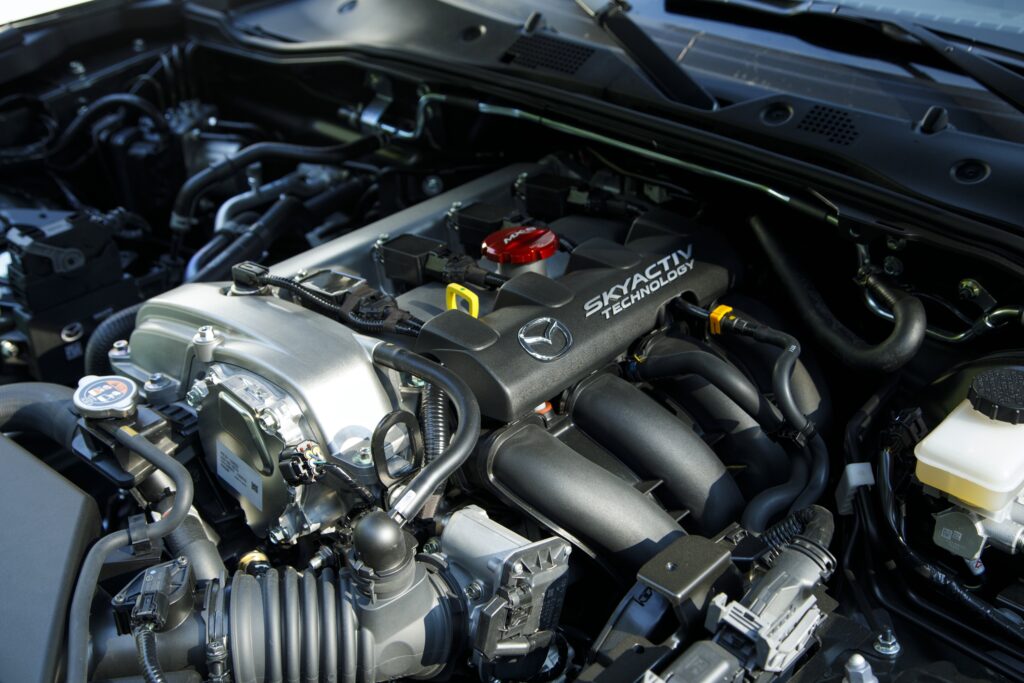
2-liter 4-cylinder engine produces 181 horsepower, but one must work hard to extract that final bump of power, screaming at 7000 rpm. The sweet spot is just above and below the torque peak of 4000 rpm. Keep the engine between 3500 and 6000 rpm. The engine is simply a means to set the chassis in motion. Sound will tell you when the engine is growing unhappy and wants an upshift. You really don’t need the tachometer. Just listen.
Beyond those easily purchased and maintained cars listed above, you’re looking at esoterica, like Caterham 7s and Morgans and the $250,000 Pur Sang Bugatti Type 35 replica, all of which feel vulnerable on the freeways of my native Los Angeles.
A wonderful place to spend time. Even short trips to the post office or local market become epic journeys and opportunities to hone the Dark Arts of clutch and gearbox. Steering has just enough weight, and brings a sense of connection to the tires themselves—excellent.
Could Miata be better? Sure. Are my horsepower junkie pals who mock my Miata fixation justified in laughing at the car’s limited power? Absolutely. The power peak at 7000 rpm is more for advertising than real exploitation. The engine is happiest operating just above and below its torque peak at 4000 rpm—which of course gives excuse to shift gears up and down frequently. Flogging the engine to redline will not bring that sweet Junior Ferrari sound of a 65-year-old Alfa Romeo Giulietta. The engine is just a means of setting the chassis in motion and experiencing its effortless dance with physics, in stunning contrast to supercars that batter down and conquer physics with electronics, nuclear horsepower and a broad tire patch. In this, Miata is very similar to the now-vintage Lotus Elise of 20 years ago. Miata glides.
Backup camera helps even in a car this tiny. Not really needed with the roadster, but the Retractable Fastback folding hardtop does have tall flying buttresses that restrict view to the rear blindspot.
But the lads in Hiroshima resist change, convinced that Miata must be the final exceptional evolution of the Populist European Sports Car. With a little investment, using 21st Century technologies, Mazda could bolster Miata’s image amongst a broad swath of American males. Add a 48-volt system to power a tiny electric turbocharger and double the amount of torque. This would require a unique gearset constructed of extremely high-strength steel, perhaps shot-peened or phosphate-coated to increase torque capacity while still fitting in the slender case. Yup, the limitation is the little gearbox, which cannot handle much more than the car’s current 151 lb. ft. Miata’s unique “trellis,” a sort of space frame or girder hidden from view that ties together the entire powertrain, would need to be modified to maintain good crash integrity. And yes, a Super Miata might gain weight, but the increase in power would transform the car into a baby Ferrari 812. Also, it might grow twitchy combing loads of power with such a short wheelbase.
Trunk is big enough for a couple traveling light for a weekend from Los Angeles to Santa Barbara. San Luis Obispo and the Central Coast wine country might feel like a long drive without a leg stretch in Montecito and another break farther north. Miata is not like riding a sport-touring bike two-up, but the cockpit is snug, the suspension relatively taut. She’s a sprinter, not a long-distance touring car.
Will the Japanese pursue such a program? I doubt it, having argued the point with them unsuccessfully more than 20 years ago, when a Ford-owned Mazda built the Mazdaspeed Miata against the will of the Japanese engineers. Build such a car, call it a Mazdaspeed Miata, Super Miata, or Miata Mofo Edition and the current car could remain in production for another decade, basking in that glow of serious performance. Yes, the fundamentals of the car are utterly timeless—Miata can hang around for many years.
But honestly, even if Miata only had a 2-cylinder engine and 100 horsepower, it would still rate a parking space in the best Garagemajals, in the best Man Caves. There is no other car just like it in the U.S. market, it can teach a new generation of young car enthusiasts the Dark Arts of Clutch and Gearbox, and keep alive a type of joyously spirited driving that is so hard to find in our age of electronic emasculation, a style of driving that might soon disappear from the earth. For those reasons, my love for Miata remains undying, a treasured part of my most fabulous sports car life.
This car, so often disparaged as a girl car or worse yet a hairdresser’s car, is in fact often found in the most impressive collections, humbly off to the side but always at the ready.
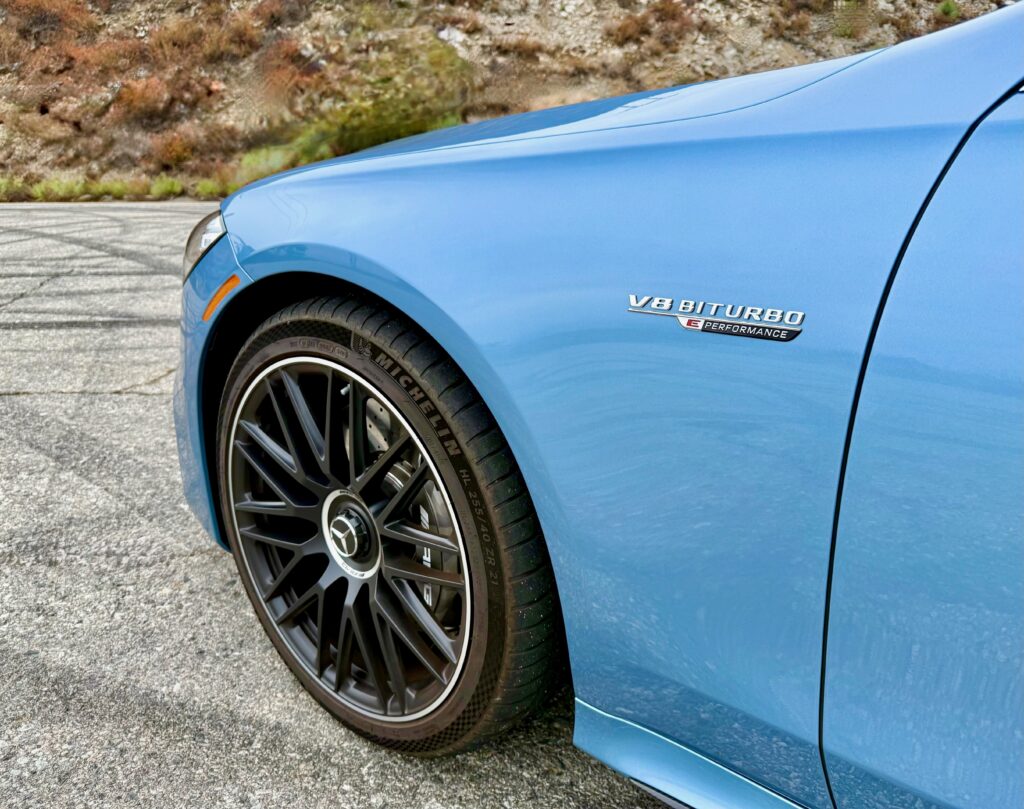
Mercedes-AMG carries the S-class to brave frontiers, mounting its well-proven 235 lb.-ft. electric motor/battery pack between the rear wheels. Combined gas-electric power is almost beyond comprehension for a sport-limo: 791 horsepower and 1055 lb.-ft. of torque.
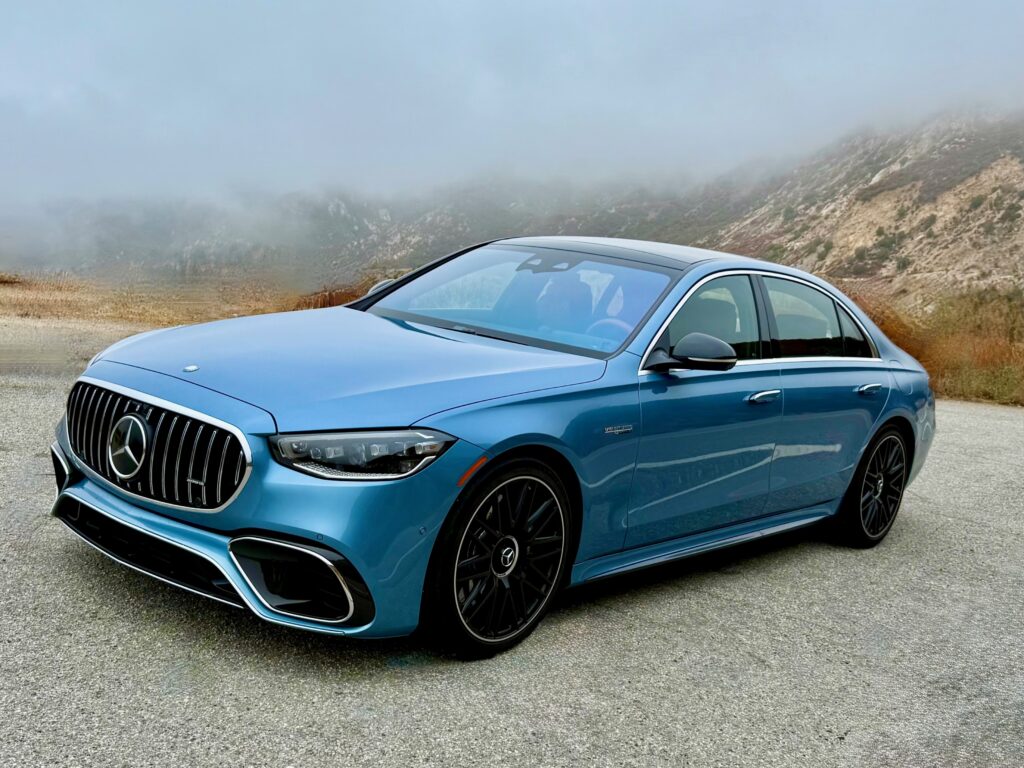
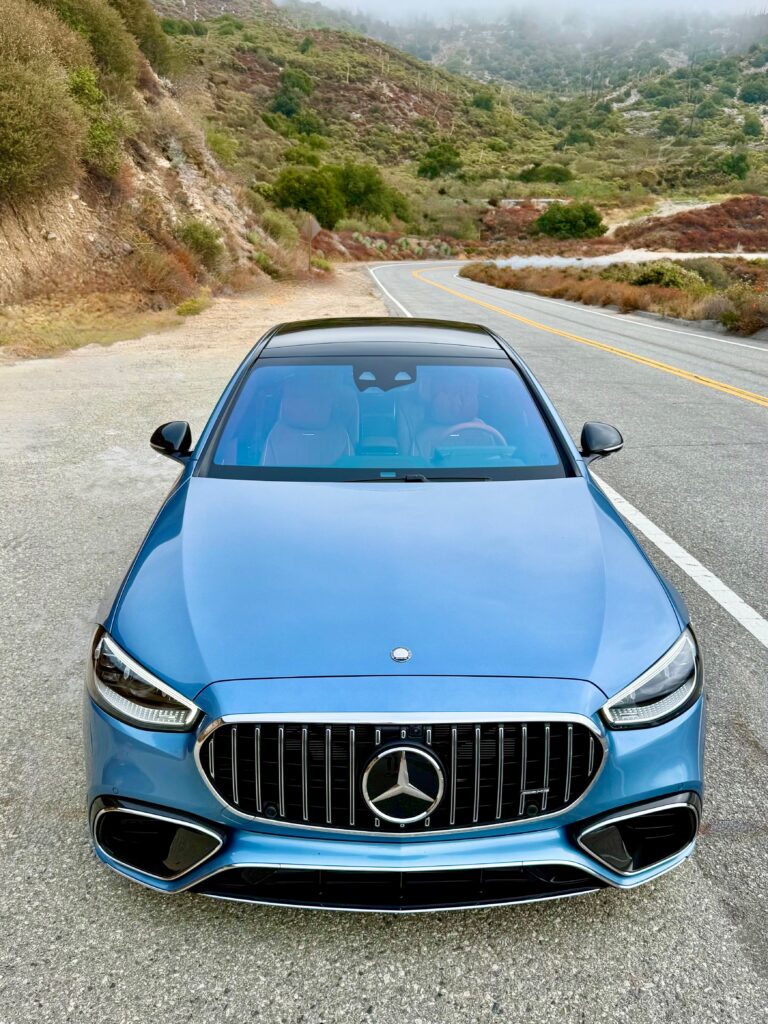
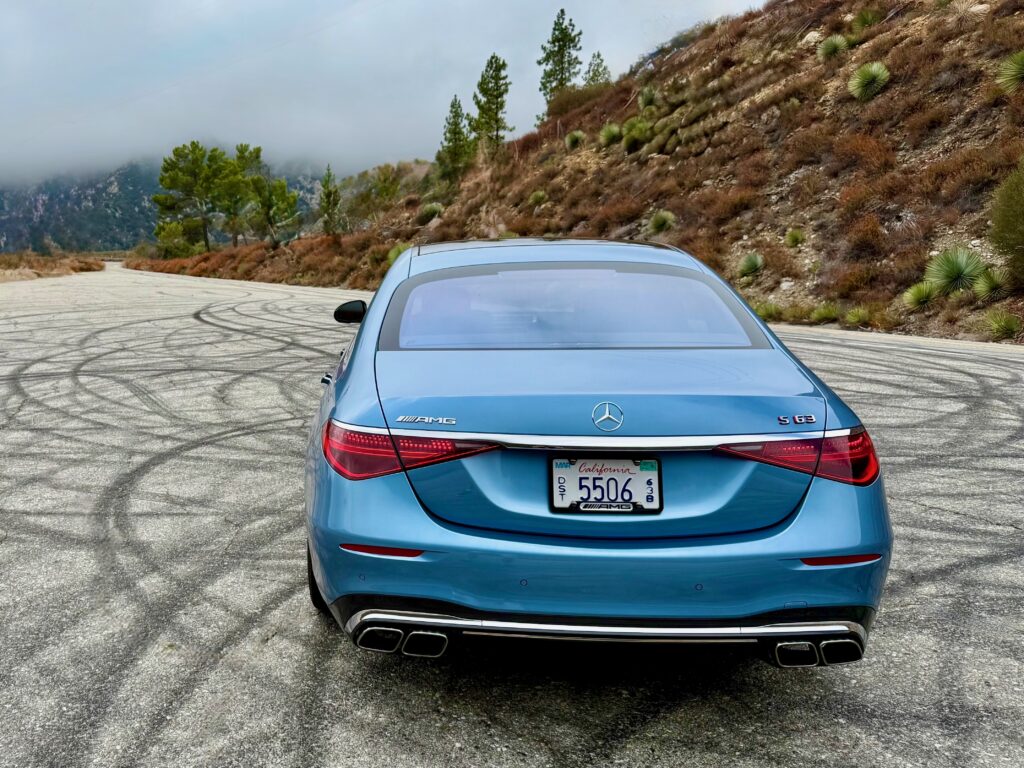
Mercedes-Benz is in a perpetual state of becoming, a requisite for any civilization or company to thrive long-term. Seen here is not just a big boy S-class sport-limo in a custom-order shade of blue, but the AMG S 63 S E, with a combined gas-electric 791 horsepower, the most powerful S-class ever built, yet another testament to AMG’s act of becoming.
Around town, S 63 S E is whisper-quiet, easily navigating traffic in spite of its considerable length and heft, a serviceable everyday vehicle that “drives” much smaller than it is. The gauge pod offers a display providing instant readouts of just how much (or little) horsepower and torque is being used. Morning traffic requires little more than a burble.
Becoming can also mean reinvention building upon achievement, and Mercedes has for more than 120 years offered tailor-made car-building, the most famous being the very first “Mercédès” of 1901.
MANUFAKTUR Studio is the branded name for Mercedes’ reconstituted in-house custom-build facility in Sindelfingen, where Mercedes has constructed big-bore cars for 110 years. MANUFAKTUR Studio offers Mercedes, AMG and Maybach buyers a 21st Century process for special-order car-building, extending the act of becoming. Call it MBA Kraftwerk.
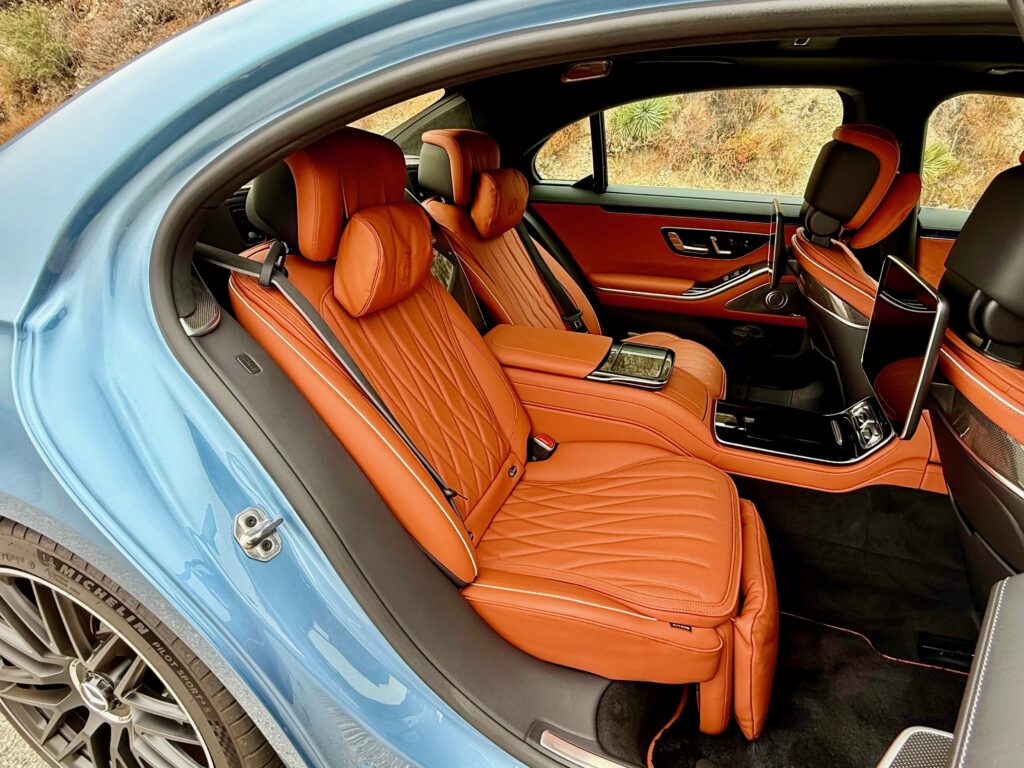
Children were bemused by Executive Plus optional features, fiddling with the sleeper position, whooshing privacy screens up and down, or fiddling with flatscreens. Passenger entry and exit is graceful and glamorous thanks to those huge rear doors, even when hoisting rucksacks and violin cases.Show me the child who would complain about riding in this rear seat. Or for that matter, The Man who rides in this mobile C-suite with his driver/bodyman up front.
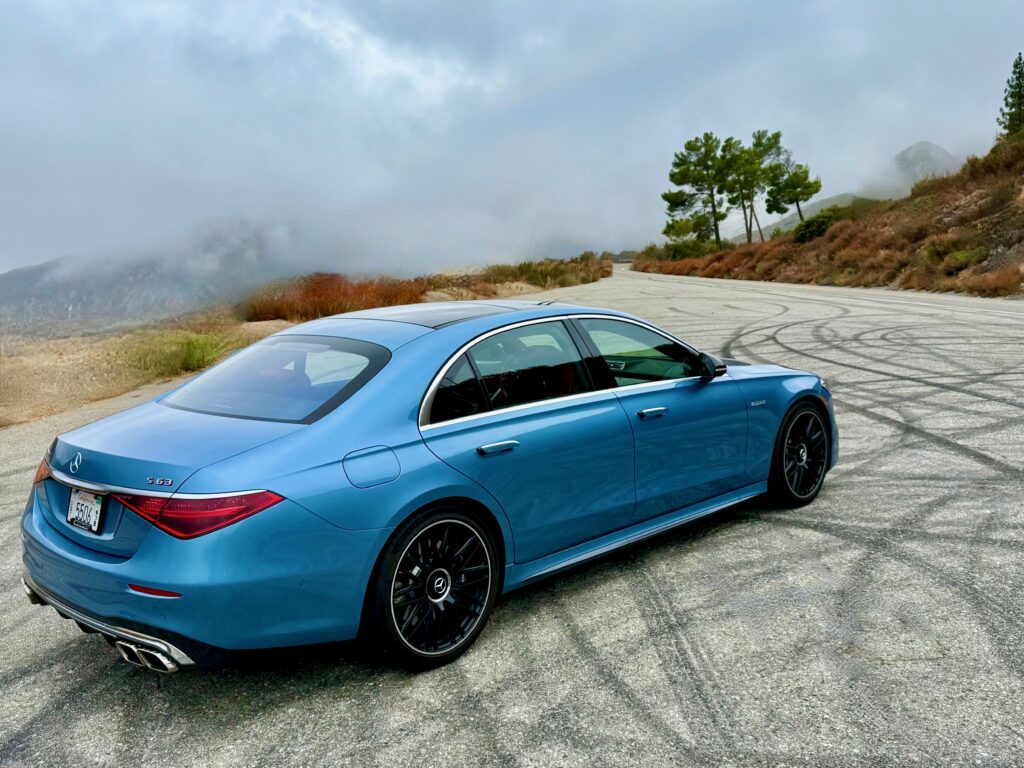
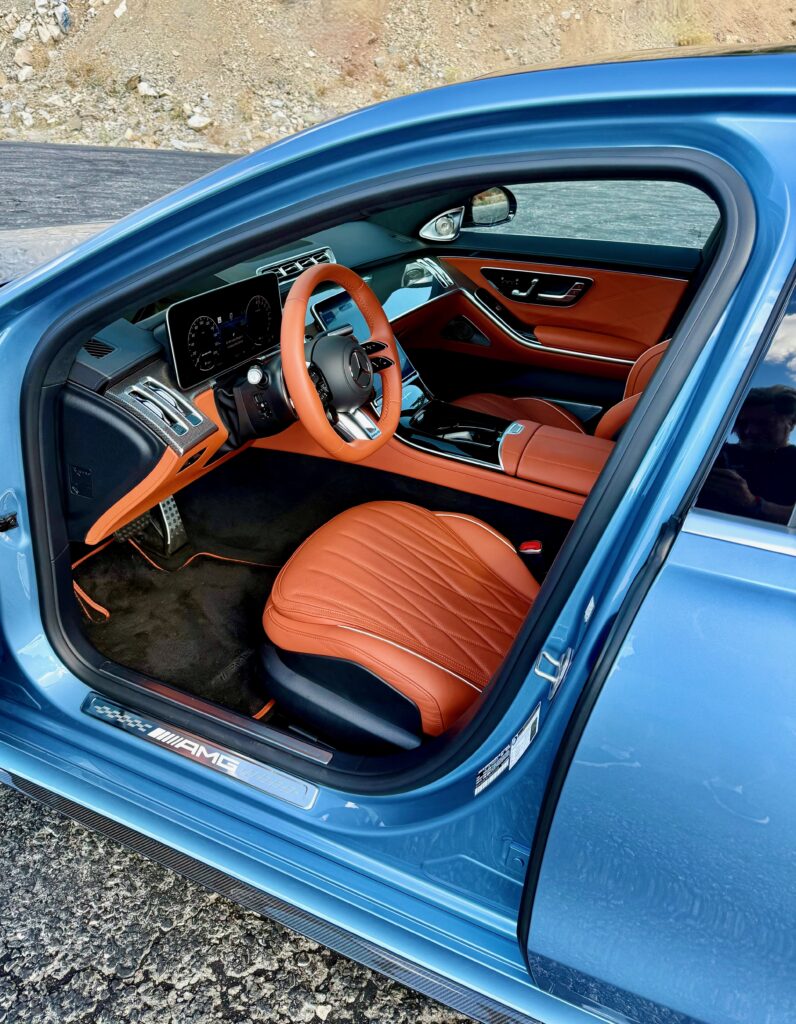
MANUFAKTUR now offers more than 50 colors and numerous interior hides and trim. For the exuberant, several colors are on the wild side: oranges that remind of a desert sunset, a lush shade of yellow, and a neon jungle green that should pop on an AMG GT 63. Most are jewel and earth tones, like the Quartz Blue on this test car.
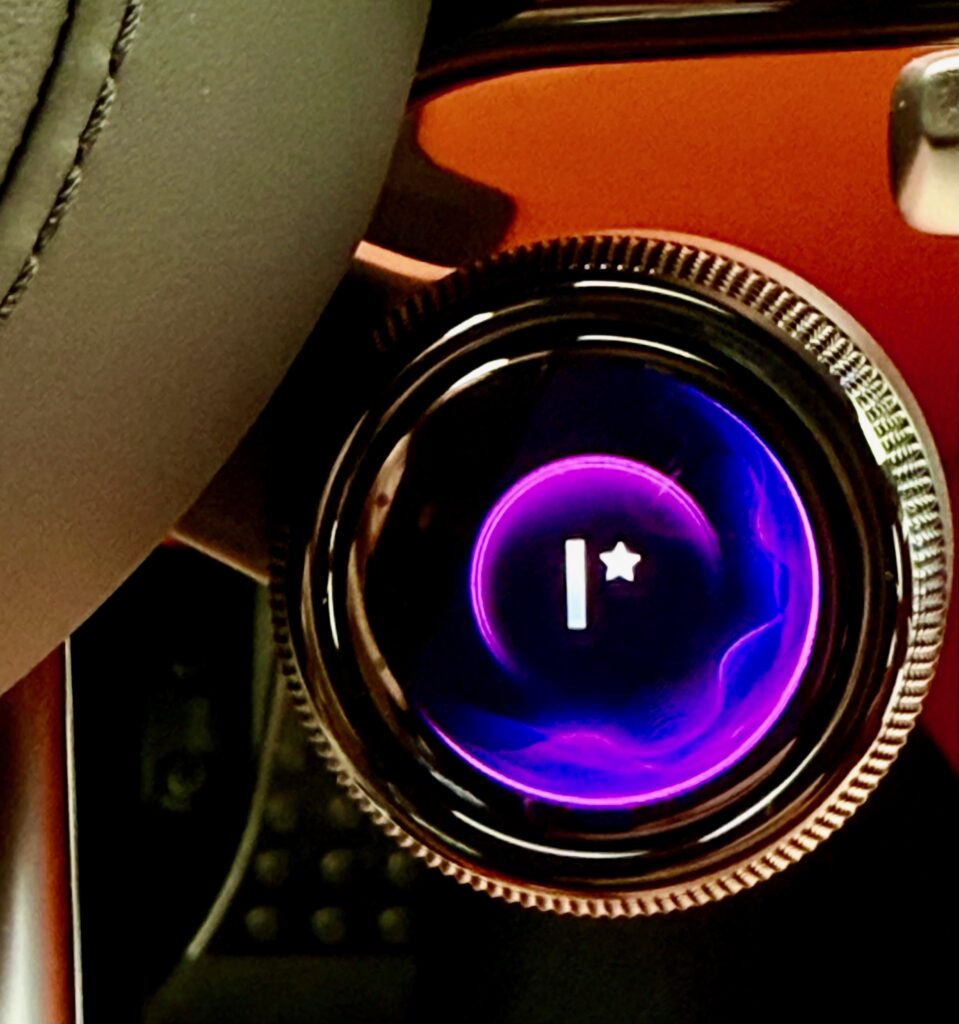
The Mercedes “Dial of Destiny.” Rotate and change calibration settings. For the often harsh roads and highways of Los Angeles, I use the Individual setting with suspension to Comfort and the powertrain to Sport.
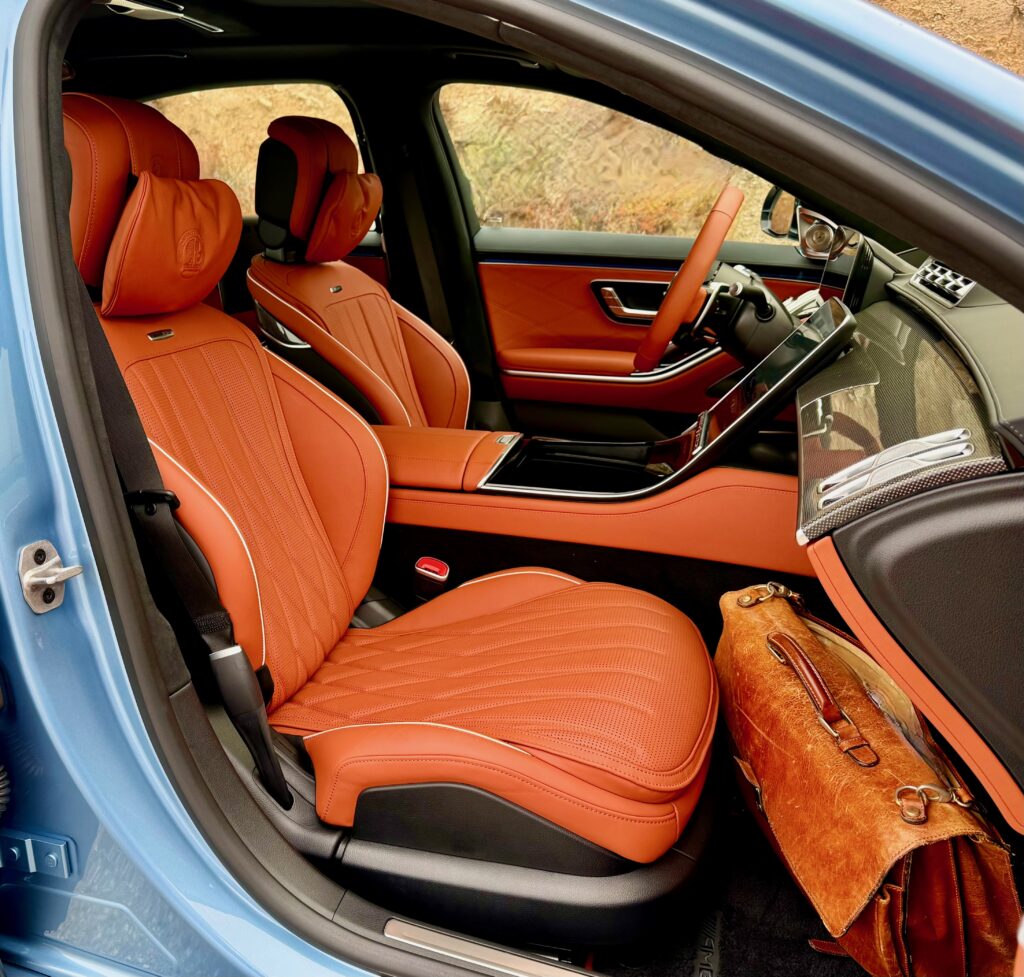
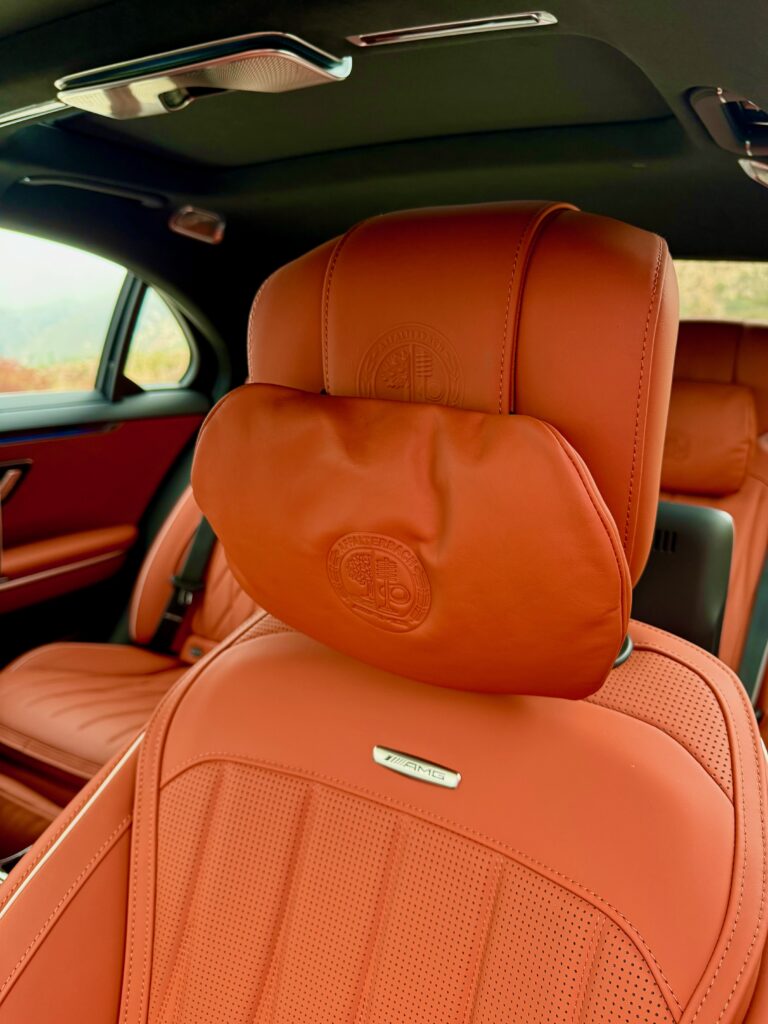
Because the car here was specially built to showcase the talents of the Sindelfingen paint shop and stitchery, it’s the only such S-class currently on the road. Rarely does one see a blue jewel of these dimensions. When I offered folks a peek at the Amaretto leather inside, jaws slackened ever so slightly. Inevitably, hands reached for the buttery soft headrest pillows.
Carbon-fiber befitting an AMG variant. Vents push huge volumes of air, keeping the cabin fresh. The subtle scent of the new MANUFAKTUR leather doesn’t hurt, either.
AMG’s S 63 S E has not been available for too long in the U.S. No matter if you’re whispering along while driving Miss Daisy, shepherding a precocious Eloise to school, or hammering away like the wheelman in that bank heist movie “Heat,” S 63 S E is a supreme performer. Here again, we find becoming, as AMG has been evolved into a full-fledged carmaker, able to develop complex and highly advanced powertrains.
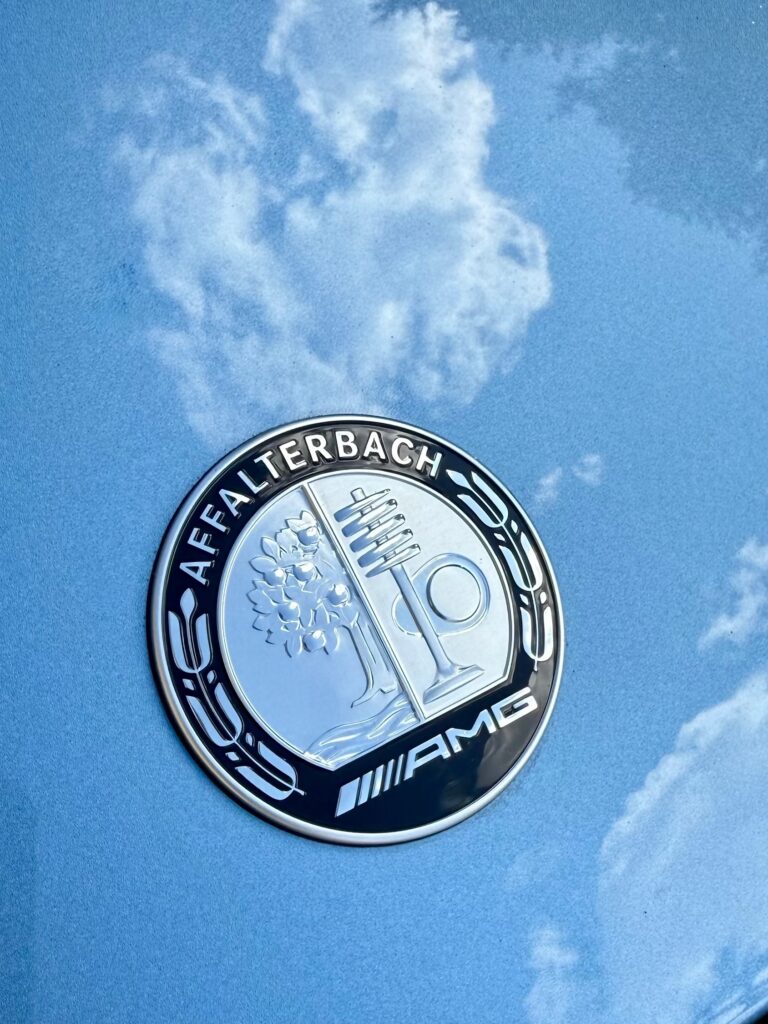
Affalterbach is home to AMG HQ. From here, AMG oversees Formula One and other competition efforts, with engineering and team management resources in Britain. Affalterbach is also home to the famous one-man/one-engine niche assembly line that produces engines for AMG, Mercedes, Maybach, Pagani and Aston-Martin.
Producing 603 horsepower and 664 lb.-ft. of torque, the 4-liter twin-turbo V8 is hand-assembled on the AMG one-man/one-engine niche line. Yes, the builder scribes his name on the engine. And yes, the V8 alone has more than enough power to bring this chassis to life. The one-man/one-engine niche line was an early act of becoming for AMG.
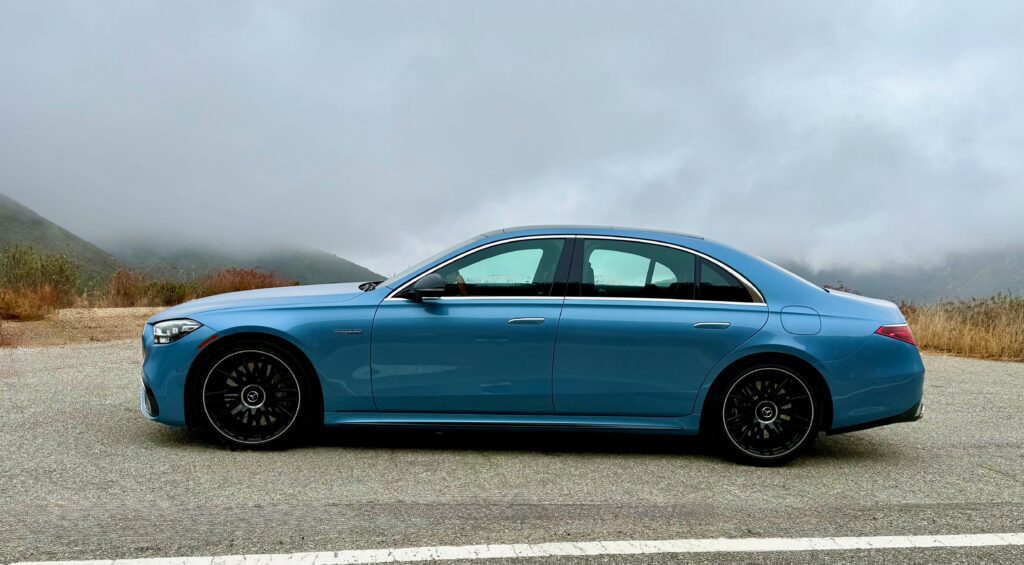
A cloudy, cool day in the mountains. This photos shows the richness of the Quartz Blue paint of MANUFAKTUR. Also the elegant lines. The shoulder line carries from the headlight to the taillight, with the pronounced rocker sill defining the firm belly. Creating a car of this size that has the surface tension and the appearance of a small super-sedan is an accomplishment.
But AMG carries the S-class to brave frontiers, mounting its well-proven 235 lb.-ft. electric motor/battery pack between the rear wheels. Combined gas-electric power is almost beyond comprehension for a sport-limo: 791 horsepower and 1055 lb.-ft. of torque.
This is by far the most powerful S-class ever offered, and that mountain of torque is available over a very wide engine rev range. All that power flows through AMG’s 9-speed transmission and fully variable all-wheel drive.
Suspension set to Comfort, the ride is creamy without any hint of numb sloppiness—that reassuring gentleness only a muscular parent can ever truly deliver. Tar strips on concrete roads or undulations in asphalt reach the cabin as mere timpani strikes, not breaking the sense of serenity, the suspension architecture easily managing the weight and size of those 21-inch wheels.
Around town, S 63 S E is whisper-quiet, easily navigating traffic in spite of its considerable length and heft, a serviceable everyday vehicle that “drives” much smaller than it is. The gauge pod offers a display providing instant readouts of just how much (or little) horsepower and torque is being used. Morning traffic requires little more than a burble.
Thanks to impeccable man-machine relationship, driving S 63 S E like a bank robber is an earthly pleasure. No matter the car’s considerable length, in very short order a driver can understand its dimensions intuitively. One can argue of all the full-scale sedans and vehicles on the U.S. market, this vehicle has the very best man-machine. Honestly, because one sits upright the driver’s relationship to the car is better here than in many 2-seat mid-engine supercars.
Most of the several hundred miles I logged were in Los Angeles suburban traffic. Children in school uniforms jokingly referred to fictional characters of childhood like Eloise at the Plaza Hotel, which led to jokes about being Kevin McCallister of Home Alone fame staying at the Plaza and using limos to reach toy stores. And no, we didn’t risk a cheese pizza in the back seats.
Mercedes-AMG S 63 S E took to sweeping mountain roads beautifully, and a few hours later was serving as a luxury shuttle for children, running through some of the most congested urban traffic in Los Angeles. Most men dream of owning a 2-seat supercar, a GT supercar, but this vehicle delivers most of the same sensations and forms of satisfaction. And the 3.3-second 0-60 mph claim was validated numerous times on these empty mountain roads.
Children were bemused by Executive Plus optional features, fiddling with the sleeper position, whooshing privacy screens up and down, or fiddling with flatscreens. Passenger entry and exit is graceful and glamorous thanks to those huge rear doors, even when hoisting rucksacks and violin cases.
Headrest pillows can adjust for height, and are a blessing on long, boring drives on highways, allowing one to relax and clear the mind.
Suspension set to Comfort, the ride is creamy without any hint of numb sloppiness—that reassuring gentleness only a muscular parent can ever truly deliver. Tar strips on concrete roads or undulations in asphalt reach the cabin as mere timpani strikes, not breaking the sense of serenity, the suspension architecture easily managing the weight and size of those 21-inch wheels.
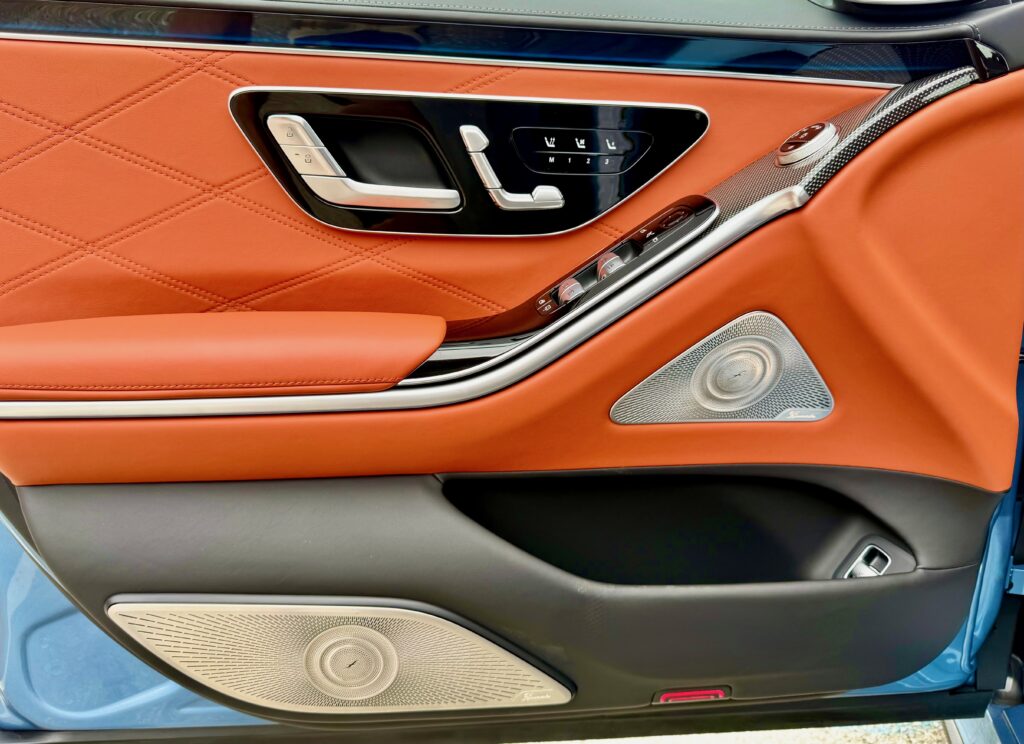
Note the Burmester speaker screens. Also, Mercedes seat adjustment controls are a careful evolution of designs Mercedes has used for decades. They work. The lower seat cushion (the squab) can be adjusted considerably to provide under-thigh support for those of us with long legs. Seats can warm, seats can cool. Materials quality the highest.
But with so much athletic ability so easily applied, driving like a bank robber is irresistible, that call of the wild once the school carline is left behind. AMG S 63 S E doesn’t feel like a mid-size car that’s been stretched beyond its abilities, with brittle, jouncy suspension. Nor is it a wallowing heavyweight that leaves the driver feeling lost in a zero-gravity anechoic chamber. S 63 S E puts the sport in sport-limo. Thanks to impeccable man-machine relationship, driving S 63 S E like a bank robber is an earthly pleasure.
Find a freeway onramp, mash the throttle pedal and the car squats down, electric torque nearly overwhelming traction at the rear. But before your brain can comprehend, the fully variable all-wheel drive shoots “excess” torque and power forward to the front wheels, and one absolutely senses the front tires clawing into the pavement. The long wheelbase is advantageous, ensuring a stable trajectory. AMG’s claim of 0-60 mph in 3.3 was validated, many times.
The S 63 S E swims comfortably through traffic, a joy to drive when set to Comfort for lollygagging, or in the more aggressive settings, hammer down. Best of all was backseat chatter about Eloise and Kevin McCallister at the Plaza Hotel. Children always recognize the fun, the amusing aspects of a car, and S 63 S E entertains, an unprecedented evolution of the ultra-luxury sport-limo species.
“When I hired George McPhee as general manager, he asked me, ‘Will you spend to the cap?’ I told him ‘Bill Foley wants to win, and he’s going to win. There is no budget.’” With that advice, McPhee, a forward for the New York Rangers and New Jersey Devils in the 1980s, went to the National Hockey League’s expansion draft in June, and added solid players to the free agents he had already picked up. In three years of negotiations and development, Foley has brought Las Vegas its first top-tier professional sports team, the Vegas Golden Knights.
“I knew nothing about how to do a ticket drive,” says Foley. “We fumbled around with it, and at the end of about 60 days we had 11,000 deposits for season tickets for a team that did not exist to play in an arena that had not been built. The arena was not finished until April of ’16. We have sold 13,500 of the 17,000 seats. We sold all the suites—we held back two suites to bring in guests. All the opera boxes on the third floor are nearly gone. Game day ticket sales are the most important thing in the NHL because everyone wants to see a game live.
“We are number five, six or seven in terms of ticket revenue in the league. That’s how good Las Vegas has been to us,” says Foley as we sit on a veranda at his Chalk Hill winery in Napa Valley. “Edmonton has more revenue in their brand-new arena. The Rangers, Toronto, Chicago Black Hawks, they’re all ahead of us. Montreal is right with us. We have more revenue than the Flyers, Penguins, the Boston Bruins. Most of our tickets are multi-year. The lower bowl is three to ten years.”
Hockey in Vegas is not as improbable as it might seem. Vegas had a minor-league hockey team, the Wranglers of the ECHL (East Coast Hockey League), playing in the Orleans Arena from 2003-14. With a strong local following, the Wranglers proved Vegas loves hockey.
“Once I got to understand Vegas, that it has 2.2 million residents and a lot of them work on the Strip but a lot of them are lawyers, dentists, teachers, fire fighters—they’re just common people. Vegas had a tough time in ’08, ’09, ‘10, but now housing prices are coming back. You don’t have people flipping houses. People are buying and living in a house. And there’s big construction again.
“We did a market study for Las Vegas and determined that we had about 200,000 avid hockey fans, people from Minnesota or Canada, the northeast. People trying to get to a nice climate. We went to the high end and our average ticket price is about $88. The league average is down in the $70s. Financially, we will be strong,” Foley contends.
Foley tasked general manager McPhee to build a winning team, with a target of making the playoffs within three seasons. In this, Foley follows the pattern of Wayne Huizenga, who built the Florida Marlins into a World Series championship team in just five seasons, in great part by paying top dollar for free agents.
“I’m a 15 percent owner of the stadium. Privately financed. Loans from B of A. About 60 percent loan and 40 percent equity. My partners are MGM Mirage and AEG [Anschutz Entertainment Group]. AEG handles selling the suites. MGM manages the arena. We’re a tenant. But we are also minority owners. I am a 70 percent owner of the team. Dictatorship…benevolent. I don’t have a board of directors. I am the only member of the board.” His partners in team ownership are the Maloof brothers, who until 2013 owned the Sacramento Kings.
“We did a terrific TV deal with ATT Sports Net for Root Sports throughout the Rockies. Not just Las Vegas. My TV territory is Idaho, Wyoming, Montana, Utah, the state of Nevada, eastern California, eastern southern California, and northwestern Arizona.” The Golden Knights have supplanted the Colorado Avalanche in these TV markets.
“When I was approached with the idea, I was told you might be able to get involved in St Louis, you might be able to get involved here. I said ‘No.’ It must be a place where I want to live and put my roots down. I played hockey as a kid in Canada—I loved hockey. It is the most affordable of all major-league franchises. It’s not reasonable, but more reasonable than football. And it’s an up-and-coming sport. Plus, I love the hockey players. They’re such good citizens. They really are good guys.
Foley grew up on military bases, and spent summers on his mother’s family ranch near Amarillo. After graduating West Point in the late 1960s—he earned $40,000 in profits trading equities while a cadet—Foley opted for an Air Force commission. The Air Force recognized Foley’s special talent was not at the tiller of an airplane, but applying a critical eye to Boeing contracts. By his mid 20s living in the Seattle area, Foley had power to approve contracts up to $250 million. After the Air Force, Foley earned a JJD at University of Washington law school, and joined a small Arizona firm. His main client was Fidelity National Financial, a small commercial and residential title insurance underwriting firm he decided to take over. Through acquisitions, he transformed Fidelity into a $7 billion giant. In 2016, his final year as Fidelity’s chairman, Foley received compensation just over $100 million. The executives of Fidelity and Foley’s related data firm, Black Knight Financial, are supported with his own private air force, a fleet of no less than seven Gulfstreams.
Owning a professional sports team might seem like a boy’s dream fulfilled, and Foley did play hockey for a few years as a child, but that is a minor component. With FNF and Black Knight humming along, Foley is focused on not just the Golden Knights, but his burgeoning wine-making empire, and ownership of productive vineyards. “I got in the wine business in the late ‘90s, but I really got serious about it when I knew we would be moving back west to Montana and California.
“The recession hit and I bought properties that were a little distressed and there was a value proposition. I was convinced that by the time we got to 2012 or ’13 we would be in hyper-inflation. Didn’t happen. But I ended up buying a lot of properties from people who got over-extended, then over-levered. I would come in, do about 25 percent leverage and 75 percent equity so there would never be an issue about valuations.” Foley’s venture into winemaking and ownership of prime vineyards has proved prescient. “Since that time, these properties have gone through the roof, they’ve really gotten valuable. Cabernet land in Alexander Valley…I was buying it for $50,000 an acre three years ago. Today it’s $150,000 an acre.”
“If you don’t own your supply chain, don’t own your vineyard, you’re a virtual winery, you’re buying grapes, suddenly you’re not paying $1700 a ton, you’re paying $3400 to $3500 a ton. You can’t sell a bottle of wine for 12 bucks. You gotta sell for 18, 20, 22 bucks and probably not make money even then. I feel fortunate that we acquired 3000 acres of vineyards over the past eight years or so. We supply about 80 percent of our grapes, our own grown fruit, and about 20 percent is purchased and that’s more the lower priced programs.”
“At 3000 acres in vineyard property we are in the top seven or eight. Expensive to buy in now. I am still buying vineyards. I have two vineyards under contract, one a chardonnay vineyard, the other a cabernet vineyard. I need that assured supply. But in terms of wineries, if it’s not a high-end winery with a good name that’s got brand identity, I’m not interested. I’m not going to rebuild any more wineries. I’ve done enough of that. I might pay a little more for marquee properties. I will probably improve the wine-making if it’s possible. Maybe it’s perfect. Probably improve the grape growing with the farmers I have working for me. Get a little more production, but make sure it’s high quality.”
Foley’s business philosophy is pure Deming, learned the hard-nosed way, always refining the process, digging out root cause of flaws. “I always want things better than they were. I can be a little anal about it. When I’m in a conference room, if the chairs are not all behind the table properly, I rearrange them. When we leave here I will put these chairs up so they look proper.” When we are called to lunch, Foley straightened his chair and seemed appreciative that I sorted my own, and helped with a few others. If Foley’s rampant success in winemaking is any indication, the Vegas Golden Knights will be in the playoffs in three years, looking to claim the Stanley Cup.
Big engine placed in a small car is the formule ancienne for scintillating performance, standing the test of time for those who believe that too much is just barely enough. Mercedes-AMG’s SL 63 S E with gas-electric powertrain carries this concept beyond the 20th Century’s primitive lust for power.
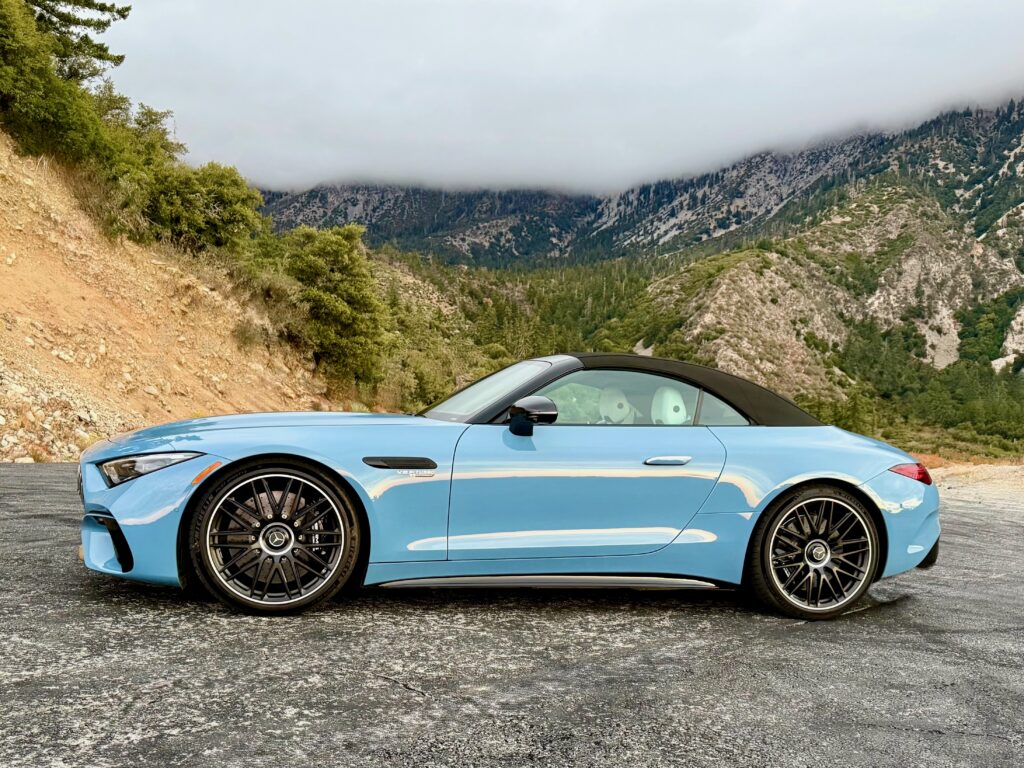
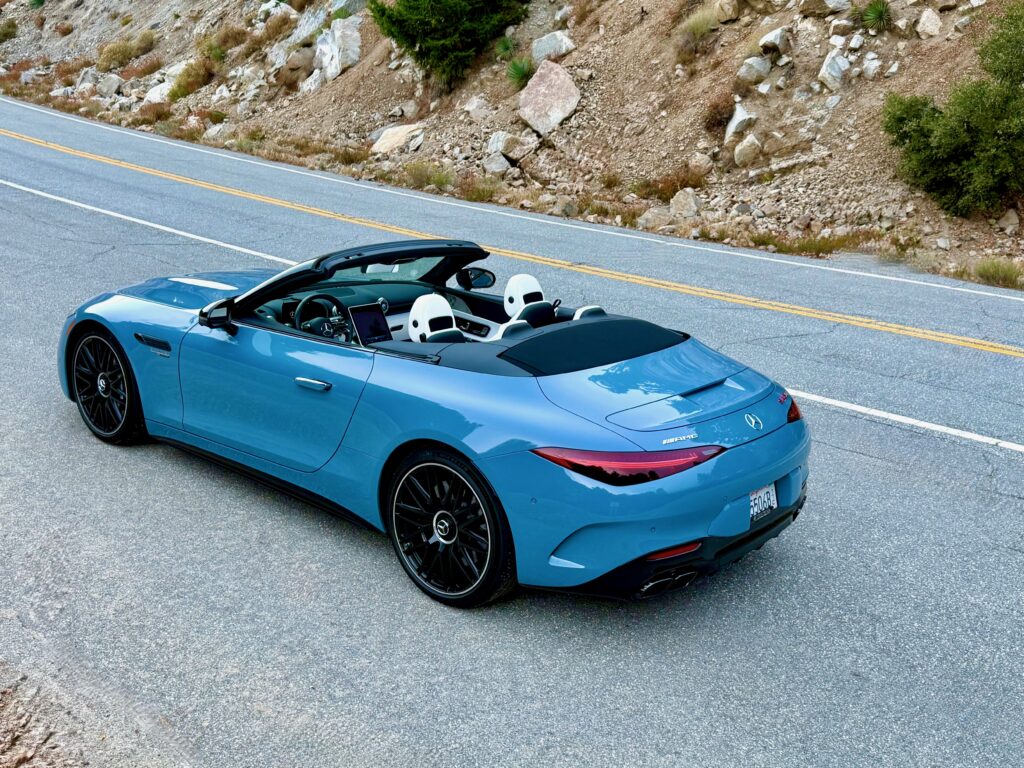
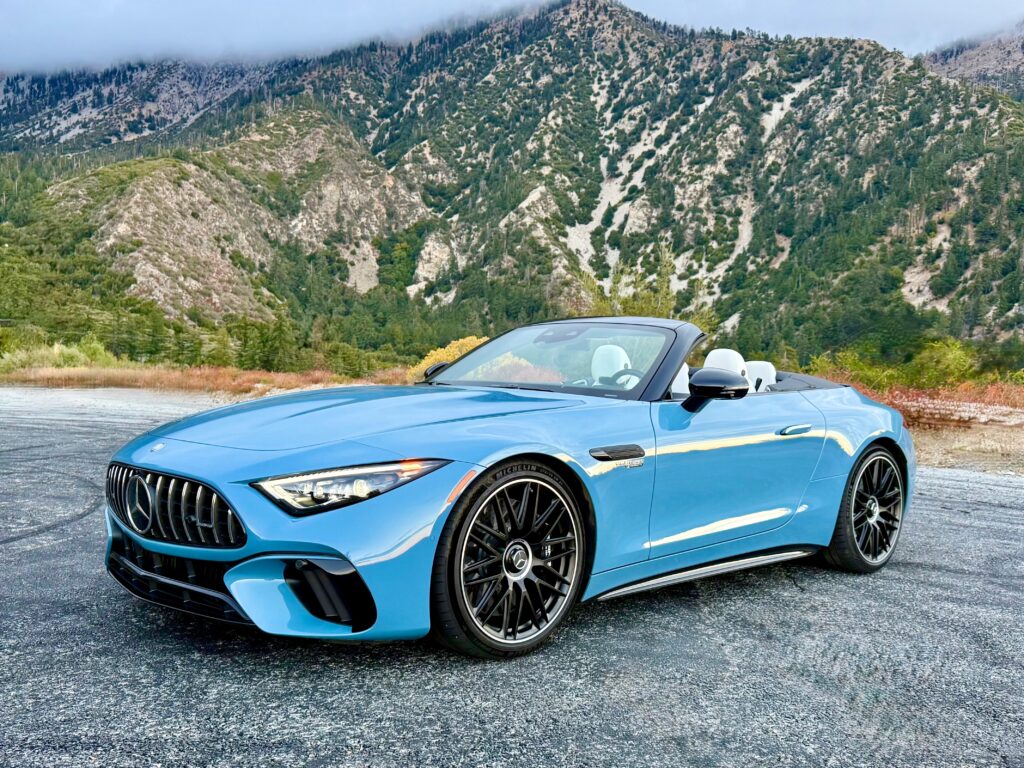
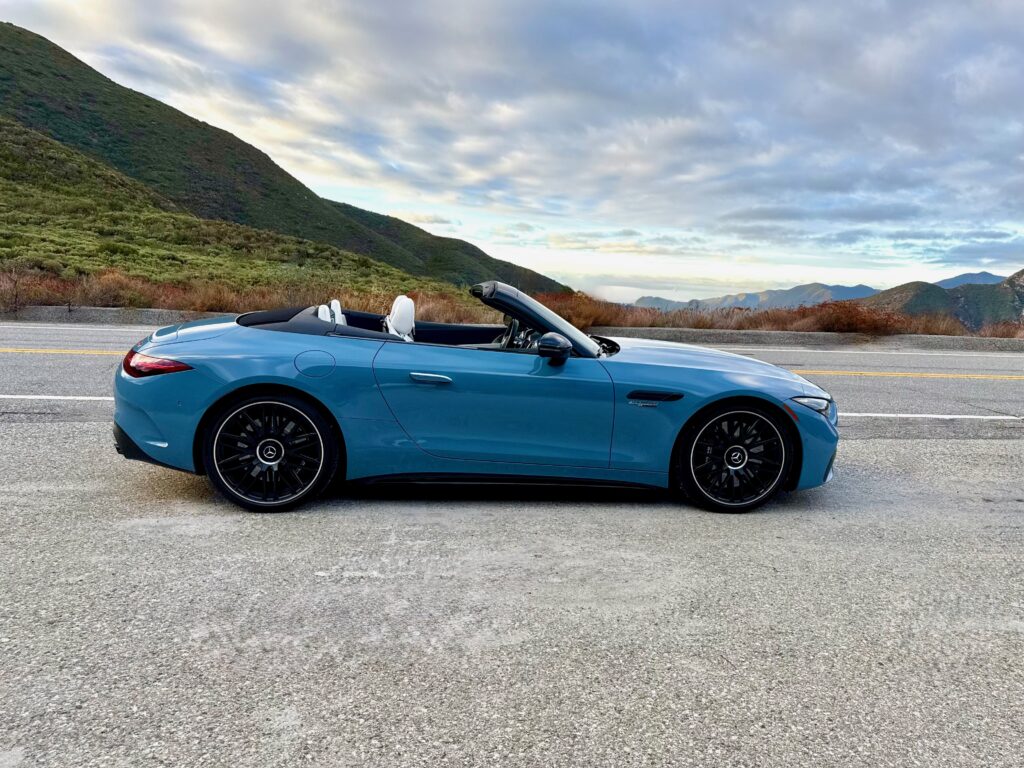
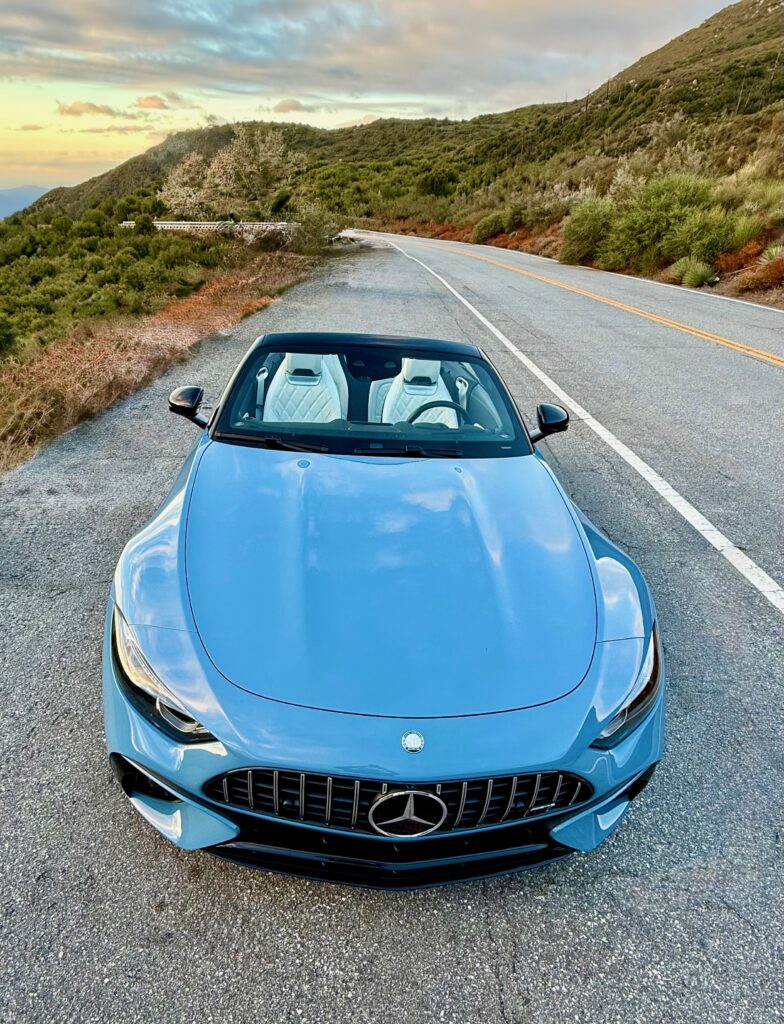
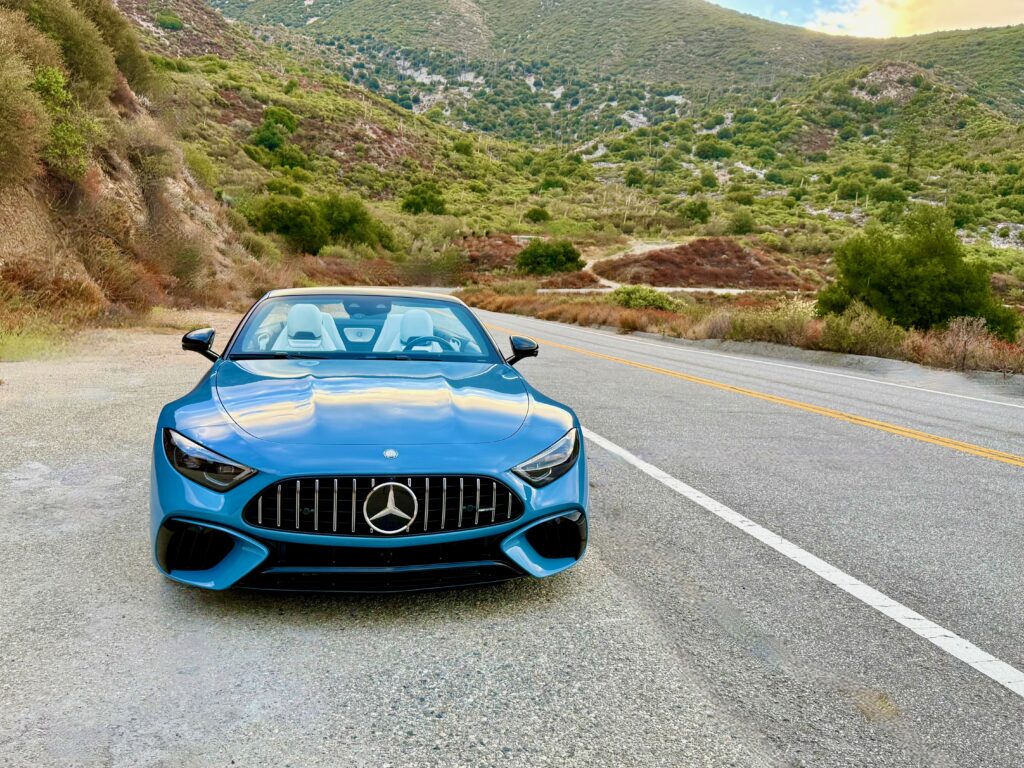
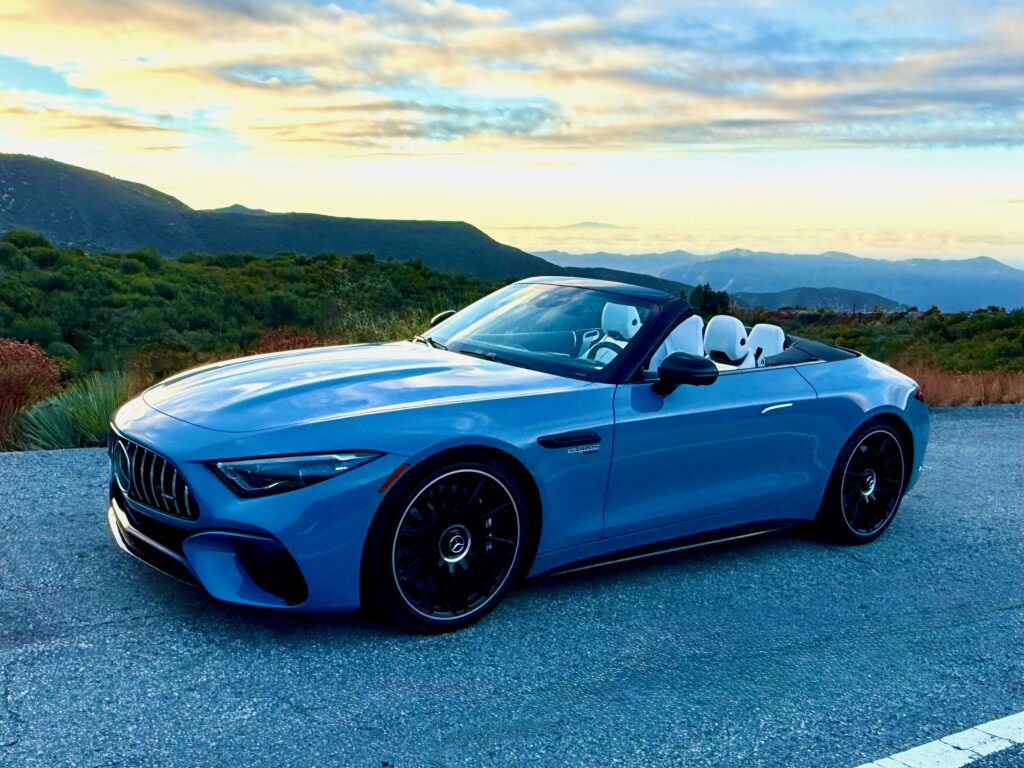
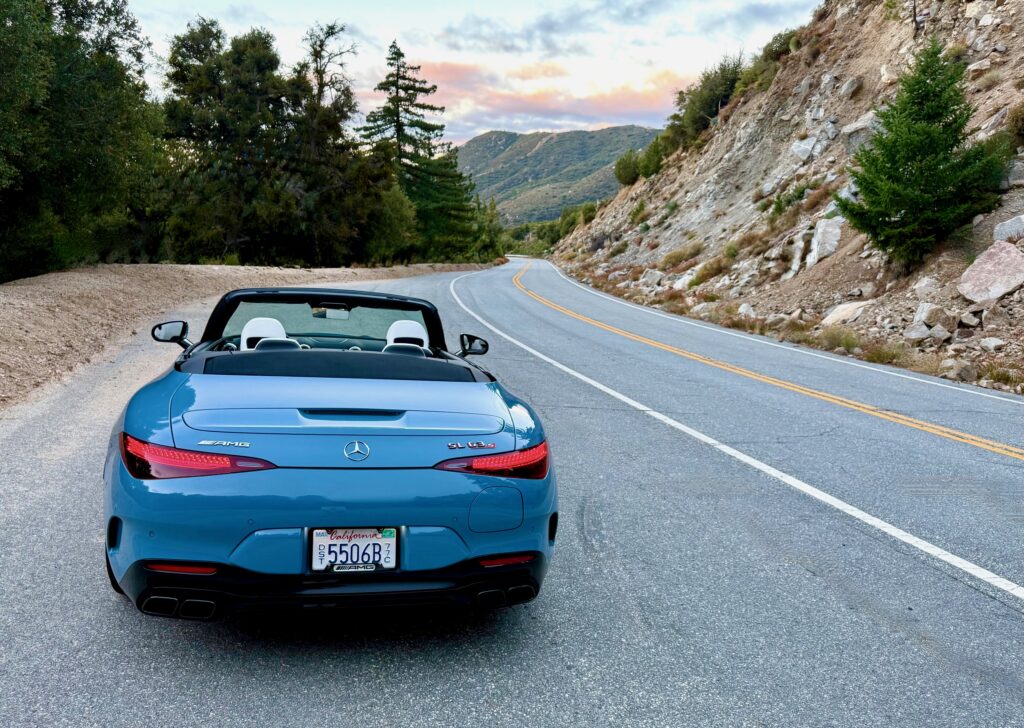
Moody dawn light on the western slopes of a mountain. Test car wore MANUFAKTUR China Blue paint, sprayed at the niche paint facility in Sindelfingen. China Blue has depth, shifting with ambient light. Many German and French sports cars from the 1920s to the 1950s wore a color very similar.
Arriving in the U.S. market in limited numbers, SL 63 S E is the highest evolution to date of AMG’s Gentleman’s Sport-Tourer, packing a combined gas-electric horsepower rating of 805, and 1047 lb.-ft. of torque over a broad range of engine revs, delivering a sense of fathomless power.
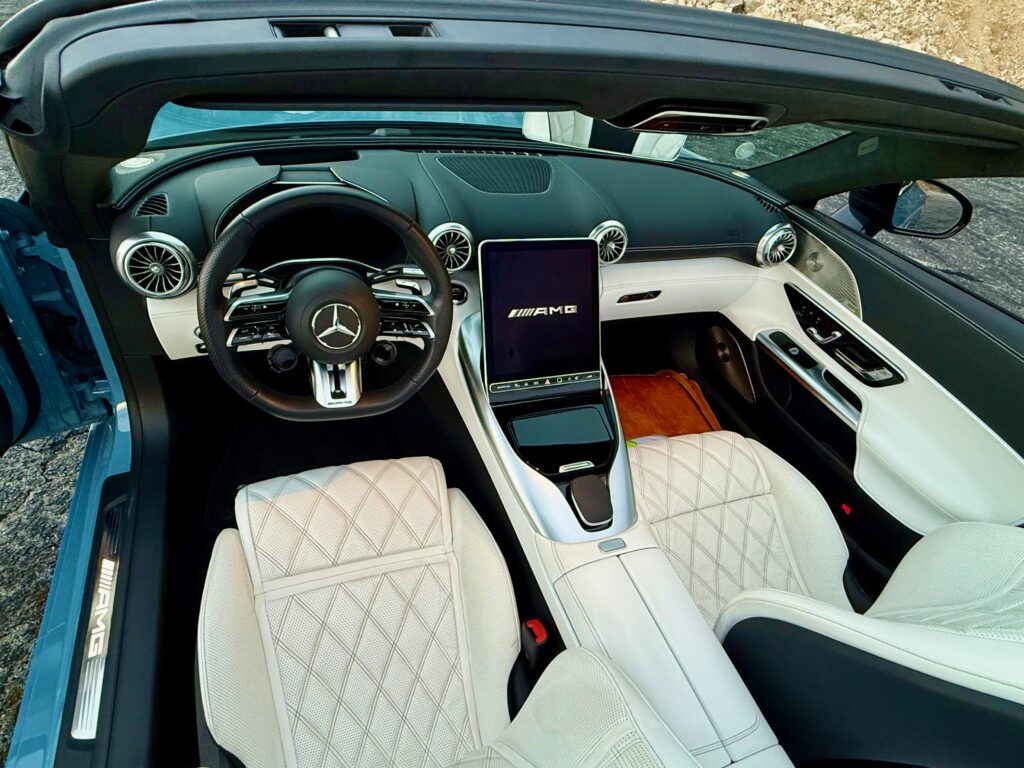
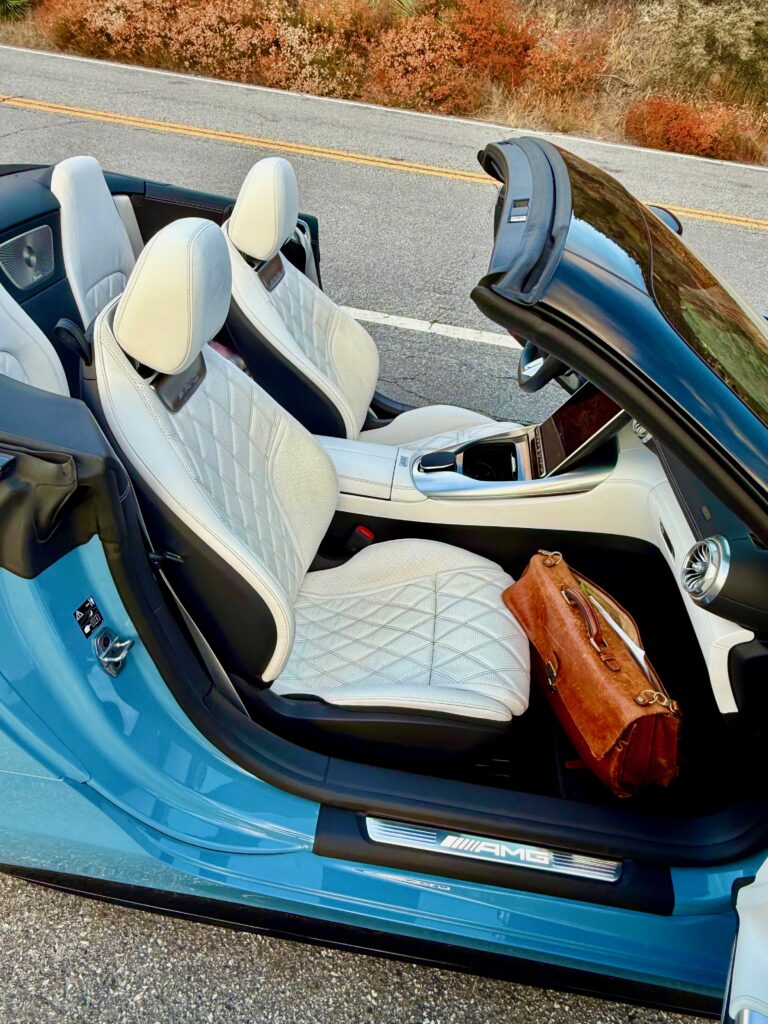
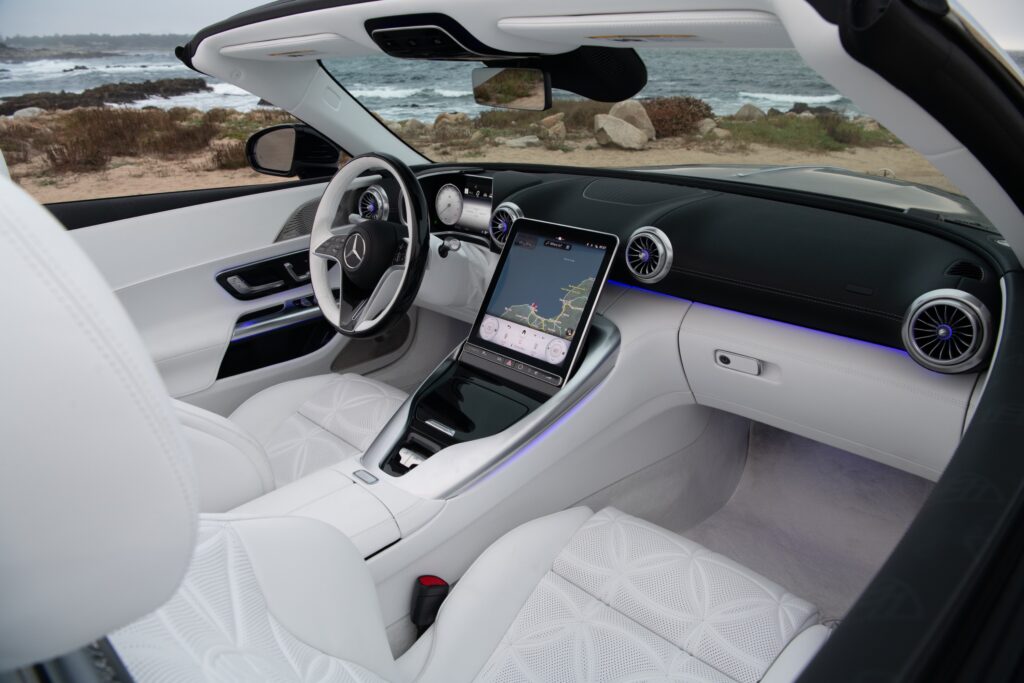
Steering wheel has a thick padded rim, and column offers considerable adjustment. Controls on wheel, center console, touch panels and the like are all from the Mercedes parts system, and thus proven with millions of miles in customer hands. They are all logical, easily understood, and grow more appreciated as miles are racked up.
Working seamlessly through a 9-speed gearbox and fully variable all-wheel drive system, SL 63 S E delivers supercar performance, unequivocally and without doubt. Yet retains the civility and refinement one expects of a Mercedes, a combination of power and glory unparalleled in the market today.
Mercedes-AMG has placed its “P3” gas-electric hybrid system into the SL with a V8 up front and a combined electric motor/gearbox/battery placed on the rear axle line. A total of 805 horsepower and combined 1047 lb.-ft. of torque over a wide rev range.
Set to Comfort, SL 63 S E happily toddles down boulevards to beautiful destinations, twin-turbo V8 murmuring subtly, sculpted seats and suspension cossetting, Airscarf ducts gently spilling warm air around shoulders and neck when driving top-down. Your own private view of heaven.
Top can be raised or lowered long before that left-turn arrow turns green. SL 63 S E is a high-performance supercar, but it never forgets that it’s a Mercedes. Here, at a mountaintop location to great the dawn on a gloomy morning.
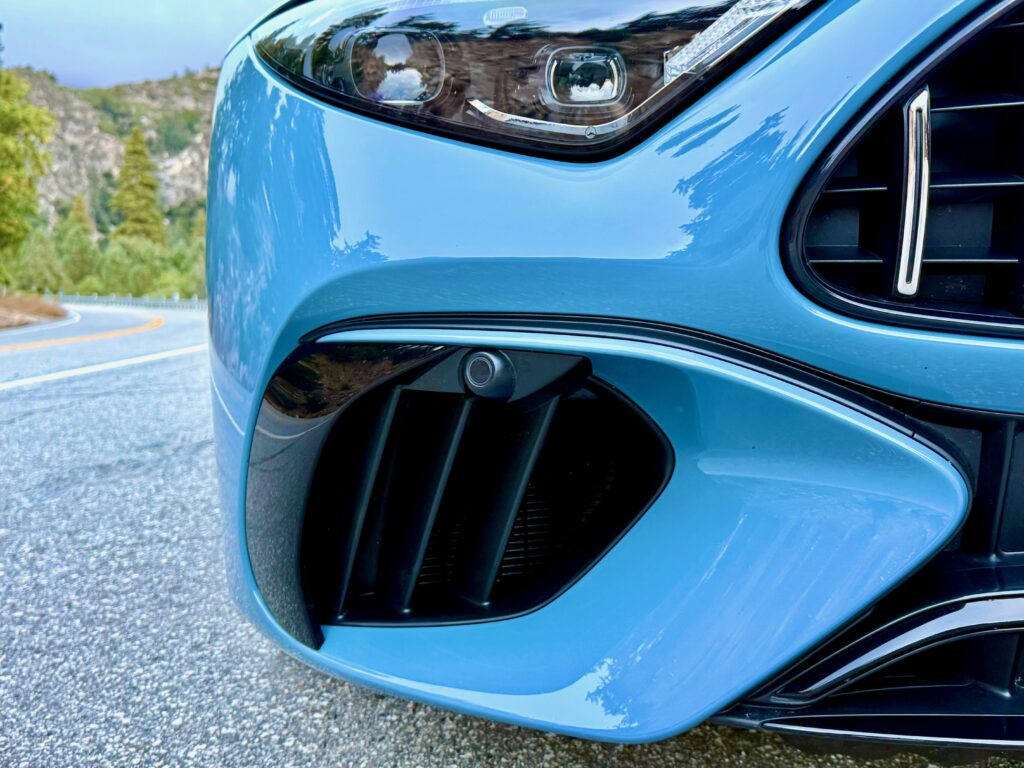
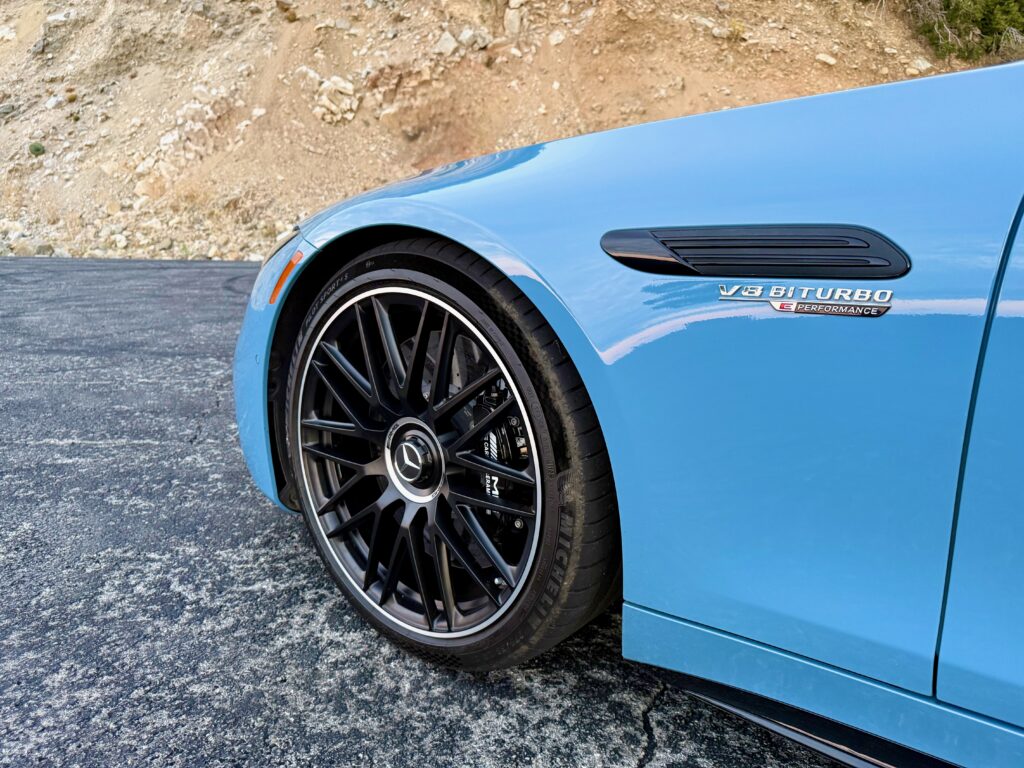
Outward indications of the monstrous power of the V8 and electric motor are the big footprint of the forged wheels and tires, and discreet badging on both flanks and on the rear bodywork near the pop-up active spoiler. And the cover panel for the battery’s recharging plug, placed on the right rear bumper cover, is another indication that something clever is afoot.
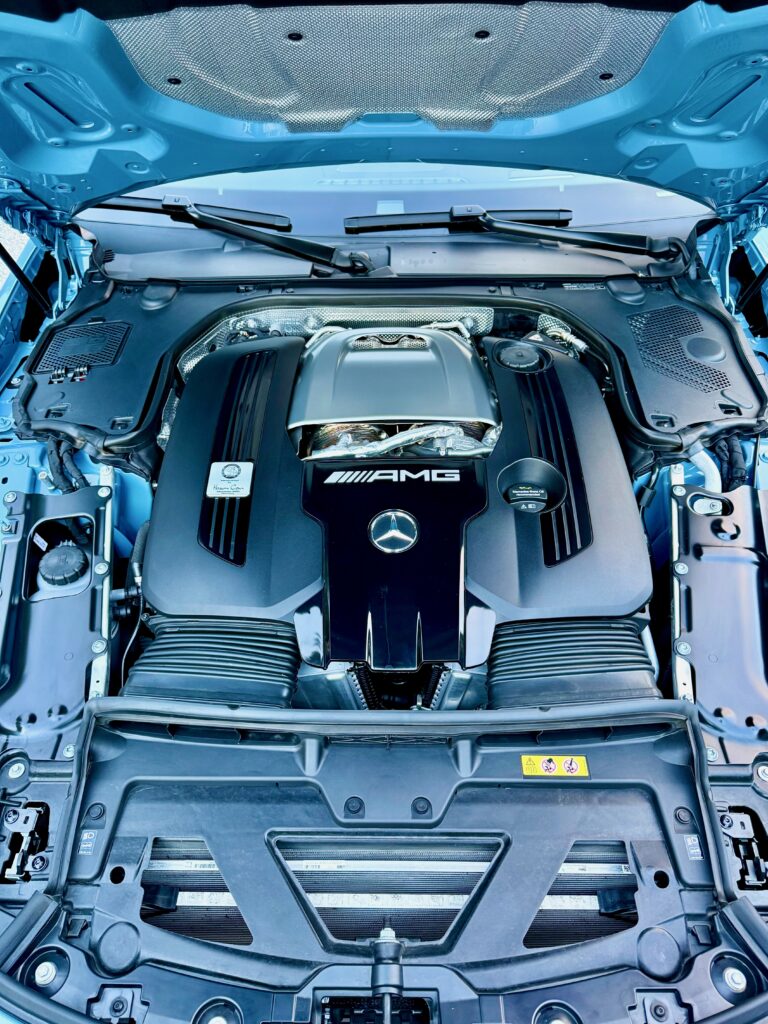
AMG’s family 4-liter twin-turbo V8, built on the one-man/one-engine niche assembly line in Affalterbach, the home of AMG. In the upper ranges, 5500-6500 rpm, the engine delivers 603 horsepower. But more important for the otherworldly acceleration is maximum torque of 627 lb.-ft. available from 2500 to 5000 rpm. Add to that the 236 lb.-ft. of instant-on electric torque and you have remarkable acceleration. Other than a tiny handful of EV hypercars and even fewer all-out pure sports cars, not much on U.S. soil is quicker. And none of those options will deliver the savoir faire, the fine suit of clothes, the impeccable manners and the exceptional comfort of the SL 63 S E.
Only the astute lover of performance cars will recognize these outward manifestations of the beast within. Unsuspecting passersby or drivers in boulevard traffic will assume it’s a gorgeous German convertible for people of refined taste, but not a ferocious hunter.
Every builder on the one-man/one-engine niche engine line scribes his name to a plaque that is placed atop the engine’s upper intake shroud. Well done, Hasan. Well done. AMG is based in Affalterbach, Germany. AMG integrates high-performance engine development, Mercedes-AMG racing activities in Formula One and elsewhere, and is now developing road cars clean sheet. The SL is the first car AMG developed entirely from scratch, making use of proven Mercedes subsystems.
Twist the AMG Dial of Destiny placed on the underside of the steering wheel’s right-hand spar to Sport, Sport+ or Track Pace if you’re feeling particularly aggressive, and this Gentleman’s Sport-Tourer becomes an automotive equivalent of Gentleman Jim Corbett, a crafty bare-knuckle boxer who was known for his good looks and sartorial splendor out of the ring.
Mercedes-AMG “hides” all the aerodynamic trickery. But it’s there, with an active panel under the chin that guides airflow along the belly pan back to the diffuser under the rear bumper. And the rear spoiler has five distinctly different positions depending on speed. SL may have the basic form of a stone smoothed and rounded on a river bed, but the air is mastered and controlled.
In Sport +, SL 63 S E is capable of shaming all but the most outrageously cartoonish mid-engine supercars. One astute observer pulled up on my gunwales in traffic, the big V8 of his meticulously built 1960s muscle car rumbling. He gave me the look and I gave him a show. When he caught up at the next stoplight, his eyes were bigger than fish bowls. Yes, SL 63 S E can smoke just about any other car.
My SL 63 S E test car passed through the Mercedes-Benz MANUFAKTUR Studio for special paint and leather. For a car built in such limited numbers, why not order a paint and leather that express your own tastes, but are also classically handsome? Here, the sample book of leather. Just like picking fabrics for your suits.
Press skull into the headrest, flatten the throttle, sidestep the brake and SL will leap with ferocity, reaching 60 mph in a couple of ticks under 3 seconds. That sort of acceleration tunes up the 30 or so muscles of the neck to sharpen that jawline and works the abdominals like a session of planks.
The rush out of the blocks doesn’t lessen at the established measurable of 60 mph but continues unabated till that graceful hood is piercing the air at speeds law enforcement would prefer I not mention. Once you lift off, and lungs have a few milliseconds to begin recovery, give a war whoop. Accessing the biological cleansing power of adrenaline once or twice a day will keep the mind clear.
AMG has produced a complete automobile, not just a straight-line hot rod. The first car completely engineered top to bottom by the boys at AMG, SL has sophisticated 5-arm suspension front and rear. For the sake of cornering precision and weight, SL 63 S E has metal springing, not a Mercedes airbag system. Highly adjustable dampers (shock absorbers) provide a palpable, distinct change in character depending on selected calibration.
Brakes are carbon-ceramic, as required for a vehicle with this sort of power and capability. Wheels are 21-inch forged wrapped with Michelin Pilot Sport 4 S measuring 275/35ZR at the front, and 305/30ZR at the rear.
Also, this is not a cartoon of a car, requiring a Fosbury Flop over a high and wide doorsill to land in a laydown seat, like mid-engine exotics often do. SL is German, built around a driver sitting upright, with clear field of vision forward, side and to the rear, especially with the top down, obviously. Long-distance touring in comfort is readily achieved. No sore tailbone, no aches in the lower back, no buzzing in the head from an engine placed behind the cockpit. In a front engine sporting vehicle, the engine is a musical instrument that never punishes.
On a mountain road in Sport or perhaps the more daring Sport+–the safety net of electronic stability control is much less in Sport+, so watch yourself–SL spears into corners with style, balanced, allowing strong application of power on the way out. Thankfully, both the transmission tunnel and the door panel offer excellent spots to brace the knees during hard cornering. Here the variable all-wheel drive system pays dividends, front tires clawing the pavement. SL 63 S E achieves that goal of all the best performance cars: it makes you look far more skilled than you really are.
The Dial of Destiny can also call up calibration for icy weather, and an EV mode of sorts, which is included for the U.S. as a novelty, but is needed in the EU and UK for covering the last few miles to a “Green” city center under battery propulsion. I confess I only used it for a few moments. Why use it when there’s a magnificent V8 on tap? Come on, we’re in America.
Mercedes-AMG “P3” gas-electric hybrid system combines a 4-liter twin-turbo V8 up front with an electric motor/gearbox/battery on the rear axle line. Both power units feed into a fully variable all-wheel drive system. AMG places this powertrain in both the S 63 S E and the AMG GT 63 S E. The electric motor package is also used in the C-class C63, teamed with the world’s most potent 4-cylinder engine. In SL, a total of 805 horsepower and combined 1047 lb.-ft. of torque over a wide rev range.My SL 63 S E test car passed through the Mercedes-Benz MANUFAKTUR Studio for special paint and leather. For a car built in such limited numbers, why not order a paint and leather that express your own tastes, but are also classically handsome? Here, the sample book of leather. Just like picking fabrics for your suits. MANUFAKTUR Studio stitched up the interior of my test car, in Crystal White. Broad stitching tables with industrial sewing machines manage seats and door panels. Steering wheel rimss are mounted on a special brace and stitched up by hand.Rosy fingered dawn. AMG states 0-60 mph sprint of 2.8 seconds, and my repeated runs (feeling the rush is irresistible) left me with no doubt that SL 63 S E can do the business. And all while looking like a well-dressed gentleman, not an over-styled angles-and-elbows mid-engine supercar.
Unlike some recent hybrid supercars, SL 63 S E’s V8 delivers a rich symphonic performance. One does not think about the electric motor or its 2-speed gearbox, though one does sense it off-throttle heading to a stop sign. Instead, the power and the glory of the V8 sings at mid to high revs, with a rich baritone exhaust note. The car leaves no doubt where the vast majority of those 805 horsepower come from. The exhaust can turn any tunnel or sheer mountain cliff into a reverberation chamber, with sounds to stir the soul.
My SL 63 S E test car passed through the Mercedes-Benz MANUFAKTUR Studio for special paint and leather. For a car built in such limited numbers, why not order a paint and leather that express your own tastes, but are also classically handsome
MANUFAKTUR Studio offers over 50 colors, like the China Blue on my test car. Spend a few days around Stuttgart, enjoy the spaetzle and beer, visit Schloss Solitude and put in a few laps around the old Solitudering road course of Leonberg, and enjoy the process of commissioning a car that in one measure or another will likely be unique to you.
The photos here were all shot within perhaps 40 minutes of dawn’s early light glowing on the west-facing side of a mountain range, a rosy-fingered dawn, yet you can see the playfulness and richness of the color.
The road home. The outline of the active rear spoiler can be made out here. Also the right rear cover panel for the battery charger. But set the car to Track Pace and drive normally for 20 minutes and a drained battery will be almost fully recharged. Follow this advice and one does not really need to plug in to recharge.
AMG has brought a thoroughly sorted variation of the performance formula of the ancients, with an ultra-high-performance hybrid. Big engine, big electric motor with 2-speed gearbox, fully variable all-wheel drive, lots of computers to ensure efficient delivery of power to the ground, and all tidily placed inside an impeccable body structure with equally impeccable suspension architecture. And that is the story of the today’s ultimate evolution of the Mercedes-AMG SL, the Gentleman’s Sport-Tourer for those who think too much is just barely enough.
Maybach has delivered one of the finest roadsters on earth for a romantic moonlight drive. Room for two, a supple ride, a gorgeous view over a curved hood, perfect flow of air up and over the windshield and cockpit with virtually no backsplash to disrupt pleasant conversation, and the ability at any time to experience a rush of power and speed when the moment calls. Sounds of the deep, burbly bass-baritone exhaust dancing atop the engine’s upper intake sounds in the treble clef—utterly magnificent.
Wheel is massive. All secondary and tertiary controls are proven components straight from the Mercedes parts system, and thus have millions upon millions of miles logged “in the wild” with real customers. With the steering column at full extension and seatback up against the parcel shelf, my elbows were not locked, but I could lock them very easily. I wear a 36 sleeve.
As the most luxurious evolution of AMG’s SL 63, Maybach SL 680 proves the truth of that old song: every girl’s crazy ‘bout a sharp-dressed man. Wherever this car travels, people double-take and triple-take. The SL is the world’s best Gentleman’s Sport-Tourer. Maybach brings muchness, meaning much more luxury.
Flatscreens allow car companies to tailor presentation using talented graphic designers. Maybach SL has the same pair of flat screens found in the AMG SL, but with unique graphics. Note the rose gold rims of the analog-style gauges.
At stoplights on the grand boulevards of Los Angeles I had people rolling down windows to engage in conversation, to lean out to better gape at the white leather and carpet of the open cockpit.
My well traveled satchel in the passenger footwell, in my garden. A week with this car. I did not use it for school carline as I did not want a wheeled backpack landing on the fine leather of the cargo deck behind the seats. Scuffing that would have been an offense to the Gods of Luxury Living.
Maybach SL sneaks up mentally on people because it’s not obvious, like a mid-engine hypercar wedge. It’s subtle, until the onlookers process, and then the double-takes begin. Wherever you go, you own the scene. Maybach SL was born for Sunset Boulevard.
Top controls. The multi-layered top rises and falls quickly, a sequenced dance. If only this had arrived during a week with a little winter rain. Nothing better than putting down the top and driving beautiful roads just after the rain stops.
Inside, the rear jump seats are removed, replaced with a leather-lined parcel shelf. No gain in legroom, but SL offers ample shoulder, leg and foot room for men seven or eight inches beyond the U.S. median height.
Grille surround illuminates, as does the Maybach lettering. Headlights have rose gold accents.
Maybach SL has the same pair of flatscreens and touchscreen logic found in the AMG SL, but with unique graphics. Note the rose gold surrounds of the analog-style gauges.
Inside, the rear jump seats are removed, replaced with a leather-lined parcel shelf. No gain in legroom, but SL offers ample shoulder, leg and foot room for men seven or eight inches beyond the U.S. median height.
The multi-layered top performs its sequenced in less than the time spent awaiting a left-turn arrow.
Calibrations are Maybach, Comfort, Sport and Individual. Note that there is no Sport+, which means there is no super-aggressive Launch Control software. But after performing multiple standing-start launches in Sport, spearing through mountain meadows, rest assured that only hardcore Sports and GT cars will outpace SL 680.
If only this car had arrived a few months later during one of our brief bouts of winter rain. Nothing better than putting down the top and driving beautiful roads just after the rain stops and the air is powerfully charged by the nearby ocean, scrubbed clean. Anyone in California or Miami will understand.
Maybach’s steering wheel is massively proportioned, a big hoop, reminding of wheels in my 1940s, ‘50s and ‘60s luxury cars. But Maybach SL has well sorted Mercedes controls on the left and right spars allowing thumb-press and finger-tip control of a range of functions just like in any Mercedes. Just German reason and logic.
But Karl Maybach’s greatest contribution to the wonders of European civilization were his enormously powerful diesel engines that gave birth to the very first high-speed trains of Europe, emphatically putting steam trains out of business. His designs were built under license by Bristol for use in British passenger trains, too.
The 4-liter twin-turbo V8 is the same as the AMG SL 63’s, built on AMG’s one-man/one-engine niche assembly line. The engine has 577 horsepower between 5500-6500 rpm. And 590 lb.-ft. of torque from 2500 to 5000 rpm.
After the passing of Karl Maybach, his company was fully absorbed into Daimler/Mercedes-Benz in the 1960s, and Maybach-Mercedes rail engines were produced till 1966. Unlike other ultra-luxury brands that were reconstituted in the past few decades under new ownership, Maybach has intimate century-long ties with its mother, Mercedes-Benz.
Lower grille comprised of Maybach logos. This was introduced in 1918-19 when the firm was renamed. It means Maybach Motor Construction. Why is there a connection to Mercedes? Well, the very first Maybach road car was built with a Mercedes chassis, and Maybach was fully absorbed into Daimler/Mercedes-Benz in the 1960s. Maybach built huge engines for zeppelins, but then also for performance aircraft. Eventually, Maybach developed reliable diesel engines that brought the first high-speed rail system to Europe.
Maybach’s 4-liter twin-turbo V8 is built on AMG’s one-man/one-engine niche assembly line. The engine produces a creamy 577 horsepower between 5500 and 6500 rpm. And 590 lb.-ft. of torque from 2500 to 5000 rpm. Power is delivered through a 9-speed transmission and fully variable all-wheel drive system.
Hood available with Maybach logo. Process creating the hood is meticulous, with many layers, from basecoat to imprint of logo to finishing coat. Also note the bright spear down the center, hearkening to the 1920s and ‘30s when Maybachs has center-hinging engine covers. Depending on seat adjustment, the spear is visible when driving.Calibrations are Maybach, Comfort, Sport and Individual. Note that there is no Sport+, which means there is no super-aggressive Launch Control software. But after performing multiple standing-start launches in Sport, spearing through mountain meadows, rest assured that only hardcore Sports and GT cars will outpace SL 680.
For those obsessed with specs charts, yes, Maybach SL 680 is a slower out of the blocks than the highly athletic AMG SL 63. But there’s a reason: No Sport+ calibration, which means no Launch Control scripting. I always remind people that Launch Control in any German or Italian supercar is computer-controlled violence, and I doubt many Maybach owners would ever use it. I doubt many AMG SL owners use it, except to show off for a friend. I only use Launch Control once or twice in any test car. In Sport, Maybach SL is nearly as quick in a straight line as its AMG brother. Maybach delivers 4 seconds flat like a swimmer effortlessly backstroking, leaving the Muggles in its wake.
Maybach SL also has considerable additional sound insulation to filter out all but the sweetest sounds. Top up, Maybach SL is almost an anechoic chamber, perfect for a little Zen meditation while ambling down a beautiful road.
A moonlight drive is best accomplished in a car with easy, nearly effortless acceleration and speed, allowing the pilot to press down firmly on the throttle while wafting down a quiet, open highway, the car rushing to speeds not to be mentioned, bringing a thrill to a friendly passenger. At this, Maybach SL succeeds like no other.
Shown here is one of the available wheels, with turbo fan design. My test car wore the “Monobloc” wheel. Both measure 21 inches and are wrapped with specially developed Pirellis that suit the car’s raison d’être. Set to Sport, Maybach SL attacks curved freeway ramps or 2-lanes with style.
“In a combat zone if you drive into an ambush, your first priority is to drive out of it. A vehicle with steel armor is heavy, slow and doesn’t turn or brake well,” says Pete Blaber, CEO of AddArmor, a Wyoming firm that is bringing military-grade lightweight composite vehicle armor, ballistic glass and special forces style emergency communications to the established market for diplomatic corps, military and civilian contractors operating in dangerous locations, but also to high-value private citizens. A retired Lt. Colonel and Delta Force commander who has orchestrated take down and capture of war criminals and other bad guys in some of the ugliest war zones of the past 30 years, Blaber understands the art of the ambush and survival situations as no civilian can. His 2010 book “The Mission, The Men, and Me” is an excellent read, distilling the problem-solving and decision-making process of deadly work for wider applications in civilian life.”
“To survive, you must make sensible choices. Our composite armor and defensive systems give options if you’re caught in spontaneous anarchy or are under attack,” says Blaber. Steel armor weighs about 13 pounds per square foot and can add 4000 lbs. or more to a full-size sedan or SUV, essentially doubling the weight of the vehicle. “B6-grade composite armor and ballistic glass weighs only 3.3 pounds per square foot, adding about 1000 to 1400 pounds to the vehicle,” says Blaber. Simply put, a composite-armored car retains strong everyday performance because it is several thousand pounds lighter, and its suspension, brakes and engine cooling systems are not placed under unusual strain that can impact reliability and radically increase maintenance requirements.
For vehicles heading into combat zones, AddArmor installs B6-grade composite armor. Like steel, B6 is capable of stopping anything up to and including a 7.62 x 51 from an AK-47 or a .223 round from an M16 or AR-15. It can stop any small-arms round that travels at velocities up to 3,250 foot per second. A fast car is harder to take down.
To experience the performance of a composite-armored car that a “Lincoln Lawyer” might commission, I’m circulating one of my short test loops in the Audi RS7 of AddArmor founder and president, Jeff Engen. The car is fitted with most of the firm’s defensive features available in the U.S. market, plus several more appropriate for extremely dangerous locations overseas.
“Rioters, aggressive homeless people, active shooters…they are operating off lizard brain…smash, grab, hit, kill,” says Engen, who was an LAPD officer stationed in South Central LA when the Rodney King riots broke out. Engen later served on a Fugitive Task Force in Southern California comprised of federal and local law enforcement personnel.
Modified by famed Audi tuner APR to produce as much as 765 horsepower and about 800 lb. ft. of torque from its twin-turbo V8, the AddArmor RS7 is a strong sprinter from standstill to triple-digits. This is no lumbering Brinks truck. One can pull up alongside a comparable European sports sedan, signal “game on” and race with style. To save a little weight, this car uses B4-grade composite armor in the doors, which weighs a mere 0.8 lbs. per square foot that adds about 245 lbs., yet can stop extremely powerful handgun rounds. The RS7 also has B4 ballistic glass, which can readily stop handgun rounds. Even with this lighter armor, Dirty Harry and his .44 Magnum wouldn’t feel lucky, unable to punch a hole. It would be a rare Downtown LA or Hollywood Boulevard street urchin armed with anything as powerful or expensive as a .44 Magnum
Rocketing up long freeway onramps then braking hard to smoothly blend with traffic, a full pilot’s head swing is needed to see to the left because the driver-side glass performed as advertised in a live-fire demo and subsequent getaway pursuit staged two days earlier for Jay Leno’s CNBC show, which should air in August or early September. For Leno’s cameras, Engen delivered four rounds of 9mm, then took a shot of water to the face to demonstrate the pepper spray system, and also grabbed the electrified door handles. The photo below illustrates how composites work, dispersing energy laterally, but the rounds simply not penetrating.
Joe Vega is AddArmor’s VP of R&D, advising on the most effective and current materials and security technologies. Vega works for the U.S. Army’s Asymmetric Warfare Group, and serves on the IED Task Force. “Most civilian contractors never meet with the vendors Joe does. All he does 24/7 is work on keeping people out, or getting the good guys in,” says Blaber. Vega is a Master Breacher, the highest rating in the United States. Other military officers describe Vega as the physical and mental archetype of a bad-ass operator. As with Blaber, Vega’s best stories will never be told, but his vast knowledge of the defense industry supplier network and unparalleled experience inform the creation of AddArmor vehicles.
Because composite can be formed and fitted to the most exacting dimensions, installations requires no butchery of the bodywork that is either ugly or a signal to street criminals that something is out of the ordinary. Climbing into this Audi RS7, only a security professional or someone intensely interested in cars will notice that the black window surrounds are more than two inches thick. Neat and tidy.
Beyond the pepper spray system, Engen’s RS7 has a broad range of defensive features to fend off Antifa rioters, protesters and street thugs. “I am a fan of all the non-kinetic techniques,” says Blaber. “Every situation is different. We provide options that allow you to have a graduated response with proportionality and discrimination. The PA system is step one: ‘Get back! Do not touch the vehicle!’” The system is like those used by law enforcement and can startle assailants, buying a few seconds to afford a speedy getaway. The car also has police-style blue and red lights hidden in the grille that might have a similar if more subtle effect.
“If they keep moving up, the electrified door handles deliver a 120-volt taser-like shock. If someone is pulling on your door handle, not a good situation,” says Blaber. The back of the Audi has landing lights from a small aircraft that even in broad daylight can prove bright enough to make attackers blink and pause; at night, they will stun anyone approaching the back of the car.
“The sound cannon puts out 120 to 130 decibels,” says Blaber, “that will force people surrounding the vehicle to put fingers in their ears,” providing another opportunity to stand on the gas and escape. Engen mentions that AddArmor has gone so far as installing airhorns from freight trains.
“If they’re still wailing on your vehicle with bricks or axe handles, the next step is our pepper spray dispenser embedded along the roof rails,” says Blaber. “This is a last ditch when all other options have been exhausted. That is about all we do for non-lethal defensive systems for the United States market.” The dispensers are tiny, virtually imperceptible to anyone other than an auto detailer applying that second coat of wax, yet they shoot a considerable volume of liquid many feet, enough to put several attackers off their A-game.
“If all these features have not done it, you need to floor it and get out,” says Blaber. In short, damn the torpedoes. “We install barrier-busting steel bumper reinforcements,” says Blaber. On the Audi these hefty steel sections are hidden behind the factory bumper covers, but they can knock through improvised road blocks like trash barrels or commandeered traffic control barriers. According to Engen, each of these devices can cost anywhere from $1800 to $2800, perhaps $3000 depending on vehicle. Each vehicle is a highly personal creation, made to order.
“We have a tear gas option. The Audi RS7 you drove has it. That is the next level on the use of force. It has two embedded tear gas canisters, one on the left, the other on the right. Deploying tear gas is always a touchy situation. We have systems that include masks and oxygen tank,” says Blaber. An over-pressure system generates higher air pressure in the cabin, creating a temporary pressure barrier that keeps tear gas or even poison gas from seeping in. “We have a poison gas detection system that can warn if the outside air might have Sarin or other poisons,” Engen adds.
For markets outside the U.S. that are high risk, AddArmor has developed proprietary drone suppression systems, but this technology is not available to private citizens in the U.S. because it can impact air traffic control, though it can be sold to government entities. AddArmor can also install gun ports.
The day before my drive, Jay Leno had the car for a full test on video. Add Armor put multiple rounds into the side glass.
IEDs are a major threat in many parts of the world, so AddArmor can install a type of Kevlar “blanket” of its own development that is molded to the underside of the car, and in key points around the wheel wells, fuel tank and the engine’s most critical “black boxes.”
“It will protect against the equivalent of two US M67 grenades or equivalent-type mine of C4. Kevlar is the best metaphor to understand any of these composite armoring materials. It is ballistic nylon, with resin and multiple layers,” says Blaber. For clients in the U.S. or overseas who believe they face significant threat, AddArmor can create a literal cocoon around the passenger compartment, with armor in the roof, bulkheads, and portions of the underlying body structure. They also offers ballistic louvers that protect the engine’s radiator.
Engen, Blaber and Vega are bootstrapping the company with their own cash. AddArmor has an alliance with International Armoring Corporation (IAC), the established leader in building composite-armored vehicles for military, diplomatic corps and overseas contractors. Much like firms that remanufacture vintage vehicles—ICON, Legacy, East Coast Defender—IAC has a niche assembly line that moves vehicles from station to station, making it easy and cost-effective to install AddArmor’s unique materials and defense mechanisms. Also, armored cars are commissioned, with 50 percent down and the rest due upon delivery, which means cash flow for every vehicle built and sold. Engen, Blaber and Vega are brand ambassadors of a sort thanks to their life experience, and they manage R&D, sales, and post-sale client relations, with a little bit of manufacturing liaison tossed in. This fall, AddArmor will finish its own assembly plant and trained labor force in Latin America, developed in partnership with IAC. AddArmor has access to IAC’s plants in the Middle East, South Africa and Southeast Asia. All AddArmor vehicles for the U.S. market are built at IAC’s American facility.
AddArmor brings a compelling dimension to ensure long-term client retention, a page taken straight from special forces and police work. “In a crisis situation a client can push a button and call into our special operations command. With Interpol-enabled software we can neck down to the local law enforcement no matter if you’re in Tanzania or Turkey or Texas. While staying on the phone with you they will call local law enforcement and get them to you,” says Blaber. Think of it as OnStar crossed with 911 but operated by intel analysts who are dedicated to serve AddArmor clients. The system consists of an Iridium global sat phone as well as a secondary system using a satellite beacon mounted in the car. When activated via a switch in the car or a smartphone app, the beacon goes to the command center staffed by former intelligence officers, first responders, and military veterans and displays the client’s location and prompts a response to a designated cell number, which activates the client’s camera phone to get a voice imprint and visual to assess the situation.
“If the cell goes down, you can flip the switch and there is a beacon in your vehicle. That beacon goes live and connects to a satellite and to the Global Special Operations Command Center [GSOCC]. It is primarily cell phone and any type of cell tower. But it can also work off satellite, which we think everyone should have for the highest-level contingencies,” says Blaber.
It’s a simple argument Blaber, Engen and Vega forward to high-value civilians in America and around the world who might assume an armored car is a miserable, unreliable rolling tank with practical limits in daily life: for about $30,000, any person who commutes in a potentially dangerous place can have a practical, comfortable vehicle with battle-proven security measures that dramatically raise the chances of safe escape in the midst of an Antifa riot or active shooter situation. For those in the U.S. who write down car leases against an LLP or LLC, AddArmor is currently negotiating with several firms that can finance the cars, making this level of security far more attainable, more sensible. For thirty grand on top of the cost of a luxury sedan or SUV, a real “Lincoln Lawyer” operating in the seedier parts of Los Angeles—or Naples, Sao Paulo, or any other city that can be home to potential street violence—can have what Blaber has christened a “mobile safe room” with armor and defensive mechanisms allied with speed, agility and daily practicality.
Originally published in 2020. Since then, Lucid has had many struggles. One assumes when Germans become CEOs of US EV companies that a German company might purchase after proper vetting.
“Tesla Model S was a landmark car,” says Peter Rawlinson, who led creation of the Model S, his signature on roughly 70 percent of the patents for the vehicle. “Lucid Air is the next level, next-generation technology.” Rawlinson is CEO of Lucid Motors, which will begin production of its battery-electric 4-door Air in 2021 at its state-of-the-art manufacturing facility in Casa Grande, Arizona. In 2023 Lucid will bring an SUV to market, dubbed Project Gravity. The Saudi sovereign fund has financially backed Lucid since 2017.
Lucid Air’s alloy-and-composite architecture draws heavily on aerospace techniques, it has a claimed driving range up to 517 miles, 0-60 mph acceleration time in the mid-2-second range, and a quarter-mile time just under ten seconds, enough to nose ahead of supercars like the Ferrari F8 Tributo, McLaren 720S and Porsche 911 Turbo.
“A little company called Atieva reached out to me in 2013 and asked if I’d be interested in joining. ‘We have battery technology, and we are developing in-house motor inverter technology,’ they said, though the inverter was pretty primitive. They wanted me to do an electric car,” says Rawlinson.
“I said I’ll join under two conditions. We’re not going to make any car, we’re going to make the best car in the world, best electric car that’s ever been, and I have a whole bunch of ideas to take us to another level. I told them I am not interested in mediocrity.” Rawlinson aimed at the world’s finest internal combustion luxury cars—the Germans, Lexus, Jaguar—to elevate electric cars beyond market anomaly. He had no interest in merely one-upping the Tesla Model S.
“The other condition was changing the name of the company from Atieva. It sounds like some kind of yogurt,” Rawlinson says, then adds mischievously, “I said so politely.” In demeanor and intellect, Rawlinson settles between the wizard headmaster Albus Dumbledore of Harry Potter’s Hogwarts, and Colin Chapman, the inventive genius who founded Lotus Cars. Like Chapman, Rawlinson engineered and built his own sports car, the mid-engine Imola, and presented it to Lotus in 1991, where he eventually served as engineering director. Imola inspired creation of the highly innovative aluminum-intensive Lotus Elise, which stood the performance car world on its ear.
Rawlinson’s first accomplishment at Atieva/Lucid was the second-generation Formula-E battery pack, which powers the cars for the entire race, something no one thought possible. Packaging, cooling and cell efficiency innovations pioneered in Formula-E informed design of the Lucid Air battery pack, a rare direct transfer of race technology to a real-world road car, and to date arguably Formula-E’s only useful contribution to humanity.
“I use the measure ‘miles per minute.’ Some use kilowatts, a measure of the electrons that go into the pack. I don’t. If I am stopping for a cup of coffee and I want to put my car on charge, I’m not interested in how many kilowatts are going in,” says Rawlinson. “I’m interested in how many miles I’m going to get.” Rawlinson is sensible in his arguments, a breath of fresh air in a field crowded with tech fanboys.
“Lucid Air has a drive unit front and rear comprised of motor, inverter, reduction gearset and differential. Our drive unit can produce 650 horsepower but weighs 74 kilos [163.1 pounds]. Porsche Taycan rear drive unit with reduction gear weighs about 175 kilos [385.8 pounds] and produces 500 horsepower. Taycan has a reduction gear only on the rear,” says Rawlinson. “Open differentials front and rear. We use ABS to control torque vectoring across each axle. And a vehicle control module,” which will apportion power front to rear.
In other words, Lucid employs the best proven stability control and power apportionment strategies from gasoline cars, and they have gone the Porsche Taycan one better with a 2-speed gearbox (reduction gear) at the front as well as the rear. Lucid will not yet speak to actual curb weight, most likely because they are juggling with inertial weight classes for Federal and EU crash testing, and they intend 5-star ratings all around. The claimed weight savings make it much easier for Lucid to later introduce their high-performance “tri-motor,” which will have a second electric motor delivering power through the rear gearbox.
“Our Dream Edition will do the standing quarter in 9.9 seconds. We did it at the drag strip in Sonoma—15, 16 repeatable runs. We have all the repeatability of the Taycan Turbo S,” says Rawlinson. If this proves valid when journalists are allowed to test the Lucid Air in the coming months, Rawlinson’s claims about efficiencies within the battery pack and cabling are verified. “I’m a road racing guy. Never been drag racing in my life.” Remembering the day, he says, chuckling, “On my second run when I figured out where the green light was, I went 158 miles per hour.”
Do not be deceived by the Lucid PR and marketing photos that COVID-related events have forced me to post. “Lucid Air is smaller than Model S and Taycan, it’s shorter and narrower. Taycan is a smidge lower. Inside, Lucid has more legroom than a long wheelbase Mercedes S-class.”
“It’s all aluminium, an aircraft-style monocoque,” says Rawlinson, speaking to another significant technological differentiation. The body structure includes aluminium castings, extrusions, cold-stamped pieces, and also hot-quenched stampings, a highly advanced process for an automotive structure.
“Lucid’s competitors will waste more than 100 horsepower under acceleration heating the battery pack. In Formula-E we reduced the resistance in the way the cells are all interconnected. That has found its way directly into Lucid Air,” says Rawlinson.
“A battery pack should not be just a source of energy. Model S was the safest car in the world because the battery pack was part of the crash structure,” says Rawlinson. “We’re doing the same with Lucid, to the next level with a composite battery pack—nobody’s ever done that before.” The battery pack rigidly attaches to the underside of the aluminium body shell to enhance its structural integrity.
According to Rawlinson, recharging “is much more severe on the pack than just driving. So that’s what determines the cooling capacity. Double the voltage with half the current. Our voltage is more than double that of the Tesla, which is 400 volts and we are 924 volts. So, we have one-fifth of the heat generated at the same power, compared with Tesla. Our cables are only generating 20 percent of the heat.”
“Electrify America is very advanced technically,” says Rawlinson, who signed a deal with the VW Group’s electrification effort. “It’s a blessing for us that we don’t have to put a billion dollars into a network. Electrify America is open source. Imagine having a closed-source gas station where you can only refill your car at a Gulf or Shell station.”
“Also, the Electrify America rapid system is 1000 volts and up to 350 kilowatts. Even the fast-charge Tesla Model 3 is only 250kW and 400 volts. Two weeks ago, we didn’t warn Electrify America before we drove one of our cars to a charging station. We plugged in and drew 340 kilowatts. The engineers at Electrify America wondered what on earth had happened.”
This story has been confirmed with Electrify America’s Cliff Fietzek, senior director of technology. “With our chargers capable of 350 kilowatts, we got an immediate alert from our engineers when they observed online an all-electric Lucid Air charging well above 300kW at a station in Northern California. We are elated to see new EVs coming to market that can take full advantage of our advanced charging technology.” As the late Sean Connery might have said, “One ping. One ping only.”
“Porsche Taycan does about 2.5 miles per kilowatt hour—that’s how efficient it is. Lucid Air does about 4.6 miles per kilowatt hour. Double the miles of the Porsche, double the efficiency per kilowatt hour,” says Rawlinson. “We have the fastest charging battery-electric car in the world. We can charge for 20 miles in one minute. Or 300 miles in 20 minutes.”
Rawlinson enjoys playing Gibson guitars, and with Lucid, he is putting the band back together. Huibert Mees, who designed the Tesla Model S suspension, and before that the 2004 Ford GT suspension, designed the Lucid Air’s double-wishbone front and multi-link rear suspension. If damping and springing properly sorted and calibrated, Lucid Air should achieve both excellent ride quality and handling. Former colleagues of my own who have worked with Mees hold him in high regard.
Peter Hochholdinger is his V.P. of Manufacturing. Hochholdinger led manufacturing at Tesla. Before that, Hochholdinger spent more than 20 years managing plants for Audi. Lucid offered another chance to collaborate with Rawlinson, and perhaps more importantly the chance to build the first-ever ground-up North American manufacturing plant for EVs thanks to that Saudi sovereign funding. When asked about early Tesla Model S quality issues, he answered, “One of the best automakers right now is VW, so when you read what is happening with ID, it’s clear that everyone has this issue. We test, we learn, we alter.”
“Specific to Lucid, we have better testing and we built our engineering test cars in the factory already to prove out the processes,” says Hochholdinger. “We also have first-class partners who helped us with our equipment. For example, the best stamping presses come from Schuler and that’s what we have. When you start with the best, you end up with the best. We wrote our production system from the ground up and we adapted it to EVs and adapted it to the 21st century.”
“We have a Body in White shop, and a paint shop, and general assembly. It’s fully automated, so this is a manufacturing plant. Phase two will have an advanced servo-press line stamping facility; currently panels are made offsite by a supplier but with our dies. We will have water recycling in Phase 2 of the plant,” which will lower environmental impact.
“We are proud of the fact that this factory was built in less than a year, with an eye towards ensuring it is future-proofed for expansion. We have essentially built our paint shop to its final size, but it will share space with General Assembly initially and expand during future phases. A paint shop is a very technical facility—requiring specialized air flow, size, etc.—so you need to make it future-proof from the beginning.”
Hochholdinger also clearly takes pride in the team assembled. “I have a team of people with years upon years of experience, so when you put all these problem-solvers together, you understand lessons from countless manufacturers.”
This past Saturday Lucid opened another studio in Century City, on LA’s west side. Lucid has plans for “West Palm Beach, Miami, Manhattan, Boston,” says Rawlinson.
“We want to create a remarkably caring experience. The only way to do that is through direct sales and service,” says Rawlinson, and Lucid is obviously following the same pattern as Tesla. “We have over-the-air monitoring to predict service needs. I have to be frank with you. This [sales and long-term service and care] is going to be an imperfect process. It would take a ton of money to populate the entire U.S. And to start with we won’t have that many cars out there. We can improve as more cars go out to the wild. I make no apology. That is going to be an imperfect process. If a customer buys one to keep in Montana, it will be more challenging to support,” a scenario familiar to anyone keeping an exotic car at a remote Rocky Mountain ranch. “All we can do is look at the demographic from our pre-sales,” says Rawlinson, which indicates sophisticated owners who will understand the realities of a high-end start-up.
And then there’s money, which Rawlinson and Lucid were not able to tap deeply until the Saudi sovereign fund stepped up a few years ago when early design studies and engineering work were ready to present. Rawlinson refuses any particulars on the structure of Saudi sovereign funding.
“Far-sightedness of the Kingdom,” says Rawlinson. “They decided to have more than a toe in this new wave of sustainable mobility. They know the oil won’t last forever, but their sunshine will until our sun becomes a white dwarf. We have billions of years of sunshine and maybe tens of years of fossil fuels. They know they need to invest in their future, and that’s savvy. They performed due diligence and concluded there were only two companies with deep technology in this whole arena, and that’s Tesla and Lucid. It’s a longtime strategic investment, they are great partners, they are in for the long haul.”
“We also have an internship program for their best and brightest. They are working here in California, very cosmopolitan environment and taking that spirit back to the Kingdom. That’s a very healthy thing. If we can harness the sun in Saudi, use energy storage systems that Lucid can provide, use that to charge electric cars, we can create a whole ecosystem. And when Neom happens,” Rawlinson says, referencing the planned city of the future near Aqaba on the Red Sea, “Lucid will be huge there.”
Proof comes when Rawlinson & Co. turn Lucid Air pre-production units over to journalists, and not just Silicon Valley fanboys. Impressive as the car is in its specification, engineering and physical presence, we won’t know until journalists and early owners have imposed the chaos factor of miles in the real world. My favorite mountain roads await, Mr. Rawlinson. Maybe the long-distance run to Mt. Palomar.
“I don’t think the Lucid Air will have the same impact as Model S because the Tesla was the first. I play guitar. I own Gibsons for their fine woodwork. But I admire Leo Fender. The Fender Stratocaster was not as disruptive as the Fender Telecaster, but the Strat became more iconic than the Tele. So maybe Model S is the Telecaster…more innovative, more disruptive…and the Lucid Air will become more iconic like the Stratocaster. I put my heart and soul into the Model S, and I left that program. Part of my life. Lucid Air is even more so. I just hope people love it.”
When my Bugatti Chiron co-driver, 1988 Le Mans winner Andy Wallace, turned loose the 1500 horsepower W16 engine to help acclimate my senses before taking the helm, I felt like I was strapped spread eagle on the face of a meteor hurtling through the heavens. Chiron is the fastest and quickest in a straight line, and the most powerful, docile, civilized, luxurious, and artistic hypercar ever—gasoline, hybrid or electric. One can write a book about all the technical details.
It’s a bit much coming from a journalist interloper, but if $3 million for a car doesn’t cause a blink or stammer, I highly recommend Chiron as a lifetime achievement award. Bugatti has accepted requisite hefty deposits on more than half the planned production run of 500. Bugatti will deliver perhaps 70 of these 261-mph bolides in 2017.
In the aggregate 20 or so seconds I invested completing three full-tilt acceleration runs from standstill to just shy of 130 mph—there wasn’t enough pavement or sightline to go significantly faster without being stupid—Chiron transformed my thoughts on Bugatti from quizzical to convinced.
Each time I stabbed the throttle I hit 128-129 mph in less than seven seconds, no sweaty death grip on the carbon-and-leather wheel, not a single chirp from any of the four monstrous Michelin tires, no great physical or mental effort required. Head and spine properly positioned to land squarely in the butter-soft leather of the seatback, I experienced Chiron’s ability to suck points on the distant horizon into its horseshoe snout.
I’ve done Launch Control in a Porsche 911 Turbo S, McLaren 675LT Longtail, Ferrari 488, and all manner of Lamborghinis, which do the deed in close to three seconds, or less. By shaving just four or five tenths off the 60-mph sprint, to 2.5 seconds flat, Bugatti changes dimensions of the universe.
To outdo Chiron, one needs a serious American drag car that is only nominally road-legal, and such cars are vile single-purpose sleds always on the edge of implosion, not silky luxury sports cars for well-bred gentlemen.
At roughly 40 percent, Europeans comprise the largest market for Bugatti—this is an autobahn and autostrada car, able to jump easily in increments of 25, 50 or 100 mph with a dip into the throttle. But this ultra-luxe rocket sled would prove right at home in Streets of LA drag racing. Jackson Hole is an ideal American launch point for Chiron, string-straight roads shooting out of the Tetons across open plain.
Chiron engineers and designers gathered all the lessons-learned from its predecessor, the Veyron, to create a completely new car. I spent an hour grilling a Bugatti engineer one-on-one (he started his career creating fast bikes with BMW Mottorad) and another hour in pleasant conversation with Achim Anscheidt, La Maison Bugatti’s cerebral chief designer. Chiron is not a computer-tube evolution of Veyron, though Chiron adheres to a similar engineering brief and fills the same market space.
Veyron and Chiron share almost no parts. The entire engine, gearbox, and aerodynamic package had to be rethought to add 500 horsepower while keeping the engine reliably cool, an engineering challenge that would sweat bullets out of engineers at JPL, NASA and Lockheed-Martin.
Blendline between functional demands of a 1500-horsepower engine and 21st Century Art Deco design is elegant to the millimeter. Chiron is cohesive in its human factors, aerodynamics, cooling, performance, everything.
My six-three frame settled perfectly into the cockpit, plenty of head, shoulder and leg room, though my size 13s required careful placement. Chiron proved docile as a lamb, just another sexy sports car for impressing a dinner date while toddling down to the local bistro, but tramp the throttle and you’re riding the meteor, singeing the very atmosphere. Wallace and the other Bugatti folks call it “unleashing the beast.”
Andy Wallace piloted the McLaren F1 to its top speed record of 240 mph in 1998, and drove the Harrod’s-sponsored McLaren F1 with Derek and Justin Bell to third place overall in McLaren F1’s surprise victory at Le Mans in 1995.
An old friend and colleague who was marketing manager for the McLaren F1 said this: “At Le Mans I helped put the on-board cameras in Andy’s car for one of the first in-qualifying commentaries.” They were filming to help Electronic Arts create a video game. “Easy-going guy. He was brilliant in single-seaters and could have made F1.” Bugatti hired Wallace as primary development driver because danger is his business. Wallace is an unassuming character, modestly cool—just what you want in a high-speed assassin.
To manage the engine’s 1180 lb-ft of torque, Bugatti turned to its English gearbox partner, Ricardo, to reinvent Veyron’s dual-clutch 7-speed gearbox. Chiron’s is the smoothest dual-clutch I’ve experienced, or at least seemed so with a pint of adrenalin coursing my veins. Chiron’s W16 war song is akin to a 1960s big-block Can-Am racecar mixed with a 27-liter World War Two aviation engine, with a measure of grace and good manners. Deep, affirmative, profound, yet nothing raw or harsh. Sound and speed are delivered in an eerily refined way thanks to the all-wheel drive that forbids smoking tires.
Well, unless you want to smoke the tires by engaging a layer of software Bugatti introduces with Chiron that allows drifting at extreme angles and speeds before the electronics step in to save the day.
When will this technology be demonstrated in an action movie, I wonder. With the matrix of speed, acceleration, design, and cosseting luxury fully realized, drift software expands the Bugatti universe. Considering the damage such a heavy car can do to those expensive Michelins, an owner had better enjoy every second of tire shredding lateral acceleration.
Details down to the tire valve cap are engineered with excruciating thoroughness to conquer the physics of speed. As example, the paper-thin tire valve cap weighs 2.5 grams in your hand, but at top speed “weighs” about 16 pounds due to 3000 G’s applied to it. The spinning tire itself is experiencing 3800 G’s at top speed. As Wallace says, “It’s a very large ask to make a car go 300 miles per hour. Land speed record cars don’t use rubber tires. They ride on solid metal discs. Michelin has done a fantastic amount of work.”
Keep in mind that to achieve 261 mph, you must insert and twist a second key located on the driver’s door sill—I’ve dealt with car company attorneys for 20+ years, and I bet they had something to do with that second key. Twisting it affirms that you know the obligation, so don’t make a hash of it. Otherwise, the car is limited to 236 mph, a mere stroll down to the taco shack for carnitas and a side of guacamole.
In a world populated with 700, 900 and 1000 horsepower hypercars and supercars built primarily for short stints on racetracks, many armchair racers and contrarian journalists who will never experience a Bugatti contend that like Veyron before it, Chiron is not a worthy hypercar because it weighs well over two tons (4398 lbs, a little more than a Nissan GT-R), or because it is too refined and easy to drive, or because it’s all about acceleration and speed and not handling on a road course, or because it’s simply the wildest, most specialized evolution of a gasoline-powered sports car and as such is somehow not forward-looking like a “ludicrous” electric vehicle.
That’s all nonsense. Chiron presses the absolute limits of gasoline-engine and materials technology, all wrapped up in a carbon-fiber and alloy car that’s as luxurious inside as a Bentley or Rolls and as easy to drive as any big German sedan or coupe you might find on a dealership lot here in Los Angeles. No other car combines so much power, acceleration, speed, luxury and artistic accomplishment. Chiron is an ultimate at this moment in time, a pinnacle, a car that has no peer.