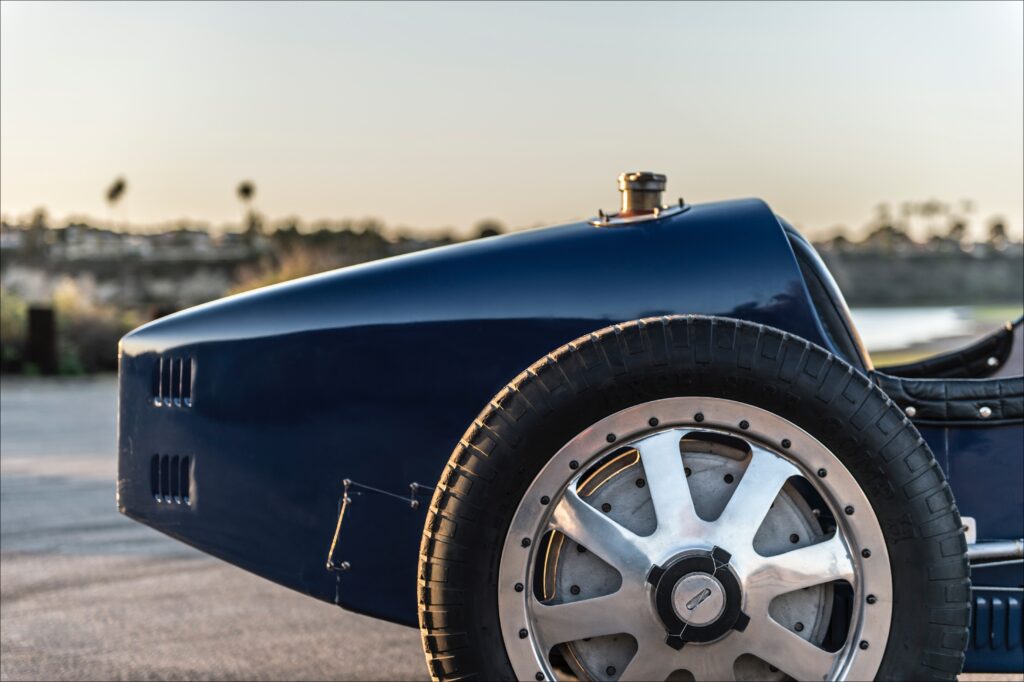
“You drive today’s sports cars, super cars, and 100 miles per hour feels like 50. In our car, it’s the opposite. Inverse correlation—50 miles an hour feels like 100, or more. When you drive a car like ours, you’re part of the machine, connected to it,” says John Bothwell, the Californian who is leading his company Pur Sang into the 21st Century. “It’s like playing the violin compared to exploring tracks on an iPhone.”
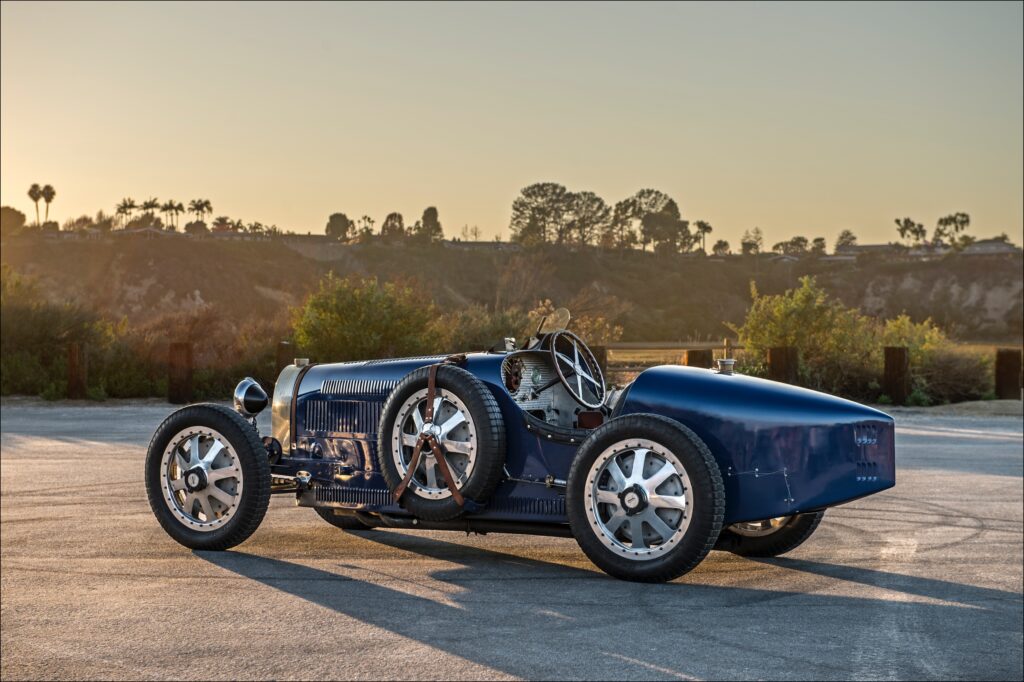
“That’s something a lot of young people who have the means to buy an original Bugatti for several million dollars, or buy a car like this, have never experienced,” says Bothwell. “All they know are contemporary supercars. Unlike most other cars 90 years ago, Bugatti Type 35s were light, agile, and nimble. Bugatti was far ahead of his time.” Pur Sang was Ettore Bugatti’s term, meaning thoroughbred or “pure blood.”

Built in Molsheim, Alsace, Ettore Bugatti’s diminutive masterpiece racked up nearly 2000 victories in the late 1920s, making it arguably the most successful racing car of all time. Type 35s won the Targa Florio road race in Sicily five times in a row, and the Monaco Grand Prix twice. Excepting the success of Bentleys at Le Mans in the same period, Bugattis dominated racing until arrival of the Vittoria Jano-engineered Alfa Romeos.

Like the original, Pur Sang’s meticulously accurate reproduction weighs only 1500 pounds—830 pounds lighter than the current Miata and roughly half the weight of supercars from Ferrari, McLaren, Lamborghini and Porsche. Pur Sang’s Type 35 delivers an exhilarating experience indistinguishable from an original, its 150-horsepower 2.3-liter supercharged straight-eight engine cracking the air with a vicious, distinctive bark.
The only cars that even remotely approximate the experience are a Caterham 7 or a Morgan Trike, but they were originally low-cost cars (the Morgan was licensed as a motorcycle) with prosaic engines, not a finely crafted thoroughbred with a
For mental calculation, a current supercar is roughly twice the weight of a Pur Sang Type 35, though of course they also have four, five and even six times the horsepower, with traction and stability control to put all that power on the ground. The two approaches and resulting experiences could not be more different, like comparing a World War One fighter plane with an F-22 Raptor.

“My youngest client is about 30 years old. Saudi guy. He has every supercar known to man and he bought one of these compulsively, not knowing what he was getting into,” says Bothwell. “He said to me, ‘Where has this shit been all my life?’ It’s that proselytizing, getting people behind the wheel and letting them experience another dimension that has brought success. We have expanded to sales in 20 countries. Our workforce has gone from 30 guys to 100, full-time.”
Pur Sang’s work force is a gift of Argentina’s protectionist economic policies and an apprenticeship culture straight out of 19th Century central Europe. While restoring an original Type 35, Bothwell’s partner Jorge Anadon could not resist measuring all the key components to build an exact reproduction for himself. Anadon later set up Pur Sang in Parana, a town north of Buenos Aires. Pur Sang’s craftsmen can bend, shape, cast, chisel and forge any needed component.

Bothwell has sold about 150 Pur Sang cars, most of them Type 35 reproductions like the one I experienced. He plans to spend the rest of his working life introducing young enthusiasts to this pure blooded, thoroughbred driving experience, this ancient passion. Due to the talented work force, Bothwell now offers reproductions of Jano-era Alfa Romeos and the more civilized and roomier Bugatti Type 55. Using both the craftsmen in Argentina where the company was originally founded plus considerable talent added in recent years here in California, Pur Sang can recreate almost anything, from 1890s motorized buggies to 1950s sports cars. Pur Sang accepts one-off commissions, though the words of a friend and colleague, a semi-retired chief engineer who has created high-performance cars, should be considered: You can make any car once, and it costs at least a million dollars.

“‘Replica’ usually means a crappy car for the guy who cannot afford the original,” says Bothwell. “But with our cars, they are in a league of their own, and our clientele can afford the original or in fact own the original.” One should not confuse a Pur Sang with a VW Beetle-based “Bugatti” replica of the 1970s.

“The original Type 35 works so well that after a test drive people assume we have cheated on the original design, and we have not. Ettore Bugatti got it right in the Twenties. We have only adopted a few updates that are commonly used by most owners of the original cars.” Pur Sang engines are virtually identical to the originals, such that owners of the Molsheim cars often substitute Pur Sang engines when they plan to campaign a real Type 35 hard in vintage racing or rallying.
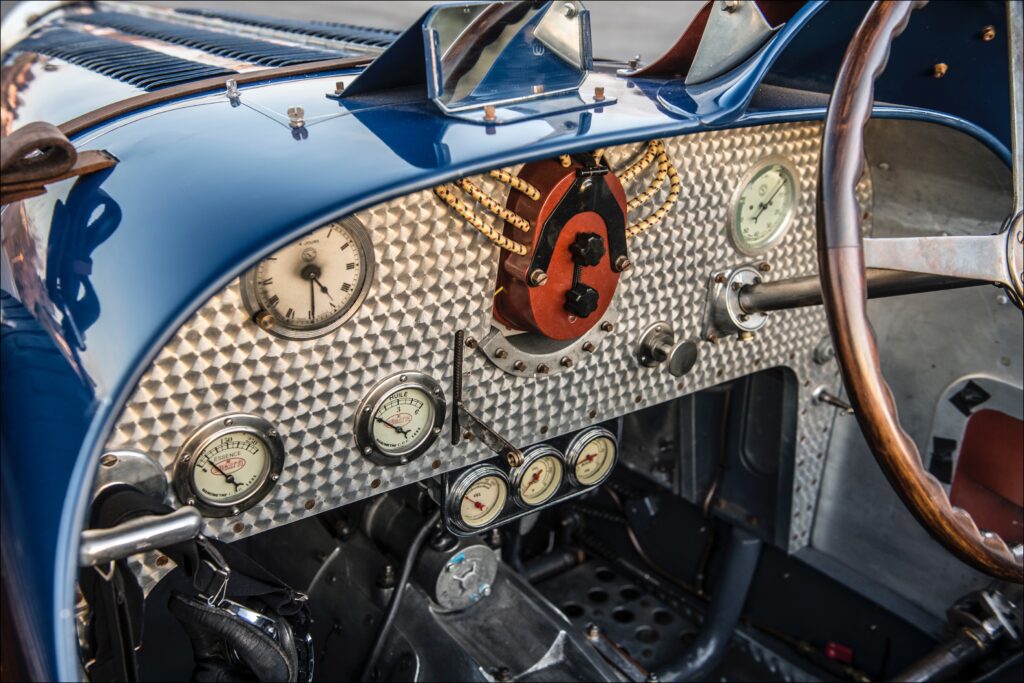
A client can choose to include modern enhancements that improve reliability without compromising the authenticity of the experience. “Our first engines all had roller bearing crankshafts, and it was the clients who said, ‘I don’t want to deal with that pain in the ass anymore.’ The guys who are critical of our plain-bearing engines are usually guys who have never owned one of the originals and they are idealizing. But the guys who are buying don’t want the hassle,” says Bothwell. Due to complexity and inherent fragility, roller bearing crankshafts often require rebuilds in five or six thousand miles, at considerable cost, and the difference in performance or visceral experience is imperceptible, virtually nil. Better to have the car on the road than in a shop torn apart.

Other differences are commonly adopted in most original Bugattis. “These so-called ‘cheats’ when it comes to the original design are miniscule in the overall scope of the car,” says Bothwell. Ignition is a reliable modern system from a V8 pickup truck dressed to resemble a 1920s Bosch magneto. Pur Sang packages a radiator fan to cool the engine in everyday traffic, expanding the car’s utility for pleasure drives. If a client wants an original-style three-lobe supercharger, OK. Or, one can opt for a simpler and more reliable two-lobe supercharger that looks the same.
Beyond using the excellent metals of our age, the only other major option is one even Ettore Bugatti eventually adopted when he finally realized his mathematical error: a proper firing order for a straight-eight engine, which helps long-term durability and reliability without effecting the engine’s symphony. No Bugatti owner will bat an eye at these invisible changes that greatly enhance reliability and lower operating costs.

The result is a car I’d love to find parked in the garden of my happy acre. Remember that heart-in-mouth sensation when as a child you rode a bicycle down a steep hill for the first time, nervous system sparking, as alive as you’ve ever felt? That’s the feeling a Pur Sang Type 35 brings hustling through a corner, straight eight ripping the air, and an incomparable view down the delicate little hood to two tall, skinny wheels.

Subjective proof of Pur Sang authenticity? Two direct descendants of Ettore Bugatti own Pur Sang Type 35s. Michel Bugatti is Ettore Bugatti’s son, his only living offspring. He and his daughter, Caroline Bugatti, each own a Pur Sang. No greater endorsement exists for the authenticity of the engineering, build quality and driving experience of a Pur Sang Type 35.