
Reasons to include a Miata MX-5 Club in a well curated collection of performance cars are obvious to any knowledgeable enthusiast: light weight, virtually perfect balance, three pedals, a manual shift lever that works directly on the gearbox resting inches away from your shin and, most importantly, everyday access to the Dark Art of heel-and-toe braking even on a five-minute sunset drive to the local market to pick out a tidy bottle of Pinot Noir.

For that well-curated collection, the only Miata model to buy is the Club with manual gearbox, equipped with the Brembo/BBS/Recaro option package. It’s an odd, awkward trim level designation—Club—probably implying amateur-level racing in a club. But tick the right option boxes and your Miata will not be like your grandmama’s Miata that reminds her of those carefree days in the ‘70s when she was a swingin’ babe.

The Miata Club with Brembos et. al. is a purist small-displacement sports car that can keep its owner’s knowledge of the Dark Arts sharp. There’s a reason Miatas are often found in the outbuildings of guys who own vintage European sports cars: muscle memory related to working the clutch pedal and that snick-snick shift lever is toned and reinforced

Miata Club can amuse and educate at relatively low speeds. Miata is a momentum car, with just barely enough power to bring the chassis to life. Its optimal operational window is 20 to perhaps 80 miles per hour. It’s slow off the line, and buzzy much above 80 or perhaps 90. The limited power forces the driver to be efficient and precise, to maintain momentum rather than bleeding it off through needless braking, with no room for the sloppy moves a supercar can cover up with massive amounts of power.

Boys weaned on motocross dirt bikes excepted, few people under the age of 30 or even 40 or 50 will understand the shifter and clutch pedal. Perhaps thanks to old movies, the children in my own life intuitively understood the sounds of shifting up and down, but were puzzled initially watching left leg and the curling wrist of the right hand performing automotive jiu-jitsu I learned as a 16-year-old driving a beat-up Alfa Romeo Giulietta, and a steel-dash MGB as an undergrad. Most satisfying of all was the tykes’ quick uptake of process, recognizing a perfectly executed heel-and-toe downshift, engine sounds rising and falling but the car’s composure smooth and unflustered—a perfectly nailed downshift under braking.

Most people old enough to immediately comprehend the meaning of that stubby shift lever consider manual gearboxes a nuisance, long since banished to society’s periphery, banished to work trucks with low, low Granny gears for pulling horse trailers out of a muddy paddock. To older folks, that stumpy shifter is something from the past, painful to operate in heavy urban traffic, a mechanical device admired only by maladjusted males of a certain age, people who still think driving is a pleasure.

British and Italian sports cars engineered in the 1950s that were sold by doddering little companies as late as the 1970s and early ‘80s served as template for Miata, though none of those vintage cars were so impeccably built, so neatly assembled, so utterly reliable and easy to maintain. Miata interprets those sports cars of the Golden Age that almost everyone remembers without ever actually having owned or driven one—must be images from old movies again. Lotus Elan, Alfa Romeo Giulietta and Duetto, MGB, MG Midget, Triumph Spitfire, and of course Pininfarina’s masterwork prized by all big-league car designers working today, the original late ‘60s Fiat 124. Miata provides the same pleasures combined with safety engineering and Seiko build quality, and all with a curb weight only a few hundred pounds more than many of the vintage sports cars just mentioned, and a far better power-to-weight ratio.

Miata was a social and cultural sensation when it arrived in 1989. For Boomers and Gen X’ers, a tidy little sports car has an irresistible gravitational pull that is far beyond the actual mass of the vehicle. In this way, Miata was to the years 1989 and ’90 what Frank Stevenson’s brilliant and jewel-like reinvention of the Mini Cooper S was to the years 2002 and ‘03: a magnet that led to happy conversations with strangers. Miata has been around four generations, though Gen-2 was more of a reskin, a refinement, with soft-touch interior materials that were surprisingly high-end. The Gen-3 car grew a little porky, a bit odd looking, not quite so perfect. But the current generation that arrived about a decade (!) ago was engineered using super-high strength steel (high mega-Pascal) that allowed Mazda to trim weight. Simple enough: if the steel is stronger, you need less of it, the car is lighter.


The Gen-4 car in soft-top roadster form weighs just over 2300 lbs., the “retractable fastback” version I drove slightly heavier. Bear in mind that Porsche 718s (Boxsters) are about 700 to 800 pounds heavier, and most exotic supercars are between 700 and 1600 lbs. heavier. Much as aged Boomers might hop up and down and argue for Gen-1 with its pop-up headlight flaps and slightly lighter curb weight, well, the current generation is Darwin’s favorite, the highest evolution of the species. It’s damn near perfect, capturing what Jung labeled the collective unconscious, the cultural memory of a jolly little sports car.
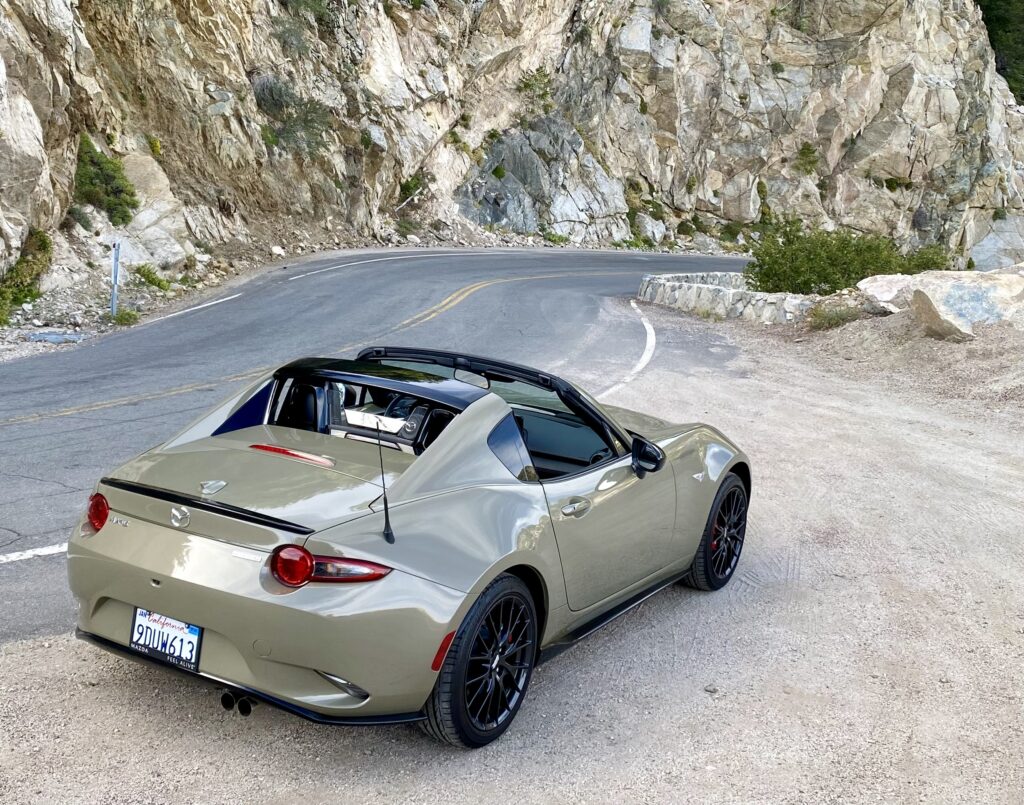
To find a manual transmission that does not use the cables and springs found in front-drive, all-wheel drive and mid-engine cars, to find one that works through a sequence of tightly machined metal bits that operate with the smooth precision of a fine deer rifle’s Peter Mauser bolt action, the population grows very small. Beyond Miata, BMW offers the M2—get one while you can. The Detroiters offer proper manual gearboxes in Mustang, but it’s a hulking, enormous car—some call it a modern muscle car—not a tidy sporting vehicle. Toyota and its vassal Subaru offer a manual gearbox in the GR86 and BRZ Twins, which are about 500 pounds heftier than Miata. Porsche offers manuals, but they use cables, as do Subaru WRX and others. Not the same, really.
Beyond those easily purchased and maintained cars listed above, you’re looking at esoterica, like Caterham 7s and Morgans and the $250,000 Pur Sang Bugatti Type 35 replica, all of which feel vulnerable on the freeways of my native Los Angeles.

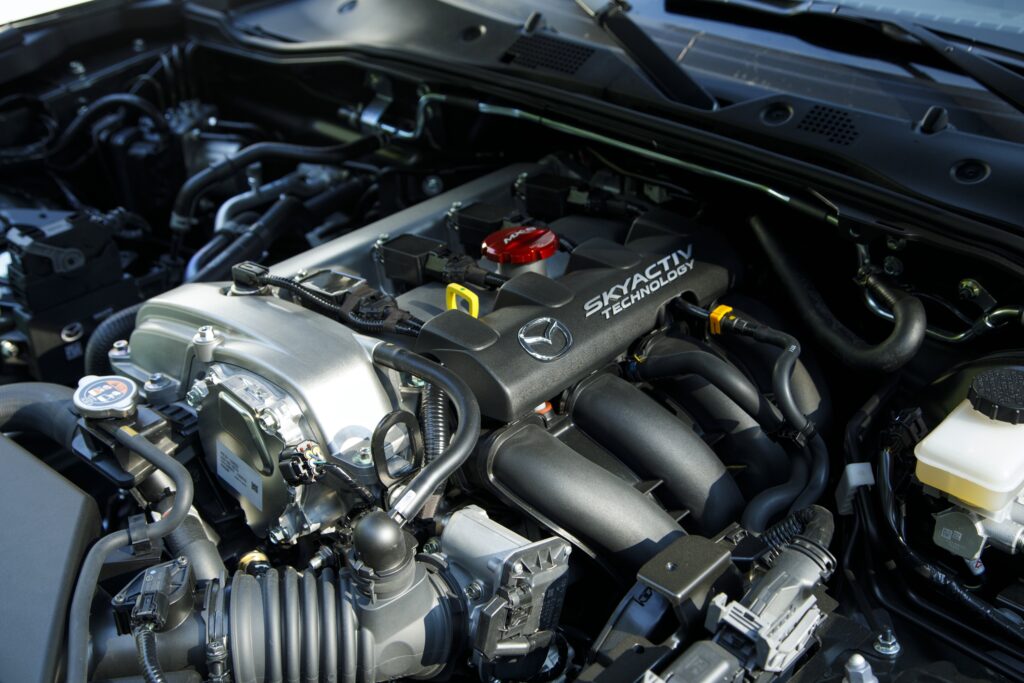
Could Miata be better? Sure. Are my horsepower junkie pals who mock my Miata fixation justified in laughing at the car’s limited power? Absolutely. The power peak at 7000 rpm is more for advertising than real exploitation. The engine is happiest operating just above and below its torque peak at 4000 rpm—which of course gives excuse to shift gears up and down frequently. Flogging the engine to redline will not bring that sweet Junior Ferrari sound of a 65-year-old Alfa Romeo Giulietta. The engine is just a means of setting the chassis in motion and experiencing its effortless dance with physics, in stunning contrast to supercars that batter down and conquer physics with electronics, nuclear horsepower and a broad tire patch. In this, Miata is very similar to the now-vintage Lotus Elise of 20 years ago. Miata glides.

But the lads in Hiroshima resist change, convinced that Miata must be the final exceptional evolution of the Populist European Sports Car. With a little investment, using 21st Century technologies, Mazda could bolster Miata’s image amongst a broad swath of American males. Add a 48-volt system to power a tiny electric turbocharger and double the amount of torque. This would require a unique gearset constructed of extremely high-strength steel, perhaps shot-peened or phosphate-coated to increase torque capacity while still fitting in the slender case. Yup, the limitation is the little gearbox, which cannot handle much more than the car’s current 151 lb. ft. Miata’s unique “trellis,” a sort of space frame or girder hidden from view that ties together the entire powertrain, would need to be modified to maintain good crash integrity. And yes, a Super Miata might gain weight, but the increase in power would transform the car into a baby Ferrari 812. Also, it might grow twitchy combing loads of power with such a short wheelbase.

Will the Japanese pursue such a program? I doubt it, having argued the point with them unsuccessfully more than 20 years ago, when a Ford-owned Mazda built the Mazdaspeed Miata against the will of the Japanese engineers. Build such a car, call it a Mazdaspeed Miata, Super Miata, or Miata Mofo Edition and the current car could remain in production for another decade, basking in that glow of serious performance. Yes, the fundamentals of the car are utterly timeless—Miata can hang around for many years.
But honestly, even if Miata only had a 2-cylinder engine and 100 horsepower, it would still rate a parking space in the best Garagemajals, in the best Man Caves. There is no other car just like it in the U.S. market, it can teach a new generation of young car enthusiasts the Dark Arts of Clutch and Gearbox, and keep alive a type of joyously spirited driving that is so hard to find in our age of electronic emasculation, a style of driving that might soon disappear from the earth. For those reasons, my love for Miata remains undying, a treasured part of my most fabulous sports car life.
